

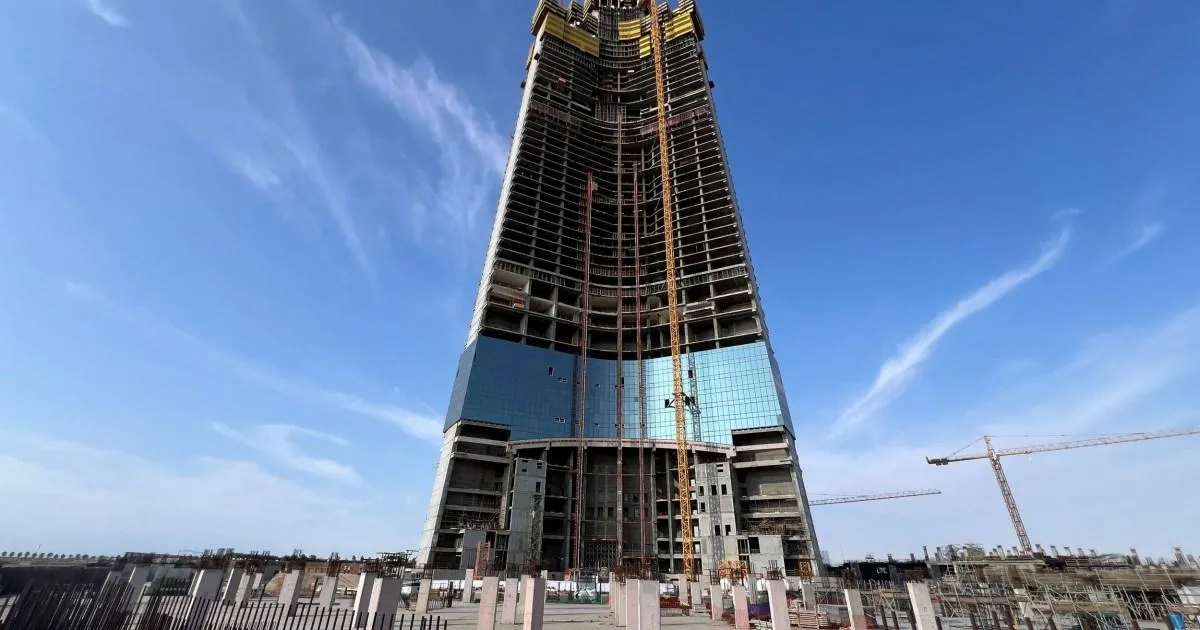
For over a decade, Dubai’s Burj Khalifa has stood as an unchallenged titan of architecture, piercing the clouds and serving as the global benchmark for human ingenuity. Since 2009, this half-mile-tall skyscraper has defined the skyline, but the crown is now destined for a new home in neighboring Saudi Arabia. The Jeddah Tower, currently rising from the desert landscape in Saudi Arabia’s second-largest city, is well on its way to shattering the record. Already standing at 430 meters with 107 floors completed, the tower is more than halfway to its final objective. When finished, it will cross the elusive 1,000-meter barrier, a historic achievement that will solidify its status as the world’s first man-made structure to reach such a staggering height.
The vision behind this monumental project belongs to American architect Adrian Smith, who—quite remarkably—was also the creative force behind the Burj Khalifa itself. The project is being championed by Prince Al Waleed bin Talal Al Saud, whose Kingdom Holding Company is driving the development. Following a recent site visit, the Prince expressed his immense pride in the progress, acknowledging the grit of the teams on the ground. For him, the numbers are more than just statistics; they represent a bold step into the future of Saudi infrastructure. After years of anticipation and careful planning, the project is moving with renewed momentum, backed by a workforce of over 5,000 people who are turning what was once a blueprint into a reality.
Reaching a height of 1,000 meters—or 3,281 feet—is an exercise in pure engineering audacity. To put that scale into perspective, the Jeddah Tower will stand taller than Scafell Pike, England’s highest natural mountain peak. This makes the tower not just a building, but a vertical landscape. Interestingly, despite being nearly 200 meters taller than the Burj Khalifa, the Jeddah Tower will only house four additional occupied floors. This structural design choice highlights the immense technical hurdles involved. Contractors are faced with the unprecedented task of pumping concrete vertically for a full kilometer, a feat that has never been attempted before. It is a testament to how far construction technology has come since the Burj was conceived.
The journey to this point has been anything but smooth. The project has been a long-term endeavor, with initial construction starting back in 2013. However, the path to the sky was interrupted in 2017 due to internal political and economic shifts within the country, leading to an indefinite pause. For years, the steel skeleton remained a dormant reminder of the project’s ambition. It wasn’t until 2023 that the gears finally began to turn again, and by early 2025, the site was buzzing with activity. Despite previous setbacks that also saw other major Saudi mega-projects—like the sprawling ‘Line’ city—face significant scrutiny or reassessment, the Jeddah Tower has successfully emerged from the shadows to regain its momentum toward a projected 2028 completion.
Beyond the sheer vanity of height, the Jeddah Tower is designed as a functional, luxury ecosystem. It is intended to serve as the crown jewel of the Jeddah Economic City, a massive, 57-million-square-foot development located just outside the city center. The building will be a masterclass in mixed-use utility, featuring premium office spaces, high-end residential apartments, and a flagship Four Seasons hotel. The centerpiece for visitors will undoubtedly be the sky terrace on the 157th floor. From this observation deck, guests will be able to look out over the Red Sea from a vantage point higher than any other balcony on Earth. It is designed to be a place where the hustle of the city feels like a distant memory, replaced by the serene perspective of the horizon.
Ultimately, the Jeddah Tower represents more than just a battle for architectural dominance; it is a profound testament to the human desire to push boundaries. From the deep foundations that burrow 105 meters into the earth to the spire that tickles the atmosphere, the building is a bridge between the ground and the stars. While the project has certainly faced its share of adversity, the sight of the tower growing day by day serves as a powerful symbol of revival and progress. As we look toward 2028, the world waits to see this colossal achievement completed, proving once again that when vision meets perseverance, the limits of what we can build are redefined by the very things we once thought impossible.