

Paragraph 1
Joanne Young walked into Winchester Crown Court not as a name in a headline, but as a woman whose life had been shattered by the person she trusted most. A mother of three, 49 years old, she had spent 22 years beside Philip Young, her husband and the father of her children, believing she knew the shape of her own life. Their marriage, she later told police, had a “normal” and “monogamous” sex life. There were no warning signs, no whispered fantasies, no secret conversations about opening their marriage or inviting others into their bed. The man she married was a former Conservative councillor, someone who appeared respectable, settled, and dependable. But in February 2023, that illusion collapsed in the most brutal and humiliating way imaginable. Joanne had been out drinking with friends that evening, and when she came home, she found herself in a darkened bedroom, blindfolded and restrained, believing she was making love to her husband. Then she felt another hand on her wrist. It was not Philip’s hand. In that moment, her entire reality turned inside out. She ran to the bathroom, locked the door, and hid there, naked and terrified, not knowing if a stranger was still in her house, not knowing what to do, and not knowing that the nightmare had only just begun. Her husband, she would later learn, had not only brought a stranger into their home to watch them have sex, but had advertised her to other men online, drugging her, blindfolding her, and handcuffing her so that others could abuse her without her knowledge or consent. Joanne has bravely waived her right to anonymity, allowing her name and face to be shared publicly, so that the world can understand the full horror of what was done to her. Her testimony at Winchester Crown Court is not just a legal statement; it is a raw, painful account of betrayal, manipulation, and the slow, agonizing process of facing the truth.
Paragraph 2
The night that changed everything began innocuously enough. Joanne and Philip had been out drinking with friends, and later, upstairs in their own home, Joanne assumed she was with her husband. She had a blindfold on and restraints around her wrists, something she later said she did not fully understand but had accepted as part of their private moments together. In her police interview, played to the jury, she described the disorienting confusion of that evening. “I had been having sex and I felt someone else’s hand on my wrist – and it wasn’t his hand because he was at the end of the bed on me – and the hand was over there,” she said. The hand was not her husband’s. It was a stranger’s hand, and when she tried to pull at her blindfold or wristband, she heard Philip say to the person, “Get down,” and the figure ducked at the end of the bed. Joanne’s mind scrambled to make sense of what was happening. She thought she was with the man she had loved for more than two decades, the father of her children, the person who was supposed to protect her. Instead, there was another person in her bedroom, a man she did not know, a man who had been watching, and possibly participating, while she was vulnerable and unaware. She ran to the bathroom, locked the door, and stayed there, naked and shaking, uncertain whether the intruder had left or whether she was safe to come out. When she finally emerged, the bedroom was silent. She went downstairs, looked out the window, and saw a car she did not recognize parked nearby. Philip never came back upstairs that night. Joanne eventually went to sleep, alone, still processing the shock. The next morning, she saw something she had rarely seen before: her husband upset, almost tearful. He apologized and said he had invited someone around to watch them have sex. He mentioned forums he had been looking at online. Joanne was devastated, humiliated, and deeply shaken. She asked him if it had happened before, and he swore it was a one-off. She chose to believe him, because the alternative was too terrible to accept.
Paragraph 3
In the weeks and months that followed, Joanne did what many people in abusive relationships do: she buried her head in the sand. She did not leave Philip, did not call the police, did not tell anyone about what had happened. She told the court that she and Philip barely spoke about the incident again, and when he said he would understand if she wanted to end their marriage, she simply could not respond. “I just didn’t bring it up. I just couldn’t really, what do you say? It’s done. It’s horrible. I was just so shocked,” she recalled. “I just stuck my head in the sand and carried on and didn’t do anything about it and just took it at his word that it was a one-off.” It is a response that might seem difficult to understand from the outside, but for Joanne, it was survival. She had spent more than half her life with this man. They had built a home, raised children, shared holidays, birthdays, ordinary routines. To admit that Philip was capable of such betrayal would mean dismantling everything she thought she knew about her marriage, her past, and even her own body. She chose to believe the lie because the truth was unbearable. But the truth was not finished with her. On the day Philip was arrested, he came to her and confessed that he had shared intimate images of her online without her consent. That confession, delivered out of the blue, reopened the wound. Joanne immediately thought back to February and asked him again: was that really the only time it had happened? Philip stood there, looked at her, and said no. When she asked if it was the same person, he said no, it was two people. In that moment, Joanne realized that her husband had not made a single terrible mistake. He had been systematically deceiving her, using her body without her knowledge, and inviting other men into their marital bed while she was unconscious or restrained. Her testimony about their sex life made it clear that she had never consented to anything like this. There was no fantasy about sleeping sex, no agreement about blindfolds and handcuffs as part of a consensual game. She described waking up on occasion to find the blindfold and wrist restraints already on her, with Philip having sex with her, and feeling confused about how it had happened. She assumed she had fallen asleep after drinking. Now she knows the truth was far darker.
Paragraph 4
The criminal investigation that would eventually bring Philip Young and the other men to justice began in the summer of 2023, when police were notified that he had uploaded extreme images to a messaging app called Kik. Those images, along with other digital evidence, revealed a horrifying pattern of behavior. Philip had been using the internet to advertise his own wife to other men, offering her up for sexual abuse while she was drugged, blindfolded, and handcuffed. The men who responded to these advertisements were allegedly willing participants in a scheme that treated Joanne not as a person, but as an object to be used and discarded. When police began to investigate, they uncovered a network of abuse that stretched beyond the February 2023 incident. Philip Young eventually pleaded guilty to a total of 56 charges relating to the abuse of his wife, a staggering number that reflects years of betrayal and violation. But he is not the only one facing justice. Four men are now standing trial at Winchester Crown Court, accused of taking part in the abuse. The court heard that three of the incidents were captured on video, and the judge, Mr Justice Saini, ordered the courtroom cleared for the footage to be shown to the jury, out of concern for Joanne’s privacy. Only the jury, barristers, judge, defendants, and two observing journalists were allowed to remain. It is a measure of how deeply personal and invasive the evidence is, and a reminder that behind every piece of footage, every charge, every legal argument, there is a real woman whose life was turned upside down by the people who should have protected her.
Paragraph 5
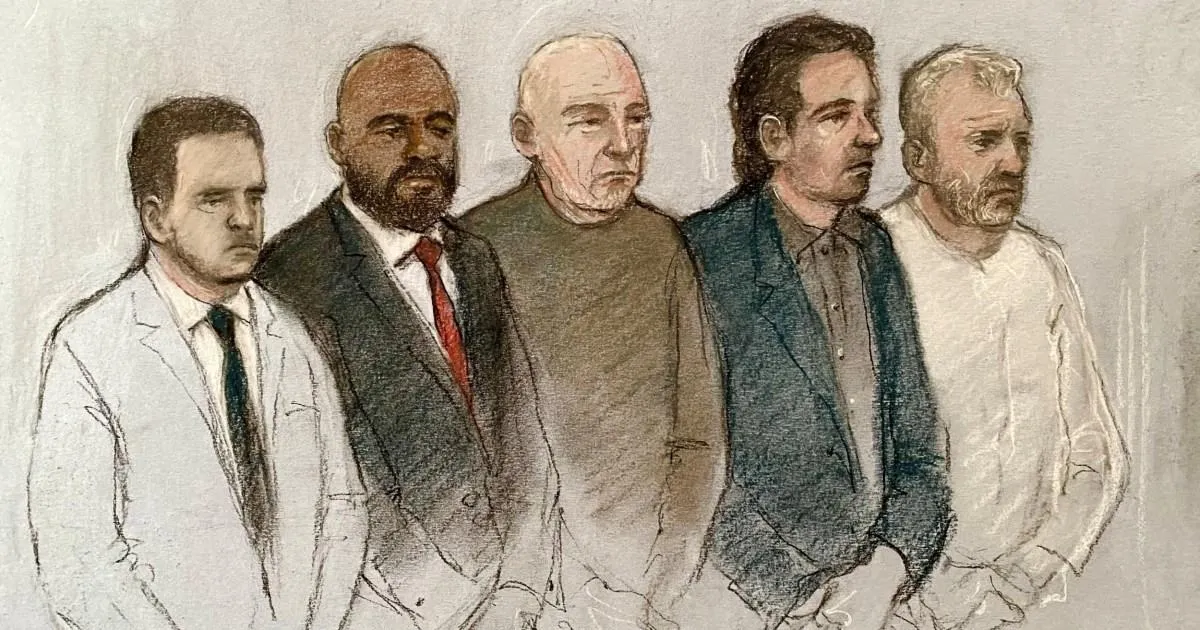
The four men on trial each face serious allegations. Norman Macksoni, 48, from Bedfordshire, has denied one count of rape. Richard Wilkins, 62, from Swindon, Wiltshire, has pleaded not guilty to one count of rape and one of assault by penetration. Connor Sanderson-Doyle, 32, also from Swindon, has denied sexual assault by penetration and sexual touching. Mohammed Hassan, 38, from Swindon, has pleaded not guilty to one count of sexual touching. A sixth defendant, Dean Hamilton, 47, from Somerset, has already admitted one charge of assault by penetration, two of sexual assault, and one of rape. Hamilton, along with Philip Young, will be sentenced at the conclusion of the trial. The charges against these men are grave, and the court will have to determine their guilt or innocence based on the evidence presented. But for Joanne, the trial is not just about legal outcomes. It is about being believed. It is about standing in a courtroom and telling the world that what happened to her was not her fault, that she did not consent, that she was not a willing participant in her husband’s twisted fantasies. The fact that she has chosen to waive her anonymity is an act of extraordinary courage. She could have hidden behind the legal protections that are available to victims of sexual abuse. Instead, she has allowed her name to be published, her face to be shown in court sketches, and her words to be repeated in the press. She has done this so that people understand the reality of what she endured, and perhaps so that other women in similar situations might find the strength to speak out. Her testimony is a powerful reminder that sexual abuse can happen anywhere, to anyone, even inside a seemingly ordinary marriage.
Paragraph 6
The trial continues, and the full scope of Philip Young’s crimes may not be known until the proceedings conclude. But regardless of the verdicts, the damage has already been done. Joanne Young has lost more than her trust in her husband; she has lost the sense of safety and autonomy that most of us take for granted. The man she loved for 22 years used her body in the most degrading way possible, and invited other men to do the same, all while she was unable to see, unable to move, and unable to consent. It is a betrayal so profound that it is almost impossible to comprehend. And yet, Joanne has shown remarkable strength in the face of it. She has sat in court, relived the trauma, answered difficult questions, and watched as the details of her private life were laid bare for strangers to examine. She has done all of this in the hope of justice, not just for herself, but for the truth. Her story is a reminder that consent is not something that can be assumed, borrowed, or transferred. It is a reminder that marriage does not give a person ownership over another’s body. And it is a reminder that the people we love most are sometimes the ones who hurt us the deepest. As the trial moves forward, Joanne’s voice will continue to be heard. She has refused to be silenced, refused to be shamed, and refused to let her husband’s actions define her. In the end, that may be the most powerful testimony of all: that even after everything she has been through, she is still standing, still speaking, and still demanding that the world look at what happened and call it what it is.