

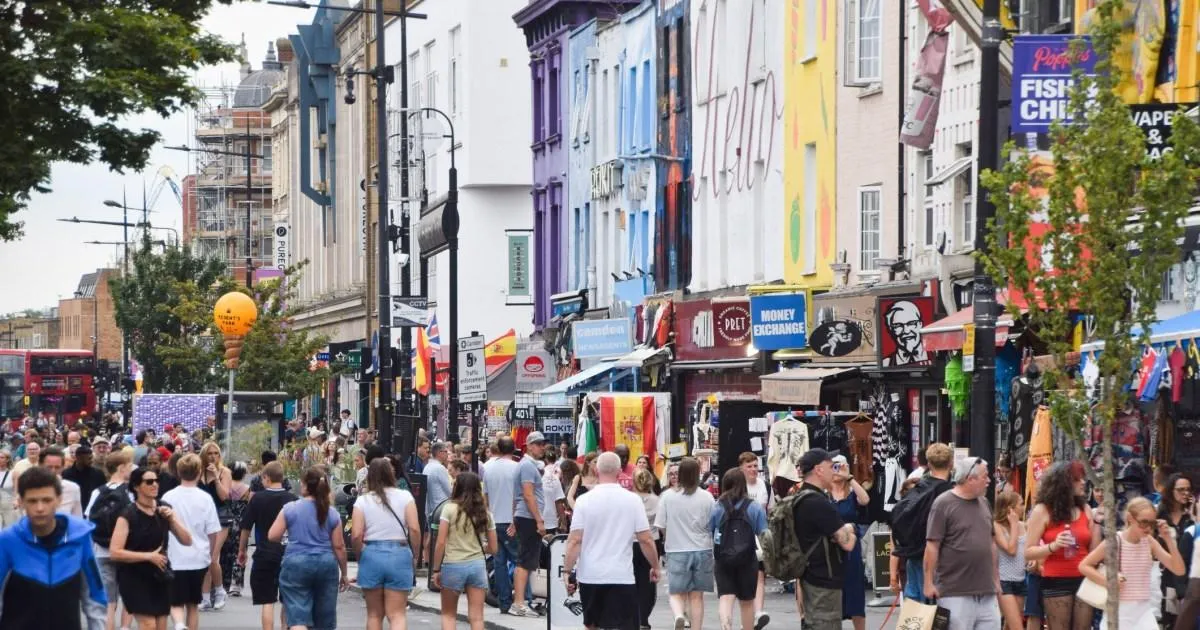
Camden High Street is not just a shopping street; it is a living piece of London folklore. For decades it has been the backdrop for punk rock rebellion, alternative fashion, and the kind of independent businesses that make a city feel real. It is where tourists come to get piercings and vintage leather jackets, where locals come for street food and live music, where teenagers from every corner of London come to feel a little less ordinary. But anyone who has tried to walk its narrow pavements on a Saturday knows the romance often came with a soundtrack of traffic jams, delivery lorries, and buses grinding past inches from your face. That experience is now being deliberately retired. After an 18-month experiment, the council has made the street permanently traffic-free, joining a growing movement of London streets where pedestrians get priority. The change feels momentous because it touches one of the capital’s most recognisable destinations, a place that draws millions of people not just from the UK but from all over the world. It is also a clear statement: the car, the bus, the taxi and the bicycle are no longer the default rulers of this particular stretch of asphalt. The decision follows a public consultation that showed 57% support, but the atmosphere around the news suggests something beyond statistics. There is a sense that a long-awaited rebalancing is happening, one street at a time. With Oxford Street having just launched its own pedestrian era, the city is suddenly having a conversation about what public space is for. Camden’s answer, at least for this stretch, is that it’s for people. The road between Britannia Junction and the corners of Jamestown Road and Hawley Crescent will now stay open only to feet, not engines. And while the final permanent barriers won’t appear until 2027, the decision has already changed how the neighbourhood feels. It feels easier to breathe, easier to wander, easier to belong.
Back in May 2025, Camden Council took a leap of faith. They closed the high street to vehicles, not with a grand ceremony, but with barriers, cones, and a considerable amount of nervousness. Would local businesses lose trade? Would tourists stop coming? Would the traffic simply relocate and worsen life on nearby roads? The trial was designed to answer those questions with evidence, not guesswork, and last summer the council listened to what people actually thought. The result was not unanimous, 57% supported making the change permanent, which in a neighbourhood as independent and argumentative as Camden amounts to a clear vote of confidence. Councillor James Slater, the borough’s cabinet member for planning, put the decision in context. Camden Town, he said, is an important shopping and transport hub for residents as well as an internationally recognised destination drawing people from across London, the rest of the UK, and the world. But that success had become a burden. The dominance of motor vehicles on the stretch had created a negative experience, he explained, with pedestrians overspilling from the pavement and suffering poor air quality. Anyone who had ever tried to push a pram through a crowd while a bus idled beside them, or tried to talk to a friend outside the market while moped engines drowned out the conversation, knew exactly what he meant. The traffic-free stretch is not the whole high street, but it is the most vital part: from Britannia Junction down to the junction with Jamestown Road and Hawley Crescent, the area around the famous markets and the tube station. That is where the pavements had become most dangerously crowded, and where the change was most needed. The trial-then-consult-then-commit process may have felt frustratingly slow to pedestrians who just wanted to breathe, but it gave everyone a chance to experience the street before voting on it. And experience is a powerful persuader. Walking down the middle of a road that used to be bumper-to-bumper, hearing the clatter of café tables instead of the roar of engines, changed minds. The temporary barriers that made that possible will eventually be replaced with permanent infrastructure in early 2027, signalling that this is not a whimsical experiment but a lasting piece of city making.
The results, so far, are encouraging on almost every front. The council has reported that spending at local businesses has remained in line with the levels recorded before the changes, which is the answer to the fear that pedestrianisation would kill trade. In cities across the world, the opposite often proves true: people who arrive on foot or by public transport stay longer, wander further, and spend more than people who simply drive past. Camden appears to be experiencing that same dynamic. The environmental data is equally striking. Harmful nitrogen dioxide levels across monitoring sites fell by 14.4%, a significant improvement in a neighbourhood where air pollution has long been a quiet public health scandal. Children walking to school, market traders spending eight hours a day in the street, tourists pushing pushchairs, everyone breathes a little more easily now. And then there is the safety record, which is almost too neat to believe: no collisions were reported on Camden High Street in the nine months after the trial began. Not one. That is not a minor statistic; it is the difference between a street designed for throughput and a street designed for human beings. In the old layout, pedestrians and vehicles were forced into constant negotiation, with the pavement acting as a thin refuge from moving metal. Now the negotiation is over. The road belongs to walkers, and the number of injuries, near misses, and moments of acute stress has collapsed to zero. These are the kinds of outcomes that don’t always make headlines, but they change daily life in profound ways. The street is no longer a place where you brace yourself before stepping out. It is a place where you can look up at the Victorian architecture, stop to listen to a busker, or let a toddler wander a few steps without grabbing their jacket. The permanent closure is not just about convenience; it is about dignity, health, and the simple pleasure of being in a city without constantly being treated as an obstacle.
The timing of Camden’s announcement was impossible to ignore. Just days earlier, Oxford Street, the most famous shopping street in Britain, finally began its own long-awaited pedestrianisation. Around half of the 1.2-mile stretch is now closed to vehicles, with buses, taxis and bicycles diverted onto surrounding roads. The ban covers the crowded section between Selfridges and Ikea, taking in John Lewis and dozens of other major shops, and it operates every day from 7am until midnight. For years, the idea was dismissed as impractical. Critics warned of chaos, gridlock, and the end of the West End as we know it. But, as in Camden, the reality on the ground has been more nuanced and more hopeful. The two pedestrianisations are connected by more than timing. They represent a shift in how London thinks about its streets. For half a century, transport planning in the capital tended to prioritise the smooth movement of vehicles, often at the expense of the people who actually live, work, and shop in the places those vehicles passed through. The new approach, sometimes awkwardly labelled ‘placemaking’, asks a different question: what does this street need to be a good place, not just a good route? Oxford Street and Camden High Street are very different animals. One is a global retail cathedral of chain stores and flagship branches; the other is a chaotic, independent bazaar of vintage clothes, street food, and music venues. But both had reached a breaking point, pavements overflowing, buses crawling, air thick with fumes, and visitors having a worse experience than they deserved. Pedestrianisation is not a silver bullet, and there are genuine concerns about displacement, deliveries, and disabled access that must be handled carefully. But the fact that two of London’s most recognisable streets have now chosen the same path is a powerful signal. Walking might not be the fastest way through London, but it is increasingly being treated as the most human way. And once you give people the space to walk, they tend to ask why they can’t have it everywhere.
Of course, taking traffic off one street does not make it vanish. Buses still need to carry people through Camden, and deliveries still need to reach the shops, and residents still need to get about. A pedestrianised high street only works if the surrounding network absorbs the pressure, and this is where the trial’s success becomes more complicated. On nearby Kentish Town Road, the council has introduced a trial bus lane specifically designed to speed up northbound journeys and reduce disruption to bus services. The idea is to keep buses moving so that people are not punished for choosing public transport over driving. It is a reminder that a people-friendly street cannot exist in isolation; it needs reliable alternatives. There are also broader changes happening around London that will shape the future of the whole area. The Bakerloo line, which serves the capital’s oldest and most congested tubes, is finally getting an extension, a project that could dramatically improve access to the wider region. Elsewhere, new transport upgrades are constantly being planned, from walking routes to cycling infrastructure to better interchange between the Tube, London Overground, and National Rail. None of this is glamorous, but it matters. Pedestrianisation is often presented as a simple battle between cars and people, but the reality is more subtle. It is a reordering of priorities, a way of saying that a street should be a destination, not just a passageway. The bus lane on Kentish Town Road may not make headlines, but it is the kind of unglamorous adjustment that makes the grand vision workable. For every person who now walks comfortably along Camden High Street, there is a bus passenger successfully navigating a diverted route, a shopkeeper getting a delivery at 6am, a local resident finding a way home. The challenge is to make the whole system work together, so that the pedestrian zone does not become a walled garden surrounded by chaos. So far, the evidence is mixed but mostly encouraging, and the pilot bus lane is a sensible step towards a more connected, less stressful neighbourhood.
What will Camden High Street feel like in five years’ time? If the early signs are anything to go by, it will feel alive in a new way. The permanent barriers due in 2027 will not just mark a boundary; they will mark a changed relationship between the city and its inhabitants. There will still be challenges. New street life brings new problems; on newly pedestrianised Oxford Street, authorities are already dealing with a dangerous teen craze that has spilled into the crowds. Camden will need to manage its own quirks, from market deliveries to festival crowds to the late-night energy that has always defined the area. But the direction of travel is clear. London is learning to give its streets back to people. For decades, the city was reshaped around the car, and pedestrians were treated as trespassers in their own neighbourhoods, forced into narrow margins, breathing fumes, dodging traffic. The pedestrianisation of Camden High Street is a small but significant reversal of that logic. It acknowledges that the people walking through a high street are not just consumers or commuters; they are citizens. They are the reason the street exists in the first place. By making the change permanent, Camden has made a quiet but powerful statement: that convenience can be redefined, that growth does not have to mean congestion, and that the best city streets are the ones where you never feel the urge to hurry. Visitors will still come from all over the world to explore the markets and clubs and music venues. But now, when they step out of Camden Town tube station, they will not have to dive into a torrent of traffic. They can simply look up, breathe in, and join the movement of human beings filling the street. That is not just a traffic policy. It is a promise about the kind of city we want to live in. And on a grey autumn day, as the market lights begin to glow and the sounds of conversation replace the roar of engines, Camden High Street feels less like a road and more like a room, open to the sky.