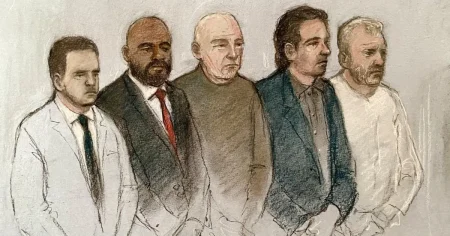




On a busy London-bound LNER train, ordinary passengers were thrust into a waking nightmare when a knifeman moved through the carriages with chilling determination, asking one terrified traveller, “Do you want to die?” before lunging at him. The man at the centre of that horror is Anthony Williams, 33, who is now standing trial at Cambridge Crown Court, charged with the attempted murder of fourteen people over the Halloween weekend last year. Ten of those attacks took place on the train itself, in a frenzied five-minute assault that left passengers with nowhere to go. The violence, however, began before the train journey, with three alleged attacks in Peterborough and one at a Docklands Light Railway station in London. As the prosecution opened its case, Christopher Paxton KC described a scene of “terror and fear on an unimaginable scale,” telling jurors that Williams moved up and down a busy train, stabbing several people, while passengers realised with dread that there was no escape. It is a case that lays bare not only the physical wounds inflicted but also the profound fear that rippled through a group of strangers who suddenly found themselves fighting for survival in a confined, moving metal box.
The prosecution’s account of the train attack is graphic and deeply unsettling. Paxton described a “ripple effect” as passengers watched the attack “erupt and spread down the train,” with some people running for their lives and others choosing, with remarkable courage, to stand in harm’s way to protect people they had never met. The court heard how the carriage became a place of panic and desperation. Some travellers hid in locked toilets, squeezed into storage cabinets, or crouched under seats, praying they would not be found. Others, in “sheer terror,” kept running until they literally reached the end of the train and could go no further, trapped on a moving service with nowhere left to flee. Yet amid the chaos, there were flashes of astonishing bravery. Some passengers grabbed whatever they could find, including frying pans and toasters, to defend themselves against the attacker. Others tried to reason with him, hoping to calm him or distract him from his rampage. The prosecutor told jurors that in the face of Williams’s “sheer brutality,” some stood tall, trying to de-escalate the violence while putting their own lives at risk to protect strangers. The image that emerges is not solely one of victimhood, but also of human resilience and selflessness in a moment of extreme danger, where ordinary people were forced to make split-second choices between flight and fight.
What makes the trial particularly significant is Williams’s legal position. He denies fourteen counts of attempted murder, including ten relating to the LNER train, three in Peterborough, and one at Pontoon Dock DLR station. However, the prosecution made clear that Williams does not dispute attacking the named individuals. Through his pleas, he admits the assaults and accepts that he intended to cause really serious harm to his victims, but he denies that he intended to kill them. It is a distinction that goes to the very heart of the trial, because attempted murder requires proof of an intention to end a life, rather than merely to inflict serious injury. The prosecutor, however, painted a far more sinister picture, describing Williams as a “dangerous threat” who “marauded” through towns and cities, on streets and trains alike, armed with a knife. Paxton said Williams stabbed many people, “seeking to end their lives with deadly intention, striking out at them when they were defenceless and in fear.” The jury will have to decide whether the force used, the targets chosen, and the manner of the attacks demonstrate a clear intent to kill, or whether the prosecution has failed to prove that specific mental element. For the survivors and their families, this may be a painful and technical legal debate, but it will determine the severity of the verdicts and the justice they receive.
Before the horror on the train, there were already signs of a violent rampage unfolding. On the evening of October 31, Williams attacked three people in Peterborough. The first victim was a fourteen-year-old boy, who was stabbed as he walked past Williams on a footbridge near Henry Penn Walk. There was no apparent reason, no provocation, just a sudden, savage attack on a young teenager going about his evening. Williams then lunged with a knife at Dawid Taborski, a man whose name now appears in the indictment as another victim of the same violent spree. Later, in the Rail World car park, he attempted to stab William Ogelby four times in the chest, an attack that could easily have been fatal. The court heard how Williams then travelled to London, where in the early hours of the following day, he approached a seventeen-year-old boy named Isaiah Idris on the Docklands Light Railway at Pontoon Dock. He knifed the teenager in the face and hand, leaving him with physical scars and, no doubt, emotional ones as well. These early attacks suggest a pattern of unpredictable, unprovoked violence against people who were simply in the wrong place at the wrong time. They also set the stage for the more chaotic, high-profile attack on the train later that evening, when the violence reached its most intense and terrifying peak.
The train attack itself lasted only five minutes, but its impact will last a lifetime for those on board. In that short window, Williams stabbed ten people, turning a routine journey into a bloodstained scene of terror. The court heard the case of David Presland, a 73-year-old man who was attacked after falling to the ground, with other passengers fleeing around him. There was Scott Green, who had his dog Poppy with him, and who bravely tried to grab the knife from Williams. Instead of stopping the attack, Green was repeatedly stabbed as he sat in his seat, defenceless against the blade. Then there was Kevin Deely, who received stab wounds to his scalp and midriff, one of which penetrated his stomach by more than nine centimetres. That kind of injury speaks to the ferocity of the assault and the jeopardy in which every passenger found themselves. The prosecutor described people hiding in “locked toilets, store cabinets, or under seats” while others ran until they could run no more. Some of those who could not flee chose to fight, using whatever objects came to hand. The image of a passenger holding up a frying pan or a toaster as an improvised shield might seem almost darkly comic in another context, but in that moment it was a desperate act of survival. The bravery of those who tried to intervene, knowing they could be stabbed themselves, stands in stark contrast to the cruelty of the alleged attacker.
As the trial continues, the court will hear more evidence from survivors, witnesses, and experts, all trying to piece together exactly what happened on that terrifying weekend. But beyond the legal arguments and the technical definitions of intent, there lies a deeply human story of fear, injury, loss, and courage. The victims include teenagers and elderly travellers, people walking home, people commuting, people with dogs, people whose only mistake was being in the same space as Anthony Williams. Some will bear physical scars for the rest of their lives, others will carry psychological wounds that are harder to see but just as real. The prosecution’s words remind us that the attack was not just a series of isolated stabbings, but a rolling wave of terror that moved through communities and carriages, leaving chaos in its wake. Yet the same events also revealed the best of humanity: passengers who protected strangers, who tried to calm the attacker, who risked their own lives to snatch a knife away, and who refused to abandon others in their moment of greatest need. For the jury, the task is to determine guilt and intent. For the survivors, the trial is another stage in a long and difficult process of healing. And for the wider public, the case is a sobering reminder of how suddenly ordinary life can be shattered, and how extraordinary ordinary people can become when confronted with danger.