

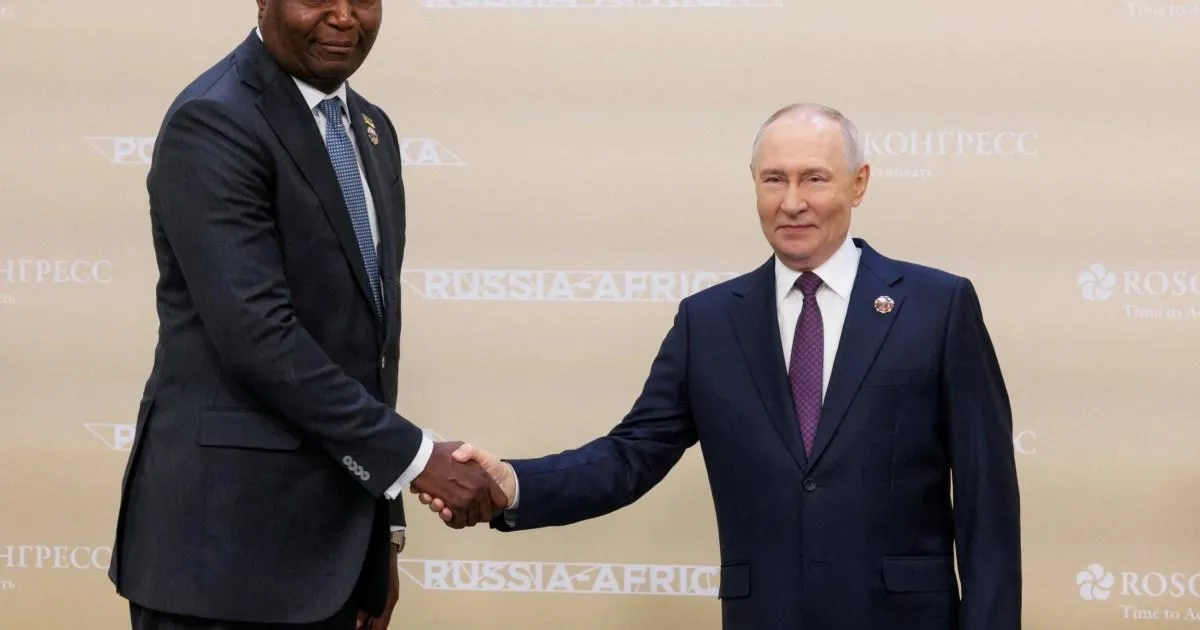
At first glance, it was just another diplomatic handshake—two presidents meeting in Moscow, cameras clicking, official greetings exchanged. But the photograph that escaped the Kremlin’s tightly managed media machine told a very different story. It showed Vladimir Putin, the Russian president who has spent decades cultivating an image of iron strength and unwavering control, standing beside Mozambique’s president, Daniel Chapo, and looking almost small by comparison. Putin, who is reported to be about 5 feet 7 inches tall, was dwarfed by Chapo, a towering figure believed to be at least 6 feet 5 inches. The physical difference was impossible to miss, and the image quickly spread across the internet. What made it even more striking was the fact that the Kremlin appeared to have made a deliberate decision not to release the photograph. Russian official photographers were present at the greeting, but no such image came from their cameras. Instead, it was Mozambique’s government that shared the photo, giving the world a rare, unguarded glimpse of a leader who usually controls every frame of his public life. For a man who has built his entire political persona around dominance, authority, and physical vigor, being photographed as the smaller man in the room is not just awkward—it is a quiet challenge to the mythology he has spent years constructing.
The most revealing part of the episode may not be the photograph itself, but the way the Kremlin tried to shape its narrative. A different version of the greeting was eventually released, but it was carefully shot from a lower angle, a simple visual trick that made Putin appear taller and more imposing. That version also cropped out both leaders’ legs, removing the comparison of height that made the original so uncomfortable. It was a textbook example of political image management, the kind of subtle manipulation that happens behind the scenes at nearly every major diplomatic event. Yet the effort did not go unnoticed. Separate pictures and footage released by Mozambique showed Chapo looming high over Putin as they took part in a session together. Those images, unflattering to the Russian leader, could not be edited or reframed by Kremlin press officers. The contrast between the two sets of images was striking: one carefully constructed to reduce Putin’s visual disadvantage, the other showing reality in all its unfiltered awkwardness. The fact that the Kremlin went to such lengths to control how the meeting was seen suggests that Putin’s sensitivity about his stature is not just a matter of personal vanity; it is a matter of political survival. In the world of strongman politics, where leaders project strength through every handshake and photo opportunity, appearing diminished is a silent weakness that opponents and critics can exploit.
Putin’s sensitivity about his height has been the subject of speculation for years. Rumors have long circulated that he wears platform shoes to add inches to his frame, and observers have pointed out that many of his official appearances seem designed to minimize the height gap between him and other world leaders. From specially designed podiums to carefully chosen camera angles, the Kremlin has often gone to extraordinary lengths to make Putin appear larger, stronger, and more dominant. This is not unusual among powerful men, of course. Height has long been associated with leadership, authority, and success, and studies have shown that taller political candidates often have an advantage at the ballot box. But for Putin, the issue seems particularly acute. His public image is rooted in the idea of the tough, decisive, physically capable leader—a man who rides bears, practises judo, and takes a hard-line approach to both domestic and foreign policy. Photographs that contradict that image are more than just embarrassing; they threaten the carefully built illusion of invincibility that underpins his rule. The image with Chapo, however, was not something the Kremlin could easily spin. It was real, it was candid, and it made Putin look exactly what he is: a human being, with all the limitations and vulnerabilities that human beings have. For a leader who has tried to seem larger than life, the photograph was a reminder that no amount of stagecraft can completely erase the realities of the body.
The internet, of course, did what the internet always does. Social media users seized on the photograph and turned it into a meme, mocking the visual imbalance between the two leaders. Chapo himself was teased on his social media accounts for appearing to inflate Putin’s size in the photos he shared. One meme showed an even smaller Putin, with the caption asking the Mozambican leader why he had enlarged Putin in the photograph. Another parody image reimagined the two leaders as characters from The Lord of the Rings, with Chapo as the towering wizard Gandalf and Putin as a barefoot hobbit. The humor was sharp, and it resonated widely, partly because it tapped into something deeply human: the absurdity of a powerful person trying so hard to appear more imposing than they really are. Some comments were lighter, joking that Putin must feel insecure looking up to his African counterpart. Others took a darker turn, with one commenter writing that shaking hands with a mass murderer dwarf was disgusting—a stark reminder that Putin’s height is not the only thing that defines his international reputation. For many people, the photograph was not just a funny image; it was a small moment of poetic justice, a chance to see a fearsome leader reduced to an awkward figure in a diplomatic handshake. The memes may have been silly, but they carried a deeper message about the gap between political performance and human reality.
Amid all the mockery, there was also a serious diplomatic context. Chapo’s visit to Moscow was not accidental. He was there at Putin’s invitation to participate in the third Russia–Africa Summit, a gathering intended to strengthen ties between Russia and African nations. In his own statement on social media, Chapo emphasised the importance of dialogue, cooperation, and the strengthening of relations between Mozambique, the Russian Federation, and other African countries. For Mozambique, the visit was likely an opportunity to engage with a global power, to discuss economic partnerships, security cooperation, and the broader geopolitical ambitions that have brought Russia back to the African continent in recent decades. For Russia, hosting African leaders is part of a larger effort to expand its influence beyond the West, particularly in regions where it can present itself as an alternative partner to the United States and Europe. The awkward photograph, however, threatened to overshadow those diplomatic goals. Instead of talking about trade, investment, or regional security, much of the conversation around the meeting focused on the physical differences between the two presidents. It was a reminder that in the age of social media, even the most carefully planned diplomatic events can be hijacked by a single unflattering image. And for Putin, a leader who prides himself on controlling the narrative, seeing the global discourse shift to his height and his so-called insecurity was likely a bitter irony.
In the end, the photograph of Putin and Chapo is more than just a fleeting internet joke. It is a small but revealing window into the fragile nature of political power. Leaders are often treated as larger-than-life figures, their images carefully polished and protected by armies of advisors, photographers, and media managers. But a single photograph can break through all of that, exposing the human being behind the performance. For Putin, the image with Chapo was a loss of control, a reminder that no matter how many cameras he stages, how many angles he adjusts, or how many photos he suppresses, he cannot fully control how the world sees him. The photograph also resonates because it touches on something universal: the desire to be seen as strong, the fear of being seen as weak, and the awkward reality that our bodies do not always match the images we want to project. It is easy to mock Putin for his sensitivity about his height, but the truth is that many people understand that feeling in their own lives. We all have insecurities, and we all try to manage how others perceive us. The difference is that most of us do not have the resources of a state behind us to help create the illusion. Seeing a powerful leader reduced to the same kind of insecurity can be strangely reassuring, a reminder that power, no matter how absolute, does not make someone immune to human vulnerability. And perhaps that is why the photograph went viral—not just because it was humorous, but because it showed a leader who seems so untouchable, so controlled, and so carefully packaged, in a moment of unguarded reality. In the end, the image of the short Russian president standing beside the towering Mozambican leader is a reminder that no matter how much we try to shape our own image, some truths are simply impossible to hide.