
Israel went to bed on election night without an answer, and perhaps that was the only thing both sides could agree on. This was the first election since the October 7 attacks, a vote held under the long shadow of war, grief, hostage families, and a society still trying to stitch itself back together. The polls did not open onto a clear horizon; instead, they delivered a portrait of a country split down the middle, exhausted, anxious, and uncertain about who should lead it through the next chapter. Early exit polls were like different weather reports from the same storm. One broadcaster showed Benjamin Netanyahu’s bloc edging ahead. Another showed the race tied at 51 seats each. No one could say with confidence who had won, and that uncertainty hung over the night like smoke. For ordinary Israelis, many of whom spent the evening staring at their phones and television screens, it felt less like a moment of triumph and more like the continuation of a long, painful argument. There were flashes of celebration from the camps, especially from those who had hoped for the end of Netanyahu’s rule, but there was also a heavy sense that the country was still trapped in the same cycles of political deadlock and trauma. The election was a reckoning, but the reckoning had not yet produced a verdict.
The numbers, at least, told a story of extraordinary closeness. According to Israeli broadcaster Channel 12, the pro-Netanyahu bloc was projected to win 52 seats in the 120-seat Knesset, while the bloc led by the opposition party Yashar, under former military chief Gadi Eisenkot, was projected to win 49 seats. That represented a modest shift from earlier polls, which had put the pro-Netanyahu camp at 50 and the anti-Netanyahu camp at 52. In other words, momentum had moved slightly in Netanyahu’s direction, but not enough to give him anything resembling a clear majority. Channel 12 also projected that Netanyahu’s Likud party would win 27 seats, up from 24, while Eisenkot’s Yashar party was projected to win 21 seats, down slightly from 22. But the picture was not consistent across the networks. Kan 11, another major Israeli broadcaster, released a later poll showing the two blocs tied at 51 seats each, after earlier projections had given the anti-Netanyahu camp 52 and the pro-Netanyahu camp 50. The difference of a seat or two may sound small, but in Israel’s fractured political system, those numbers are everything. No party wins outright; coalition building is the heart of the game, and the magic number is 61 seats out of 120. Without 61, no bloc can form a majority government. And with the two sides so closely matched, the outcome may ultimately depend not on the voters alone, but on the quiet negotiations, backroom deals, and political calculations that follow in the days after the ballots are counted. For now, all anyone could say for sure was that Israel had not chosen a clear path forward.
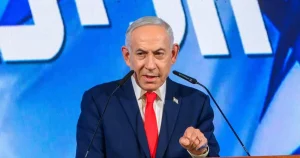
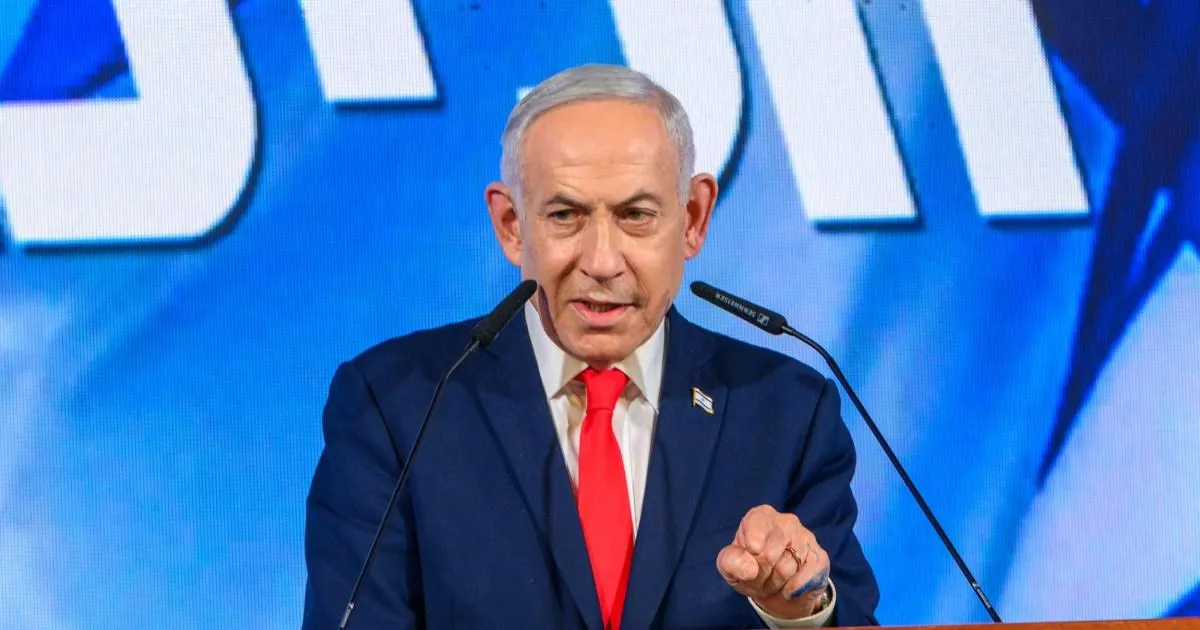
Benjamin Netanyahu, however, was not waiting for certainty. Even as the numbers remained ambiguous, the prime minister stepped forward to declare that he would form a strong, right-wing national government. It was a familiar phrase, delivered with the same defiant confidence that has defined his long political career. But behind the bravado, the arithmetic looked difficult. Yes, his Likud party had gained seats, and yes, the pro-Netanyahu bloc appeared to have narrowed the gap in some projections. Yet early in the evening, commentators looking at the first exit polls had described the night as “very, very bad” for Netanyahu, and even the later revisions left his coalition far short of the 61 seats needed for a stable government. To reach a majority, he would need the support of smaller religious and ultra-Orthodox parties, and perhaps more importantly, he would need to survive the challenge of coalition negotiations with partners who are themselves divided and unpredictable. There was also something deeper at stake: Netanyahu’s leadership has been personally polarizing, and for many Israelis, the election had become a referendum not just on his policies but on his very character. The culture of lies that Eisenkot spoke of, the corruption charges, the sense of national drift, the trauma of October 7, all of these were wrapped up in the question of whether Netanyahu should continue to lead. His vow to form a right-wing government reflected his belief that he could still rally the faithful, but it also showed how far he had to go. A strong government requires unity, and unity was exactly what the exit polls did not show.
For Gadi Eisenkot, the night was something else entirely. Standing before his supporters at the party’s headquarters, the former military chief looked like a man who saw the dawn breaking after a long night of doubt. “We made history,” he told the crowd, and even if the final numbers did not give his bloc a decisive majority, his voice carried the energy of someone who had broken through a barrier. Eisenkot spoke to the millions of Israelis who, as he put it, have grown sick with the culture of lies brought by Netanyahu’s government. It was a powerful moment, not just because of the words, but because of what they represented: a direct challenge to the political style that has dominated Israel for years. Eisenkot promised to represent all Israelis, not just his own voters, and he vowed to change the national priorities. For many listeners, especially those who have spent the months since October 7 demanding accountability and change, his speech was a catharsis. It was also emotionally charged because Eisenkot is not a typical politician. He comes from the world of security and service, a man who has spent his life protecting the state, and that background gave his critique of Netanyahu an extra weight. When he said that Israel’s security should not be used for political purposes, he was speaking as someone who understands the human cost of war, the soldiers who do not come home, and the families who wait for news in the middle of the night. The crowd at his headquarters cheered, hugged each other, and allowed themselves a small moment of hope, even as the full picture remained unclear.
Eisenkot’s direct message to Netanyahu was the emotional core of the night. “Do not use Israel’s security for your own political purposes,” he said, addressing the current prime minister by name. Then he went further, calling on Netanyahu to retire from politics, arguing that the Israeli people had voted against him. It was a blunt and personal plea, rooted in a belief that the country needed a fresh beginning and that the man who has dominated Israeli politics for so long no longer represented its future. Eisenkot spoke of representing all Israelis and of changing the national priorities, not in the language of a narrow party leader, but in the language of a unifying statesman. He said that millions of Israelis have grown sick with the culture of lies, a phrase that seemed to capture the mood of a public exhausted by endless political crises, legal battles, and broken promises. His words offered an alternative to the politics of division, a vision of a government that would put security, healing, and the ordinary needs of citizens first. Whether that vision can actually translate into a coalition majority is a question for the coming days. But for one night at least, Eisenkot gave his supporters something rare: a reason to believe that the old rules no longer had to apply, and that the country could move beyond the toxic stalemate that has gripped it for so long. He was not declaring victory in the traditional sense, but he was declaring a moral victory, a shift in the national conversation.
In the end, the election did not solve Israel’s deeper crisis; it reflected it. A nation still mourning the dead and fighting for the release of hostages went to the polls and found itself divided almost exactly in half. The pro-Netanyahu bloc and the anti-Netanyahu bloc each claimed some kind of progress, but neither could offer the country the majority it desperately needs to govern with strength. The coming days will be filled with negotiations, alliances, and possibly more elections if no coalition can be assembled. For the people of Israel, this means prolonged uncertainty at a time when they yearn for stability. The human story behind the numbers is one of anxiety and hope, grief and determination. Families who lost loved ones on October 7 and families who are still waiting for their loved ones to return watched the results with heavy hearts. Soldiers on leave and reservists still in uniform thought about what this vote meant for the country they have defended. Parents worried about the future their children will inherit, and young voters wondered whether their voices would actually change anything. The election was a mirror held up to Israel’s soul, and what it reflected was not a single answer, but a question: Can this wounded nation find a way to heal? The exit polls did not provide an answer. But maybe, in the quiet hours after the vote, the people themselves began to understand that the real work is not about winning seats. It is about learning to listen again, to trust again, and to build a government that can carry the weight of so much history without bending under it. That is the long road ahead, and it begins now, not with certainty, but with hope.