

On the evening of 7 October 2023, Haneen Hijazi was doing what millions of mothers do in the quiet hours before nightfall: helping her eldest daughter Hawa revise for a social studies exam while baking sweet treats in the kitchen for her son Saif to take to school. The house smelled of sugar and warmth. There was homework, there was flour on the counter, there was the ordinary, unglamorous rhythm of family life. “It was a beautiful day,” Haneen later recalled. But beauty, in Gaza, has a way of being torn away with terrifying speed. As the first bombs rained down and rockets soared through the sky, the world she had built around her children collapsed overnight. What followed was not just a military escalation but an unraveling of everything Haneen knew: home, safety, health, sanity, and the small daily rituals that keep a family whole. “The situation turned drastically,” she said. “We were besieged in our home by the army.” Since that night, Haneen and her family have been running — from one temporary shelter to another, from one relative’s house to the next, always trying to stay one step ahead of the destruction. They have endured what she described as “the harshest living conditions we had never known.” Her five-year-old daughter Kawthar, born into a world already fragile, has carried the heaviest emotional weight. The war has left her malnourished, exhausted, and plagued by sleeping problems brought on by the terror of bombings and the fear that the people she loves most might suddenly be taken from her. For a child who should be learning letters and playing with dolls, the conflict has become the defining force of her early life, shaping the way she sleeps, eats, trusts, and dreams.
The scale of the catastrophe is almost impossible to hold in the mind. This latest conflict began after Hamas attacked southern Israel, killing around 1,200 people and taking 251 hostages. Israel responded within hours with a large-scale military campaign that has, according to Unicef, killed or injured more than 64,000 children alone. Three years later, Gaza remains a landscape of loss and survival, where nearly all aspects of civilian life have been uprooted or destroyed. Around 1.9 million of the strip’s 2.1 million people are displaced, and many live in overcrowded shelters where clean water, working toilets, and functioning healthcare are distant memories. The United Nations estimates that two-thirds of Gaza’s population face emergency levels of hunger, and hospitals are so severely strained that even basic medicine is a luxury. Contaminated water, sewage, and poor living conditions have woven a second crisis of disease into the fabric of the first one of violence. For Haneen, the abstract numbers translate into a very personal ache. “Before, we had all we needed: food, clothing, medical care, electricity, water, and all the other facets of a normal existence. It was a beautiful life. Then the war came like a fierce gale, destroying the garden and scattering the blossoms,” she said. After multiple displacements, her family eventually returned to their apartment, which survived the bombing but still bears the scars of what she calls “cursed gunfire and shrapnel.” Returning home was not a return to life as it had been. It was simply a slightly less unbearable way to survive. Every day, Haneen and her son make multiple trips carrying heavy buckets of water up four floors to their apartment, collecting the water from a shared tap on the street where neighbours often argue and fight as they wait their turn. Nothing about survival is simple anymore. Even the most basic resource requires negotiation, endurance, and strength.
Haneen’s days have become an endless series of tasks, each one necessary, each one exhausting. She wakes at the dawn call to prayer, prays, and immediately begins her work: taking her daughter to kindergarten, walking to the market, baking bread for her children, filling containers with salty water, rushing to find fresh water, doing laundry, lighting a fire to cook, repairing what can be repaired, and comforting what cannot be comforted. “It is a day of endless tasks,” she says, and the list is not just a schedule but a testament to the sheer amount of labour required just to stay alive in a place where infrastructure has collapsed. The apartment, though still standing, is not safe or comforting. Many of its windows are broken, and despite the family’s attempts at repairs, cold air, dust, and the sounds of the outside world drift through the gaps. “The spectre of death and destruction haunts me everywhere,” Haneen admits. There is no room in her mind for the softness of her former life — no quiet cup of tea, no idle moment, no time to simply be. She says she longs for the sweets she used to make with love, for the refrigerator, for running taps and electricity, for the comfort and privacy of a home that was not a fortress. Most of all, she longs for herself. “I miss my former life, the quiet of my home. I miss me,” she said. And yet, amid all of this, she finds a small saving grace: at least she and her children are no longer living in a tent. At least they have a roof, however damaged, over their heads. It is a painfully modest form of hope, measured in broken windows and shared taps, but it is the anchor she clings to while the world around her continues to crumble.
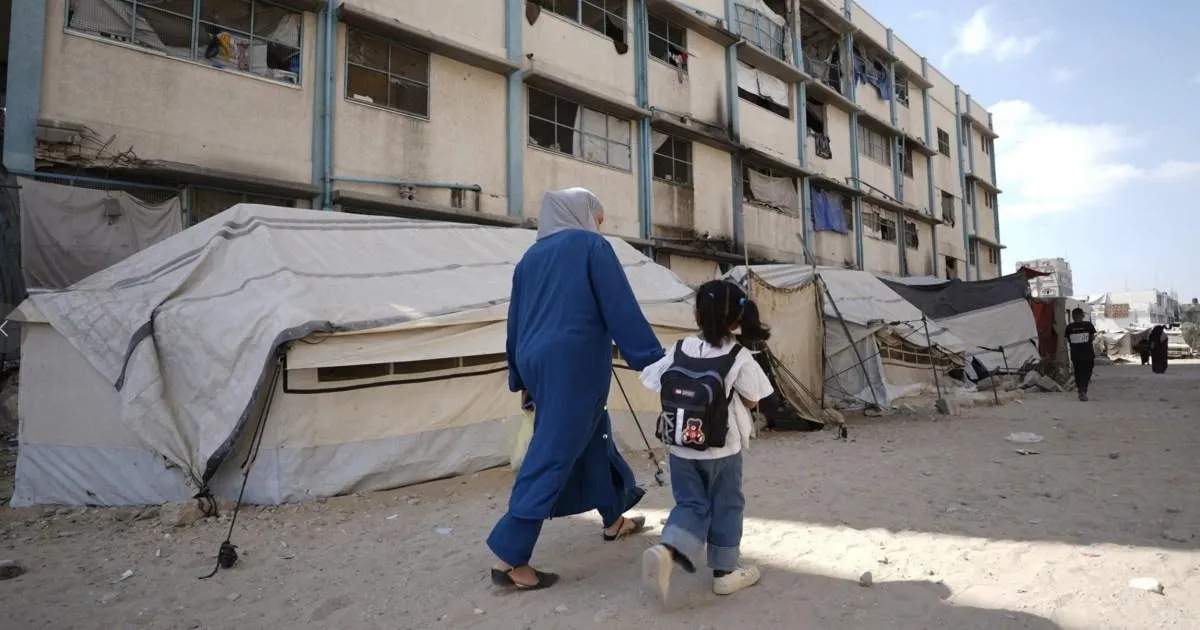
But for 52-year-old Abeer Issa, even that fragile form of stability has been impossible to find. She still lives under canvas, in a worn-out tent no larger than thirty square metres, sharing the space with ten other adults. There is no proper ventilation, no bedding fit for sleeping, only the barest essentials and the constant struggle against heat, cold, and despair. Originally from Rafah, Abeer and her family fled their home so suddenly when the war began that they could not take a single belonging. Everything they owned — furniture, clothes, photographs, the small treasures of a life — was left behind. Two of her sisters died in the conflict. Her elderly mother, who lives with her, suffers from chronic illnesses and a mobility impairment, and the hardships of tent life have taken a devastating toll on her fragile health. The family is beset by gas shortages and a lack of clean water, and even cooking a basic meal has become an ordeal. Abeer remembers the life she led before the war with the quiet wistfulness of someone who did not know she was living the good old days in real time. She loved her job as a teacher, and she loved the stability and dignity it gave her. Now, she still teaches — recently returning to an early learning centre built by the charity Theirworld — but the journey there is gruelling. She must walk an hour just to reach the bus stop before she can even begin her commute. And when she arrives, she is often too mentally and physically drained to prepare properly for her students. “Living in a tent makes it impossible to prepare teaching plans,” she explains. “The lack of internet and electricity prevents me from creating the appropriate educational materials I used to produce before the war, when I had access to a laptop and libraries.” Yet Abeer continues, because she knows, perhaps better than anyone, that Gaza’s children cannot afford to lose any more of their childhood.
The psychological and developmental toll on Gaza’s children is staggering. Three years of war have left generations of young people growing up without adequate nutrition, care, safety, or early learning opportunities. Some 58,000 children have lost one or both parents, and many more are unaccompanied or separated from their families, according to Theirworld. These children are not just surviving trauma; they are living inside it every day, in constant fear of the next explosion, the next displacement, the next loss. They have been forced to learn a vocabulary of war that no child should ever know — words like shrapnel, siege, and evacuation — while the ordinary vocabulary of childhood, like playground, friendship, and bedtime story, has become dangerously rare. In response to this severe early childhood development crisis, Theirworld recently opened twelve temporary early learning centres across two locations in Gaza. For many children, these centres offer the first opportunity since the war began to learn alongside other children, to follow a daily routine, to play, to colour, to draw, and to simply be a child again. The centres are not a cure for the trauma of war, but they are a bridge. They provide structure and safety in a place where both have been demolished. They create a small pocket of normalcy in a landscape of rubble, offering children the chance to develop the emotional and cognitive skills that will be essential if they are ever to heal and rebuild their lives. For families like Abeer’s, the centres also represent a form of resistance — a refusal to let war completely steal the future of the youngest generation.
One of the children who has been changed by this intervention is Haneen’s daughter Kawthar. Before she began attending kindergarten at one of the new centres, she was withdrawn, frightened, and struggling to sleep. The fear of bombings and of losing her family had hollowed out her confidence and left her tense and vigilant. But after just one month, Haneen said, her psychological well-being visibly improved. Kawthar became more active, more playful, and more willing to try things on her own. She began to enjoy colouring, drawing, and writing. She started doing small tasks independently at home, reclaiming the confidence that war had stolen from her. For Haneen, these small developments feel like a miracle. They are not just signs that Kagthar is learning; they are signs that she is healing, that the forces of destruction have not fully claimed her spirit. In the middle of all this devastation, there is a little hope. Haneen knows that the road back to normal life is still unimaginably long. She misses the quiet of her home, the privacy, the comfort, the electricity, the television, the running taps, the refrigerator, the cold water in the summer. She misses the sweets she used to make with love, and the state of mind that has been shattered by war. She misses herself. But hope has not died completely. “I hope our lives return to how they used to be,” she said. “I wish for peace, stability, and safety to return to our lives.” It is a modest wish, but in Gaza, where survival has become a full-time occupation, even a small wish is an act of resistance. For Haneen, for Abeer, and for the countless mothers, fathers, and children still living under the shadow of conflict, the path forward is fragile and unclear. But through the work of organisations like Theirworld, and through the unbreakable resilience of people like them, the possibility of a different future — one where children can play, learn, and sleep without fear — remains alive. It is not much. But sometimes, in a war zone, a little hope is enough to keep going.