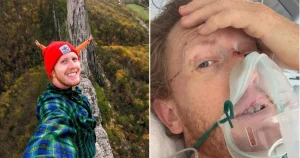

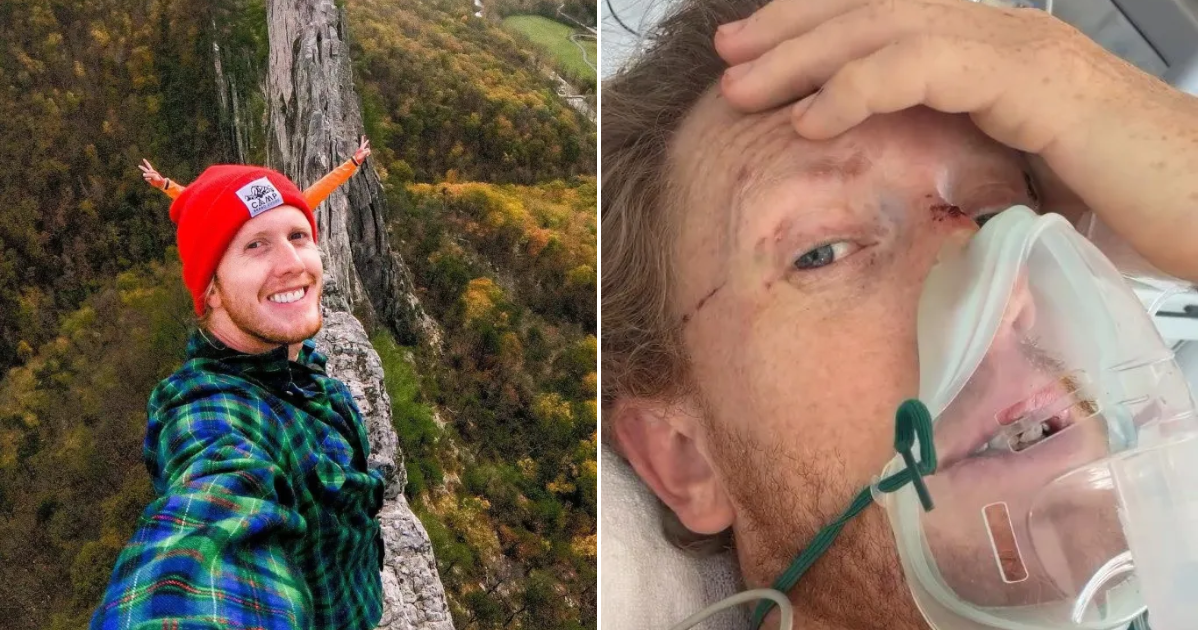
Kyle Quin Schrock was never supposed to be on that cliff. For years, he had lived the quiet, predictable life of an accountant—numbers, spreadsheets, and the reassuring hum of a nine-to-five routine. But somewhere along the way, the monotony began to suffocate him, and he made the bold decision to trade his calculator for a camera, his desk for distant horizons. With a growing following of over 1.3 million on Instagram, the 36-year-old photographer had begun to carve out a new existence, one defined by breathtaking landscapes and the freedom of the open road. His journeys took him to the far corners of the Earth, and on October 11, that path led him to the rugged, volcanic island of Madeira, Portugal. What was meant to be just another stunning hike, another opportunity to capture the world’s beauty through his lens, instead became the setting for a terrifying brush with mortality—a sudden, brutal reminder that even the most beautifully worn trails can betray you.
The trail, as he later described, simply crumbled beneath his feet. One moment he was walking, immersed in the lush greenery and dramatic cliffs that had made Madeira a paradise for adventurers; the next, he was falling—plummeting 200 feet down a sheer rock face. In that terrifying freefall, time seemed to stretch, and Kyle’s mind raced with a single, absolute certainty: This is it. I am going to die. The impact never came as expected. Instead, by a stroke of improbable luck, his body caught on a small bush, barely sturdy enough to support him. “It did not feel strong enough for me to get caught on,” he would later say, still grappling with the sheer improbability of his survival. As he clung to the fragile vegetation, his muscles screaming and his breath ragged, he heard a sound from above—the thrum of a helicopter and, impossibly, a voice telling him help was already on the way. In that moment, suspended between life and death, it was “the best news he could ever get.” The rescue was swift, but the ordeal was far from over.
Now, Kyle lies in an intensive care unit, his body a broken testament to the violence of the fall. His back is fractured, his ribs shattered, his sternum cracked—a collection of injuries that would leave most people barely able to move. He is also waiting for spinal surgery and has needed his lungs drained to ease the pressure on his breathing. In a video shared from his hospital bed, he appears with an oxygen mask strapped to his face, each breath a conscious effort. His voice is weak, punctuated by pauses, as he describes the surreal haze that has enveloped him since the accident. “Life has stayed so still since I got here,” he says, the words heavy with exhaustion. “I feel like I’ve been in a weird daze, really struggling to maintain any normalcy. I’m in extreme amounts of pain.” The photographer, who once chased sunsets and stormy skies, now finds himself confined to the sterile stillness of a hospital room, his days measured not in miles but in the slow, agonizing process of healing.
Yet, even in his pain, there is a deep, luminous gratitude that cuts through the suffering. Kyle’s video update was not just a report of his injuries—it was a testament to his spirit. “But I wanted to give you guys an update—I am alive,” he says, the words carrying the weight of someone who has stared into the abyss and somehow returned. He speaks of his gratefulness, not only for the gift of life but for the friends who acted swiftly, calling for the life flight that saved him. “They did an awesome job,” he acknowledges, his voice softening as he thanks the unnamed rescuers who pulled him from the cliff’s edge. And despite everything, there is a fierce determination in his words—a vow to “get back out there,” even as he acknowledges the long and uncertain road ahead. For now, though, he is simply here, breathing, alive, clinging not to a bush but to the fragile hope of recovery.
Kyle’s family, meanwhile, has become his anchor, mobilizing a GoFundMe campaign to shoulder the staggering financial burden of his medical evacuation and rehabilitation. “He has a long road to recovery with travel assistance, rehabilitation and further medical needs in the USA,” the fundraiser reads, painting a clear picture of the challenges ahead. Kyle will not be able to work for months—a devastating financial blow for someone whose livelihood depends on physical mobility and the ability to traverse the world’s landscapes. The family’s plea is both heartfelt and pragmatic: “We’re hoping to ease some of that stress in any way possible with some financial support. Any little bit helps.” They close with a simple, powerful request: “Keep our guy in your thoughts and prayers please. Hopes of peace in your journey.” In the wake of such a sudden and life-altering event, the fundraiser stands as a testament to the power of community, a digital lifeline reaching out to buffer the harsh realities of medical care.
As the world watches Kyle’s story unfold, there is a profound sense of the fragility of life—and the extraordinary resilience of the human spirit. This is a man who left a stable career to chase adventure, and in doing so, found a community of millions who now hold their breath for his recovery. His story resonates because it reminds us that the line between normalcy and catastrophe is razor-thin, and that the very pursuits that give life meaning can also place us in harm’s way. Yet Kyle’s ordeal is not just a tale of tragedy—it is one of miraculous survival, of a bush that held, of a helicopter that came, of friends who acted, and of a man who continues to fight. In his own words, he is grateful to be alive, and that gratitude is a beacon for all of us who follow his journey. As he rests in that ICU bed, surrounded by monitors and the quiet hum of medical machinery, we are reminded that every breath is a gift, and that even in the stillness, there is hope.