
For most of their lives, Bu and Tyapa measured the world in rusted bars and cold concrete. They were brown bears, powerful creatures built for vast forests and rushing rivers, yet they had been reduced to living in cramped, decaying cages in the southwestern Russian republic of Dagestan, on the shores of the Caspian Sea. Theirs was a story of neglect, cruelty, and invisibility—two animals that the world had looked away from for years. But after a five-year rescue effort that stretched across continents and survived war, sanctions, and impossible logistics, the two bears have finally found themselves in a place they never knew existed: a lush, green forest in Donegal, Ireland. The journey was not just a physical relocation. It was an extraordinary act of compassion involving more than one hundred people, from Russian sanctuary workers to Emirati airline staff to Irish animal lovers, all of whom were determined to give Bu and Tyapa a chance to live as bears are meant to live. Their story is one of suffering, but also of humanity’s ability to make amends, to care for the forgotten, and to bring wild things back to the wild.
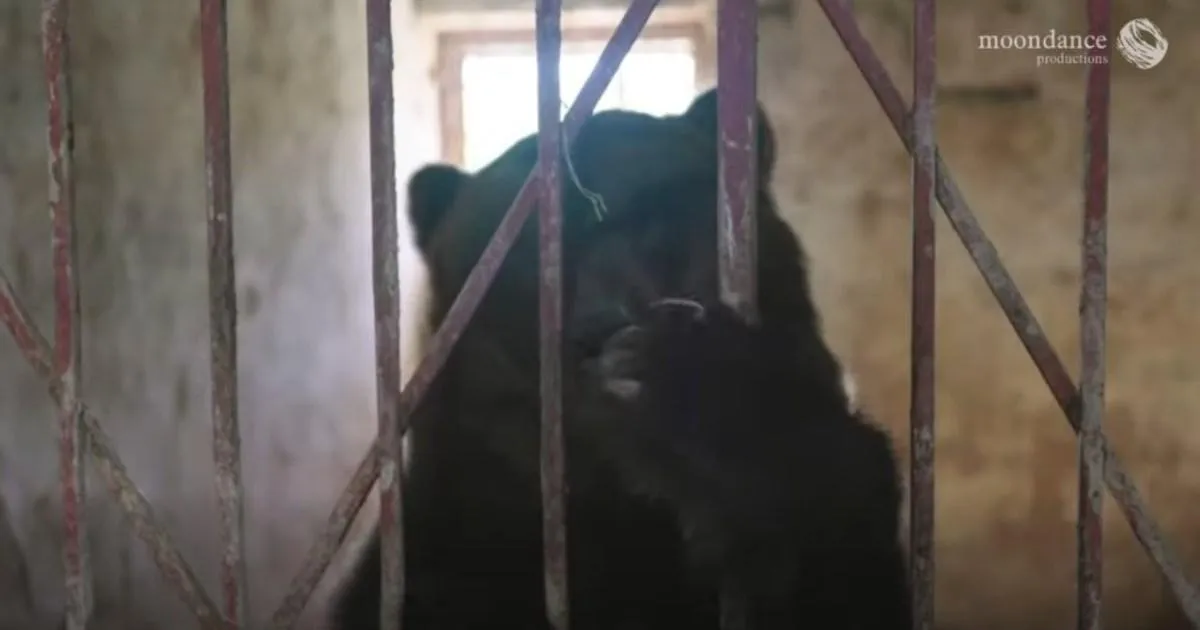
The lives they left behind were almost unbearably bleak. Tyapa, a brown bear reportedly bred to be killed and stuffed for taxidermic purposes, had spent years in an enclosure that was barely two metres high, so he could never stand upright, never stretch his limbs, never feel the simple relief of being able to look at the sky from a natural posture. His cage had no roof, which meant he was exposed to the searing heat of Dagestan’s summers and the biting, freezing cold of its winters, with no shelter, no comfort, and no escape. Water was his most precious and scarcest resource; he had to drink from streams fed to him through hosepipes, dependent on the very people who had imprisoned him. Utterly denied basic resources, he was left to rot in his own waste, his body weakened by malnourishment and dehydration. Bu’s story was different in detail but identical in tragedy. She had spent her early life performing for crowds in a circus, forced to entertain humans who saw her only as a novelty, a dancing bear in a costume of subservience. When she was no longer useful, she was locked inside a small indoor cage with limited water, left alone in the dark, her muscles wasting, her spirit broken. Both bears were not living creatures in the eyes of their keepers; they were objects, commodities, beings whose only value lay in what they could provide: taxidermy, entertainment, or simply the bizarre novelty of a captive wild animal.
Rescuing them became an obsession for a small group of people who refused to let them be forgotten. The logistical challenges were immense from the start. Dagestan is more than four thousand kilometres from Ireland, and there are no direct flights between Russia and most European countries, a problem made even more complicated by the geopolitical tensions that have defined recent years. The original plan was to transport the bears by road, driving them across the border into Ukraine and then through eastern Europe toward their new home. Solicitors and animal welfare advocates worked for years to secure the legal permissions, to arrange the paperwork, and to negotiate the complex maze of international regulations. But in February 2022, everything changed. Russia’s invasion of Ukraine made the planned route impossible, and the subsequent sanctions imposed by Western nations closed off the remaining corridors. The bears were once again trapped, not by bars but by geopolitics. The rescue team had to think differently, explore new routes, and find partners who could help them move two enormous, traumatised bears across a world that had suddenly become far more divided. It would have been easy to give up, to say that the obstacles were too great, that the bears were simply unlucky. But the people involved refused to let the bears pay for human conflict. They were determined, as one sanctuary worker later put it, to tell their story and to make their rescue matter.
The first step of the actual journey was a gruelling overland odyssey across Russia itself. Dima and Yana Kim, workers at Tiger House, a sanctuary in St Petersburg that cares for former circus animals, made a thirty-six-hour drive across the vast expanse of the country to reach Dagestan and free the bears. When they arrived, they found Bu and Tyapa in cages that were rusting, decaying, practically collapsing around the animals they were meant to confine. The bears had to be cut out of their cages, carefully and calmly, men with tools working to dismantle the metal prisons while the animals looked on, uncertain, frightened, perhaps not daring to hope. Once freed, the bears were sedated so they could be safely transported, and then began the long drive back to St Petersburg. There, medical examinations revealed the true depth of their suffering. Both bears were suffering from serious kidney problems caused by prolonged dehydration, their bodies desperately trying to function after years without enough water. They were malnourished, their muscles wasted, their teeth and claws damaged by stress and confinement. They were also, deeply, psychologically wounded—their mental trauma as real and as paralysing as any physical injury. They had learned to expect nothing good from humans, to flinch at loud noises, to distrust open spaces. The road to recovery would be long, and it had to begin with the simple, patient task of making them feel safe.
From St Petersburg, the bears were flown to Ireland via Abu Dhabi in the United Arab Emirates, a route that had been painstakingly arranged with the help of Etihad Airlines, the state-owned carrier, which agreed to ship the animals in a cargo aircraft at a reduced price. The flight itself was an extraordinary logistical achievement, involving specially designed crates, veterinary supervision, and careful handling to ensure the bears were not further traumatised. On August 3 this year, Bu and Tyapa finally landed in Dublin, after a journey that had taken them across thousands of miles of land and sea, through multiple countries and time zones, all while the world around them remained strangely unaware of their odyssey. They were then carried by lorry to Donegal, where they were quarantined and gradually introduced to their new home: a dense, natural forest in the care of Wild Ireland, a sanctuary dedicated to rescuing and rehabilitating animals in need. The physical improvements came faster than anyone had dared to hope. Blood tests showed that their kidneys, once so badly damaged, were now functioning normally. Their bodies were absorbing food and water properly for the first time in years. But their minds remained haunted by the past. The bears were still frightened of open spaces, of deep water, of the wind moving through the trees, of the very things that should have brought them joy. They had never had the chance to learn how to be bears, and so every small discovery—the feel of soft earth under their paws, the sound of birds, the smell of rain on leaves—was both a wonder and a threat.
Wild Ireland’s founder, Killian McLoughlin, who had spent years fighting for these bears, said they had been simply “left to rot” by the people who were supposed to care for them. She spoke with emotion about the moment she realised how many people had become invested in their rescue. “When I saw how many people had turned out to help in Russia, Abu Dhabi and Ireland—some with tears in their eyes—I believed these bears mattered and now so many others do too,” she said. “They just needed someone to tell their story. These bears had spent years with so few people looking out for them, and now there were so many people who cared.” McLoughlin acknowledged that rehabilitation would not be quick and that the bears were still adapting to a world that should be familiar but felt terrifyingly new. “Things we might expect a bear to enjoy can frighten them because they have never had the chance to experience them before,” she explained. “We have experience rehabilitating rescued animals, and we will work at their pace. If they want to spend time in their smaller houses, that’s okay too. It is all part of their rehabilitation. Our job is to give them what they need to feel safe.” Visitors are welcome to view Bu and Tyapa, but the dense forest means they can always retreat into privacy, hidden among the trees if they need a moment away from human eyes. After years of being watched, locked up, and used, they are finally free to choose. Their story, carried across continents and told in so many languages, has become a symbol of what happens when human beings decide that suffering matters, and that no creature, however forgotten, deserves to be left behind.