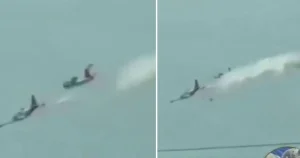


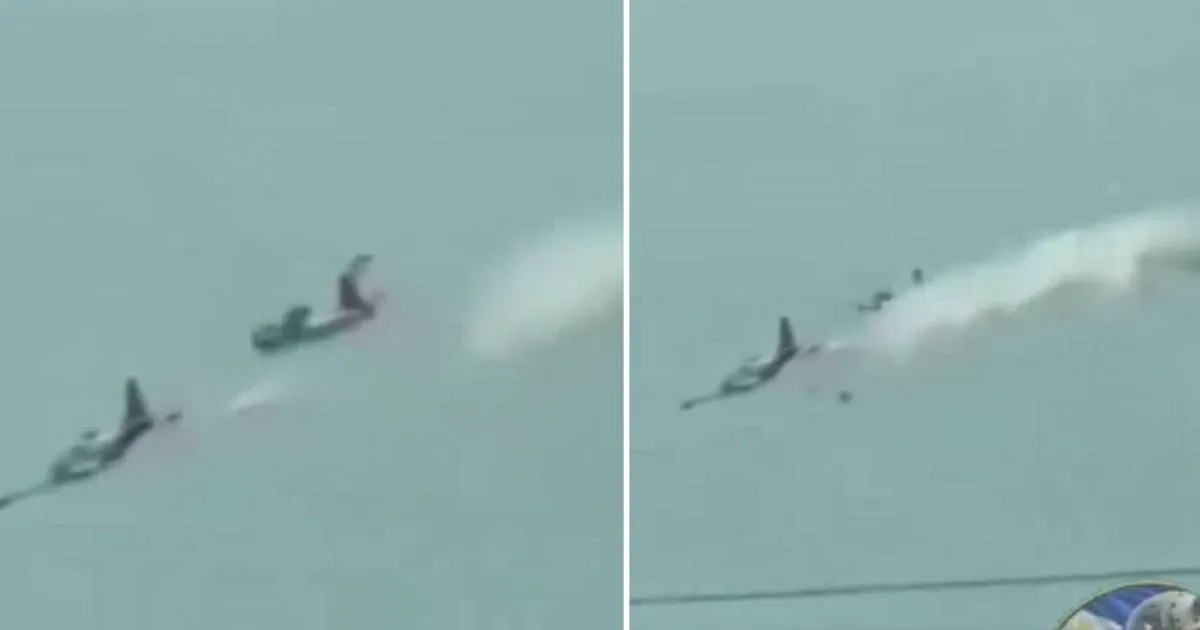
A routine training flight over the Philippines turned into a scene of devastation when two SF-260 military jets collided in mid-air, killing all four pilots on board. The accident occurred inside the grounds of Basilio Fernando Air Base in Lipa City, Batangas province, where the Philippine Air Force conducts much of its pilot training. The two aircraft came down within the base perimeter, and remarkably, no one else was hurt. A video shared online appeared to capture the final moments before the crash: seven aircraft flying in a precise arrow formation, then breaking up—and two planes veering into each other. What had been a display of skill and discipline became a moment of chaos and loss. For the Philippine Air Force, this is a deep and personal tragedy. The four pilots were not anonymous figures in uniform; they were part of a community, a brotherhood of aviators who had spent years learning their craft. They had families who waited for them, friends who admired them, and careers filled with promise. In an instant, all of that was gone. The air force’s grief was immediate and public, but also private, as the families of the fallen were notified and support systems were activated. The base, which is normally alive with the sound of aircraft and the bustle of training, fell silent with shock. The tragedy is a reminder that military aviation, even in peacetime, carries a level of risk that cannot be completely erased. Pilots know this better than anyone. They climb into their cockpits knowing that every flight is a test of their own skill and the reliability of their machines. When something goes wrong, the consequences can be catastrophic. This is one of those moments—a tragedy that will be studied, mourned, and remembered.
According to the Philippine Air Force, the accident took place at around 3:51 in the afternoon during a training flight. The two SF-260 aircraft crashed within the base perimeter, and the air force confirmed there were no other casualties. In an official statement, the PAF expressed its sorrow and outlined the next steps. “The Philippine Air Force mourns the loss of four pilots in an aviation accident involving two SF-260 aircraft during a training flight at Fernando Air Base,” the statement read. “Both aircraft went down within the base perimeter, with no other casualties reported.” The statement went on to say that an investigation was underway and that all SF-260 aircraft had been temporarily grounded as a precautionary safety measure. This grounding is not an admission of fault; it is a prudent response to an uncertain situation. Before any more pilots are sent into the air in these aircraft, the air force wants to know exactly what happened. The video of the formation will likely be central to the investigation. Flying in formation is one of the most demanding tasks in aviation. It requires total focus, constant communication, and split-second timing. Seven aircraft flying together in an arrow shape leaves no room for error. When the formation began to break up, the separation between the aircraft may have been too small, or something else went wrong. Investigators will examine maintenance records, weather conditions, radio transcripts, and the wreckage itself. They will look for mechanical failure, human error, or a combination of factors. It is a painstaking process, and it may take weeks or months. But for the families of the fallen, the investigation is not just about finding answers. It is about ensuring that their loved ones did not die in vain. The air force has asked the public to respect the families’ privacy, a request that is both humane and necessary. Grief needs space. The fallen pilots are more than casualties; they are irreplaceable human beings. Their absence will be felt in the mess halls, the briefing rooms, and the homes around the base. For now, the priority is not the future of the SF-260 fleet or the outcome of the investigation. The priority is mourning, remembering, and supporting those who have lost so much.
The SF-260 is a familiar sight in the Philippine Air Force, a light trainer and ground-attack aircraft originally designed by the Italian manufacturer SIAI-Marchetti. Many of the airframes in Philippine service were transferred from the Italian air force, and they have served for years as the backbone of the country’s pilot training program. They are not modern fighter jets, but they are reliable and versatile, capable of training novice pilots and, when necessary, carrying weapons in combat. However, the aircraft’s history in the Philippines has also been marked by tragedy. In May, two pilots were killed when an SF-260 crashed in a mountainous area in the northern part of the country. In 2023, another SF-260 TP Marchetti went down during a training flight, also killing two pilots. Each accident was investigated, and each one left scars. Now, with four more lives lost in a single collision, the questions are louder and the grief is heavier. Is the fleet too old? Are maintenance procedures adequate? Are pilots being pushed too hard? These are legitimate questions, but they are also difficult ones. The air force has a responsibility to answer them, but it must do so with care and thoroughness. For the families of the fallen, the specifics of the investigation matter less than the simple, devastating fact that their loved ones are gone. They will never see them again. They will never hear their voices or watch them walk through the door. The pain is raw and personal, and no official explanation can ease it. But the air force’s decision to ground the entire SF-260 fleet is a sign of respect. It acknowledges that something has gone wrong, and that more lives should not be put at risk until the cause is understood. It also sends a message to the public and to the families: the lessons of this tragedy will be taken seriously. The fallen pilots deserve no less.
The SF-260 has played a role not only in training but also in combat. In 2017, when Islamic State–supporting militants seized large parts of Marawi City in the southern Philippines, the military launched a prolonged campaign to retake the city. The Philippine Air Force used a range of aircraft in that battle, including the SF-260, to strike enemy positions and support troops on the ground. In the dense urban environment of Marawi, close air support was a dangerous and delicate mission. The pilots who flew those missions had to be precise, courageous, and cool under pressure. The aircraft that were involved in this week’s crash may well have been part of that effort, or they may have been flown by pilots who were trained by veterans of Marawi. The connection between the SF-260 and the nation’s fight against extremism adds another layer of meaning to this tragedy. These are not just old trainer planes; they are machines that have served the country in its darkest hours. They have helped protect soldiers, civilians, and the values that the nation holds dear. And now they are the site of an unimaginable loss. The four pilots who died were not preparing for combat in this training flight; they were sharpening their skills, maintaining their proficiency, and building the habits that would keep them alive in the air. Training flights are supposed to be safer than combat missions, but this accident proves that danger is always present. The arrow formation in the video was not a stunt; it was a standard maneuver designed to teach coordination and discipline. It ended in tragedy, but it was not an act of recklessness. It was an example of the kind of work that pilots do every day, work that most people never see. The sacrifice of these four aviators is a reminder that the safety and freedom of the Philippines are guarded by men and women who are willing to put their lives on the line, even in the ordinary course of their duties.
In the wake of the crash, the Philippine Air Force has moved to support the families of the fallen and to honor their memory. The official statement asked the public to respect the families’ privacy during this difficult time, a plea that speaks to the deeply personal nature of the loss. Behind every uniform is a human being with a name, a face, and a story. These four pilots had mothers and fathers, siblings, maybe spouses and children. They had friends who knew their laughter and their fears. They had dreams for the future—plans to advance in their careers, to start families, to travel, to grow old. All of that has been taken away. The base community is grieving too. Basilio Fernando Air Base is not just a place of work; it is a home. Airmen and their families live there, children go to school there, and friendships are forged in the shared experience of military life. When an accident happens on the base, it is felt by everyone. The sound of sirens, the sight of wreckage, the news that four pilots are dead—these are things that no one on the base will ever forget. The decision to ground the SF-260 fleet is a practical measure, but it is also a symbolic one. It says that the air force will not continue as if nothing has happened. It will stop, examine, and reflect. It will honor the dead by being honest about the risks and by working to prevent future tragedies. In the meantime, the families need support. They need time to grieve without the pressure of public scrutiny. They need to know that their loved ones will be remembered not as statistics, but as heroes. The air force’s promise to coordinate with the families and provide necessary assistance is an important first step. But the healing will take time, and the memory of this day will remain with them forever.
This tragedy is a stark reminder of the cost of military service, even in times when the country is not at war. Pilots spend years training for missions they hope never to fly. They endure long hours, difficult conditions, and constant pressure. They push themselves to the edge of their abilities, and they trust their lives to machines that are often older than they are. The four pilots who died in this crash had earned the right to be called aviators. They had passed the tests, completed the training, and proven their skill. They were part of an elite group, a brotherhood that few people ever join and even fewer understand. Their deaths are a profound loss, but they are not the end of the story. The investigation will continue, and its findings will be used to improve safety and prevent future accidents. The SF-260 fleet will remain grounded until the air force is confident that it can fly again without putting more lives at risk. The fallen pilots will be remembered in ceremonies, in memorials, and in the hearts of those who knew them. Their service will not be forgotten. The Philippine Air Force has suffered a terrible blow, but it will recover. New pilots will come, ready to take their place in the cockpit despite the risks. They will do so because they believe in something larger than themselves. They will do so because the nation needs them. The four aviators who lost their lives in this accident gave everything they had in the service of their country. Their sacrifice, like the sacrifice of all who serve, is a debt that can never be fully repaid. But the least the nation can do is honor them, grieve for them, and learn from their loss. In the skies above the Philippines, the silence will not last forever. Soon, aircraft will fly again, and new pilots will take to the air. But the memory of this day, and the memory of the four who fell, will remain—a quiet reminder of the price of freedom and the courage of those who defend it.