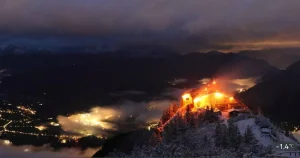


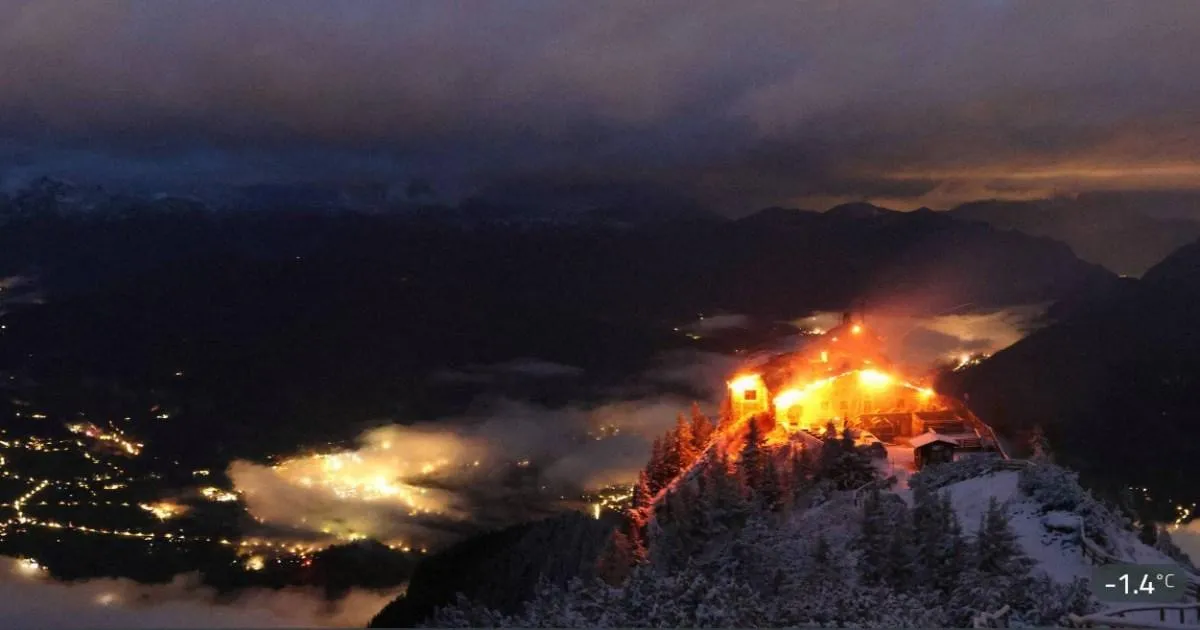
There is a strange, uncomfortable power in a place where history remains alive, and the fire that tore through the Eagle’s Nest on Friday night proved exactly that. The Kehlsteinhaus, built as a mountaintop retreat for Adolf Hitler in the Bavarian Alps near Berchtesgaden, has never been just a building. It is a scar, a warning, a tourist attraction, a quiet place for lunch overlooking the mountains, and now it is also the scene of a suspected crime. The fire alarm sounded at around 9.15pm, and within moments flames were visible across the summit at 1,834 metres above sea level. The response was enormous: around 200 firefighters were sent up the mountain, battling both the blaze and the difficult conditions of an Alpine night. By morning, the fire was still not out, and police had taken a person into custody on suspicion of arson. The news rippled through Germany and far beyond. A place that had survived the war, the fall of the Third Reich, and decades of tourism was now fighting for its existence in a single night of smoke and heat. No one was inside the building, and there were no reports of injuries, but the damage was already significant, and an investigation had only just begun. For many, the image of flames licking the walls of a structure associated with Hitler felt like a painful chapter reopening. For others, it was heritage under threat, to be protected and restored. What made it even more haunting was the element of choice, the suspicion that someone had decided to destroy this particular site, with all the symbolism it carries. The Eagle’s Nest had always been a place of paradox: a place of breathtaking beauty that was built for one of history’s most destructive figures, a place where visitors could sip coffee in the sunshine while standing in the shadow of terrible crimes. Now that paradox had turned into something darker, and the mountain itself seemed to be holding its breath as the flames consumed what had once seemed so permanent.
Fighting a fire is never simple, but fighting a fire on top of a mountain is another matter entirely. The Kehlsteinhaus sits high above the town of Berchtesgaden, surrounded by rocky terrain and limited access. The road leading to it is so narrow that private vehicles are not allowed, and visitors normally reach the building on foot or by special shuttle buses. When the emergency call went out, those same constraints turned the firefighting operation into a logistical nightmare. Bavarian Police later explained that the blaze was still being tackled the following morning, with extinguishing operations continuing. They also said drones had been banned from flying over the area, and hikers and mountaineers were asked to stay away from the peak. The request was not merely bureaucratic; it was a matter of safety and space, because the operational area was crowded with emergency vehicles and crews. Firefighters had to wear respiratory protection equipment simply to approach the building and the ground around it, as smoke and fumes could be hazardous. The remote location meant water supplies had to be carefully managed, and the altitude added physical strain to every task. It was an enormous effort, carried out under the glare of international attention. The fire itself spread across the peak, and by the time the first light of Saturday arrived, the structure was badly damaged. The people on the ground were not only fighting fire; they were wrestling with history in a place where the past is impossible to escape, and every turn of the hose felt like an argument about preservation, memory, and the responsibility of the present. From the valleys below, local residents and early morning visitors watched the smoke rising against the grey sky, aware that something more than timber and stone was burning. The mountain had always been a landmark, a quiet giant visible from miles around, but on that morning it looked wounded, and the silence around it felt heavier than usual.
While the firefighters worked, another drama was unfolding in the background: the search for answers. The Traunstein criminal investigation department announced that an investigation into the fire had been launched. An unnamed person had already been arrested, although the authorities were careful not to say, at least not immediately, whether that person was responsible for starting the blaze. The arrest was reported by Bavarian Police as being on suspicion of arson, but the exact connection between the suspect and the fire remained unclear. What was clear was that the building had been empty at the time, and no injuries had been reported. The absence of human harm, however, did not soften the blow to the local community and the many people who feel a complicated connection to the site. For decades, the Kehlsteinhaus has operated as a tourist attraction under the care of a charitable trust. It has a restaurant and a beer garden, and on clear days visitors can sit outside and look across the Alps, even as they are reminded of the dark purposes for which the building was originally created. The idea that it might have been destroyed on purpose, or that someone wanted to erase it from the landscape, raised questions that went far beyond insurance policies. What does it mean to preserve a place connected to evil? Is it better to keep it open, to let people sit where Hitler once sat, or to let it burn away? Those questions were now being asked in the smoke-filled air above Berchtesgaden, and no one had easy answers. The arrest also added a human element to the tragedy, because it meant that this was not merely an accident of weather or wiring. Someone may have stood in the darkness, watched the flames take hold, and walked away, leaving the rest of the world to deal with the consequences. That thought alone was enough to send a chill through the Alpine morning, even before the cold was considered.
To understand why this fire matters so much, you have to return to the late 1930s, when the Kehlsteinhaus was still a dream in the minds of Nazi Party officials. Commissioned by the party and completed in just over a year in 1938, the building was perched near the Austrian border, deliberately placed in the dramatic Alpine landscape as a demonstration of power and closeness to the heights. It hosted events for the Nazi elite, and Adolf Hitler himself is documented to have attended at least fourteen of them. He reportedly did not care much for the high-altitude setting, suffering from anxiety in the mountains, but his visits gave the place its fateful mystique. During the Second World War, the building became a target. In April 1945, it was bombed by the RAF as part of the Allied effort to destroy symbols and infrastructure of the Nazi regime. Remarkably, it was not directly struck, and the building survived the collapse of the Reich. In the immediate postwar period, it fell into the hands of the American military, and for a time it served as a military outpost and a social space for soldiers. Gradually, the site was transformed from a Nazi stronghold into a civilian attraction. The road, originally built with massive engineering effort, was used to ferry guests up the mountain, and the building opened to the public as a restaurant. The history was never hidden, but it was also managed, packaged, and made accessible to millions of visitors who came to see for themselves the place where so many terrible decisions were surrounded by such beautiful scenery. That long and complicated story now collided with the flames, and the building’s future seemed suddenly uncertain. To stand in front of the Eagle’s Nest was always to stand in two worlds at once: the world of the natural beauty of the Alps, and the world of human cruelty and hubris. The fire did not change that, but it changed the possibility of ever feeling neutral in that place again.
Today, the Kehlsteinhaus is one of the most visited historical sites in the Bavarian Alps, yet its daily life is surprisingly ordinary. A charitable trust runs the site, and guests come up the mountain not only for history but for Bavarian food, fresh air, and panoramic views. The journey is an event in itself. Private cars are not allowed because the road is too narrow, so visitors board shuttle buses from a parking area below, or make the long walk up the hillside. The sense of climbing into the clouds adds to the experience, and for many people, the Eagle’s Nest is a stop on a wider trip through beautiful country, a chance to take photographs and enjoy a beer. But the fire changed everything, at least for now. According to a local tourism authority, it is not yet known whether the building can be restored. The damage is severe, and the process of evaluating the structure, let alone repairing it, will take time. Even before the fire, the site required careful maintenance, with the Alpine weather wearing away at the stone and the crowds putting pressure on the old rooms. Now, after a night of intense heat, the future is unclear. For the local economy, the loss or closure of the attraction could be significant; for the memory of the past, it could be a much deeper wound. The locked doors, the boarded windows, and the smell of smoke hanging over the peak are not what visitors expected to find, and they leave a strange feeling in the air, a reminder that even the most stable-looking monuments are fragile and temporary. People who had planned trips for months woke up to photographs of the blackened building and wondered whether they would ever see it as it had been, or whether they would only be looking at ruins. The mountain, which had always seemed so patient and unchanging, now appeared more fragile than anyone had imagined. It was as if the landscape itself had joined the conversation about whether humanity is capable of learning from its own history, or whether it will simply keep burning down the very places that could teach us something.
In the end, the fire at the Eagle’s Nest is a story about the lingering weight of history and the unpleasant truths that certain places make us face. There are people who will see the damage as a kind of justice, a way of sweeping away a symbol they never wanted to look at. There are others who will see it as a tragic loss of heritage, a testament to the importance of remembering even the darkest chapters of the past. Both responses are human, and both are understandable. The authorities have promised to investigate, and the man arrested on suspicion of arson will no doubt face serious questions. But even if the fire was an accident, or a failure of electrical wiring, the timing and the location would still have made it a story about power, memory, and the strange afterlife of Nazi architecture. As firefighters finally begin to leave and the smoke clears, the mountain stands silent once again, with its summit scarred and its future unknown. The Eagle’s Nest has survived wars and bombing raids, but it has now been forced to face something else: the fire of the present, the anger and love it still inspires, and the impossible task of being a place where people can enjoy a meal while confronting the worst that humanity has to offer. Whatever happens next, the image of the flames will remain in the minds of those who care about this site, and the conversation it started will not die out as quickly as the fire did. Perhaps there is a small mercy in the fact that nobody was killed, and that the building was empty when the flames arrived. But the loss is not only physical; it is also symbolic. The mountain will remain, and the story will remain, and the question of how to live with the past will remain. What changes is the landscape of memory, forever marked by that night when the Eagle’s Nest burned, and the world stopped to watch.