

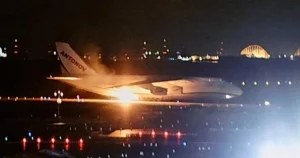

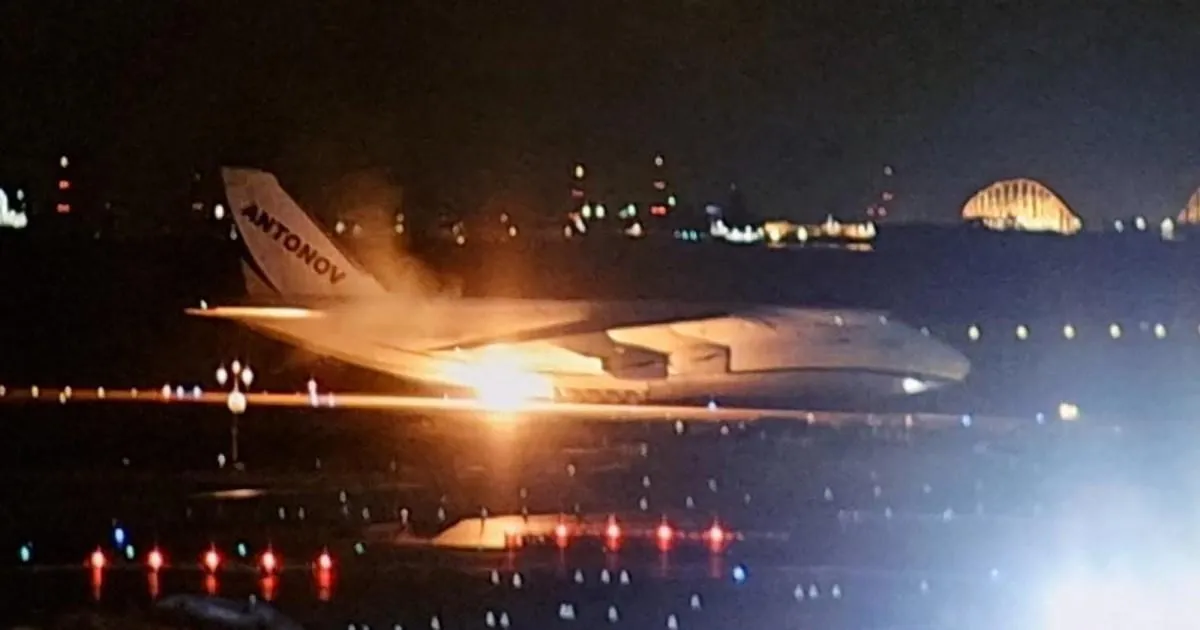
The evening had been ordinary at Chubu Centrair International Airport near Nagoya, with travellers and airport staff moving through the familiar rhythms of evening departures and arrivals. Then, in a matter of seconds, an ordinary scene turned into something that could have been pulled from a disaster movie. A giant Ukrainian Antonov An-124 cargo plane, one of the largest and most powerful aircraft ever built, was coming in to land. As its enormous wheels made contact with the runway, flames were spotted erupting around the four-engined aircraft. For anyone watching from the terminal windows, or from the tarmac, the sight of a massive metal bird trailing fire as it touched down must have been terrifying. The clock read 7:20 p.m. local time. Emergency teams were instantly mobilised, and the runway was closed for about fifteen minutes, enough to disrupt the careful choreography of airport operations but mercifully short. Fire crews sprinted into action, uncertain whether the flames would spread, intensify, or trigger an explosion. Yet the crew inside the cockpit managed to keep the aircraft under control. The plane taxied to its designated parking position under its own power, as if refusing to be grounded by the drama that had just unfolded. By the time the fire was officially extinguished, it was clear that a potential catastrophe had been averted. No injuries were reported, and local observers later described the flames as brief, never developing into a sustained blaze. But the emotional impact of that moment was far harder to extinguish. For the passengers who had been waiting for flights, for the ground crew who had been in the danger zone, and for the pilots who had landed a burning aircraft, the memory of those minutes would linger far longer than the smoke lingering in the air. The runway reopened, the flight schedule was eventually restored, and life at the airport continued. But the central mystery remained: what had caused the fire? Was it a mechanical failure, a technical fault, or something far more sinister? And why had this particular aircraft, with all its history and context, been at the centre of such an alarming incident?
To understand the weight of that moment, it is necessary to understand the plane itself. The Antonov An-124 Ruslan is no ordinary cargo aircraft. At two hundred and twenty-six feet in length, with a wingspan of two hundred and forty feet, it is one of the largest operational aircraft in the world, a colossal machine built for moving things that almost no other plane can carry. It has transported entire railway locomotives, massive industrial turbines, military vehicles, and other pieces of oversized cargo that seem to defy the laws of physics. Its capacity is staggering: up to one hundred and fifty tonnes of payload can be lifted into the sky and delivered across continents. The Ruslan, a name that means “hero” or “giant” in Slavic folklore, is a product of the Cold War era, designed originally by the Soviet Union to project power and support vast logistical operations. But in the decades since, it has become something else entirely. Today, it is operated by Antonov Airlines, a Ukrainian company that has continued to fly its giant transport planes around the world from outside its war-ravaged homeland. Since Russia launched its full-scale invasion of Ukraine, the airline has been forced to operate in exile, with its fleet scattered across bases in Europe and beyond. Yet rather than grounding their aircraft, the Ukrainian crews have kept flying, moving vital supplies for allies, delivering humanitarian aid, and supporting the global logistics chain. This makes the An-124 more than just a remarkable piece of engineering. It is a symbol of Ukrainian resilience, a giant bird that refuses to be caged, and a living testament to the determination of the people who operate it. Every time one of these planes lifts off, it carries with it the hopes and struggles of a nation under siege. So when the world saw images of an An-124 on fire on a runway in Japan, it felt deeply symbolic. This was not just another plane having technical trouble. It was a Ukrainian icon, a flying piece of national strength, suddenly vulnerable in a foreign land. And for many, the first thought was not about mechanics or weather or bad luck; it was about the long shadow of war.
The sequence of events after the landing was, in many ways, a testament to professionalism. The fire was brought under control after fifteen minutes. The runway was closed briefly and then reopened. The aircraft, despite having just dealt with flames near its engines, was able to taxi on its own, an achievement that speaks to both the robustness of the aircraft and the skill of the crew. There were no injuries, no explosions, no disastrous collapse. Emergency protocols worked exactly as they were designed to work. Japanese investigators immediately began to examine the aircraft, looking for clues that might explain what had happened. The type of cargo the plane was carrying has not been disclosed, and that single piece of missing information has fuelled a great deal of speculation. Was it carrying fuel, dangerous goods, military equipment, something sensitive? Or was the cargo entirely innocuous, with the fire caused by something completely unrelated? The lack of information makes it difficult for the public to understand the incident, but it also makes sense from a security perspective. When a plane with this kind of history catches fire, even momentarily, no detail can be taken at face value. Investigators will need to examine engine components, fuel lines, electrical systems, and possibly the cargo hold itself. They will interview the pilots, review maintenance logs, and scrutinise every moment of the approach and landing. The fact that the flames were brief and did not develop into a serious blaze suggests that whatever went wrong, it was caught early and managed effectively. But that will not make the investigation any less thorough. Every country has a deep interest in understanding why a giant military transport plane with Ukrainian national pride on its side suddenly had flames licking at its fuselage on a Japanese runway. And those investigators will be working against a backdrop of rising tensions, because this was not the first time an Antonov plane has been at the centre of a suspicious incident far from the battlefield.
Indeed, only days before the landing fire, the same type of aircraft had been operating in Leipzig, Germany, a location that carries its own ominous significance. In August, German authorities reported a Russian sabotage operation involving Ukrainian Antonov planes at Leipzig and Halle Airport. An explosive drone had been discovered near a Ukrainian cargo aircraft there, an alarming piece of evidence pointing to Russian hybrid warfare on NATO soil. That incident sent shockwaves through European security circles, because it suggested that the Kremlin was willing to target Ukrainian aircraft not just on the front lines or in Ukrainian airspace, but thousands of miles away, in the heart of Europe. The idea of a Russian drone lurking near a civilian airport, close enough to threaten a cargo plane, is chilling. It speaks to a new kind of conflict, one that moves silently across borders, using proxies, spies, and emerging technology to sabotage the West’s support for Ukraine. German investigators described the discovery as a serious security breach, and Western intelligence agencies warned that Russia was increasingly willing to carry out sabotage operations in NATO countries. Now, with an An-124 experiencing a fire on landing in Japan after a recent visit to Leipzig, the coincidence was impossible to ignore. It is important to remember that correlation is not causation, and a mechanical fault or accidental fire remains entirely possible. But the timing, the location, and the history all combine to create a troubling narrative. The fact that the plane had been in Leipzig only days earlier, at a site already associated with Russian sabotage, raises obvious questions. Were the flames a deliberate act? Was there something hidden aboard the aircraft, undetected by security checks, that was supposed to cause harm? Or was this simply a tragic coincidence, an unlucky technical issue on a plane that has been flying through one of the most turbulent periods in modern history? Until the investigation concludes, no one can say for certain. But the uncertainty itself is part of the new reality: every incident involving Ukrainian infrastructure, however far from home, must now be examined through the lens of possible Russian aggression.
This broader context is what makes the incident at Chubu Centrair International Airport so significant, far beyond the temporary closure of a runway in Japan. The war in Ukraine has never been contained to the battlefield. It has spread to undersea cables, to energy infrastructure, to election processes, to supply chains, and now, it seems, to the very skies of countries that are trying to help Ukraine survive. Russian hybrid warfare is designed to be ambiguous, deniable, and difficult to prove. It is aimed at disrupting daily life, creating fear, and undermining confidence in Western institutions. A drone near a Ukrainian cargo plane in Germany fits that pattern. A fire on a Ukrainian transport plane in Japan, if it were proven to be sabotage, would represent an extraordinary escalation, one that would demand a unified and powerful response from the international community. But even without proof, the suspicion alone is damaging. It forces airports to increase security, it forces airlines to reassess their protocols, and it forces governments to divert resources to protect civilian infrastructure from a threat that appears to be getting closer and closer. For Ukraine, the stakes are even higher. Antonov Airlines and its giant planes are a vital part of the country’s ability to maintain connections with the world. They move military aid, medical supplies, and industrial equipment that Ukraine needs to keep functioning under the relentless pressure of invasion. Every attempt to sabotage these aircraft is, in essence, an attempt to cut the lifeline that keeps Ukraine supplied and supported. The fact that these crews continue to fly, despite the constant threat of Russian targeting, despite operations from foreign bases, despite the immense danger to their country and themselves, is nothing short of remarkable. They have already lost close to their entire home base at Hostomel Airport near Kyiv, famously attacked by Russian forces in the early days of the invasion. They lost the massive An-225 Mriya, the largest aircraft in the world, destroyed during that attack. Yet they have persisted, flying their remaining giants out of increasingly secretive and protected locations, performing missions that no other aircraft can perform. The plane that landed in Japan with flames around its engines is a survivor, and so are the men and women who fly it.
In the end, there were no injuries, no loss of life, no catastrophe. The aircraft is intact, the runway reopened, and the investigation is underway. But the image of that massive Ukrainian plane, lit by fire against the dark runway of a Japanese airport, will not be easily forgotten. It reminds us of the fragile line between routine and disaster, between peace and conflict, between the ordinary world of flight schedules and the hidden wars being waged in the shadows. The passengers waiting in the terminal that evening may have been briefly delayed, but they also witnessed something more troubling: a symbol of a nation under attack, carrying its burden of steel and courage, momentarily shaken but not broken. For the crew inside the cockpit, the landing that night was surely one of the most frightening moments of their professional lives. For the firefighters who responded without hesitation, it was another reminder that danger can arrive without warning, even in a country as safe and orderly as Japan. And for the rest of us, watching the story unfold from a distance, it is a reminder that the war in Ukraine has global consequences and global reach. It reaches into airports, into supply chains, into the lives of people who have never set foot in Ukraine. It forces us to ask uncomfortable questions about invisible threats, about the reach of hostile powers, and about the price of supporting those who fight for freedom. The fire was put out in fifteen minutes, but the questions will burn far longer. What caused those flames? Who, if anyone, was responsible? And what does this incident tell us about the new world we live in, a world where even the largest and most resilient aircraft can suddenly find itself in danger thousands of miles from home? Until those questions are answered, all we can do is watch the skies more closely, appreciate the professionalism of the crews who keep flying, and remember that every safe landing, every successful mission, every ordinary day of travel is not to be taken for granted. The giant Ruslan has a name that means hero, and on that runway in Japan, it lived up to that name once again.