
On a warm afternoon in the southern Spanish town of Los Palacios y Villafranca, life inside the Las Postas Cafe-Bar was completely unremarkable. Locals came and went, ordering coffee, cold drinks and light snacks, while conversation drifted through the room in the easy, unhurried rhythm of Andalusian daily life. The sun was bright outside, the day was ordinary, and nothing about the atmosphere suggested that a catastrophe was only moments away. Then a man named Jose Rafael asked for mayonnaise with his sandwich. It was a simple, even trivial request, and any reasonable person would have accepted the answer with a shrug. But the bar did not have a kitchen, the sandwiches came ready-prepared, and no sauces were kept on hand. A waiter explained this calmly. Perhaps hoping for a different response, Rafael asked again. A second waiter gave the same reply. There was no hostility in it, no insult, no deliberate humiliation. It was just a small business saying no to a condiment it did not stock. Yet this refusal, repeated twice, lit something inside Rafael. Instead of accepting the letdown or moving on, he turned and walked out. His destination was a nearby petrol station, where he bought a one-and-a-half litre bottle of petrol. Then he made his way back to the cafe. It is almost impossible to believe that a sandwich sauce could lead to arson, but the security cameras and the flames that followed prove that it did. Within a very short time, a man who had been denied mayonnaise would set fire to a public space filled with innocent people, including children and elderly customers, and in the process set his own hand alight. The ordinary afternoon disappeared, replaced by panic, smoke and damage that would leave both a building and a community forever marked.
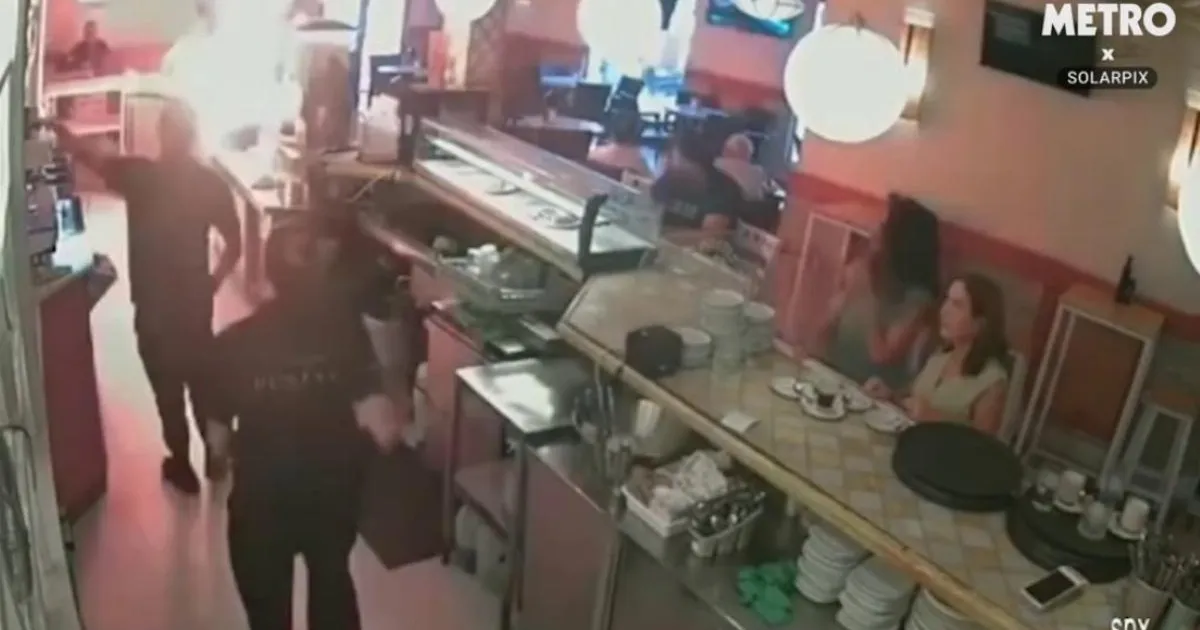
The CCTV footage from inside the cafe captures the terrifying sequence in chilling detail. Rafael can be seen strolling up to the bar counter with a relaxed, unhurried stride. There is none of the frantic energy that might be expected from someone on the verge of violence. He looks almost casual, like a man getting ready to place another order. In his hand, however, is something that will change everything. A lighter appears, and he brings it to a small object in his palm. The moment of ignition is sudden and shocking. Flames erupt upward, roaring into life, spreading quickly across the counter area and filling the space with thick, choking smoke. The video shows customers reacting in real time, their ordinary world transformed in an instant into a desperate scramble for safety. Young children, bewildered and frightened, are hurried toward the exits. Elderly people move as quickly as they can, their vulnerability painfully clear in those chaotic seconds. Chairs are knocked over, voices are raised, and the fire continues to grow. In the middle of it all, Rafael suddenly seems to realize that his own left hand has caught fire. The footage shows him trying to beat out the flames with his right hand, an almost absurd detail in the middle of the disaster he has caused. Then he turns and walks out of the building, leaving behind the panic, the destruction and the stunned victims. Watching that sequence, it is impossible not to think about how close the story came to being even worse. There were children in that room. There were elderly people. If the fire had spread differently, if the evacuation had been slower, if someone had tripped or been trapped, the outcome could have been tragic beyond measure.
Mercifully, the quick thinking of a staff member changed the course of events. Someone grabbed a fire extinguisher and fought the flames until they were brought under control. The cafe was not completely destroyed, but the damage was still extensive. Surfaces were scorched, fixtures were melted, and thick smoke stained the walls and ceiling. The owner, Jose Antonio Caballero, later estimated that repairs would cost somewhere between six and seven thousand pounds, a heavy burden for any small business, made even harder to bear by the sheer senselessness of the act. Caballero struggled to make sense of what had happened. He described the incident as “something surreal,” and his account of the moments before the fire shows just how irrational and sudden it all was. He explained that the waiters had told Rafael the same truth twice: the bar had no kitchen, the sandwiches were ready-made, and there were simply no sauces available. That should have been the end of the matter. Instead, Rafael left, bought the petrol, returned and approached the waiter one last time. “Are you sure there’s no mayonnaise?” he asked, and then, according to the owner, he did not give the waiter time to answer. The flames followed immediately. Caballero’s bewilderment is plain in every word he has said since. “There’s no explanation for what happened,” he admitted. “It was awful.” But his greatest concern was never the building or the money. It was the people who had been inside. “The important thing is that nobody was injured,” he said. “There were young children and elderly people around. Imagine if someone had been hurt.” That simple, human response cuts through the insanity of the story. The damage could be repaired and the money could be recovered, but the fear and the trauma of those customers and staff members cannot be undone by a check or a contractor. The owner’s relief that no one died or suffered physical harm is the one bright thread running through the whole dark event.
The legal case against Rafael moved through the courts with a mixture of seriousness and careful negotiation. Prosecutors initially sought an eleven-year prison sentence, reflecting the danger he had created by setting fire to a public place full of people. An eleven-year term would have sent a strong message about the gravity of such an act. But as so often happens in the justice system, the case ended in a plea bargain. Through his lawyer, Rafael reached an agreement that reduced his sentence to three and a half years in prison. Before the hearing at a court in Seville, he also paid more than €9,200, roughly £7,715, in compensation for the damage he had caused. That money no doubt helped to cover the costs of repairs, but it cannot erase the memory of that afternoon or the fear that still lingers in the minds of those who were there. Alongside the prison sentence, Rafael was handed a ten-year restraining order that forbids him from coming within five hundred metres of Las Postas Cafe-Bar. This order is meant to protect the owner, the staff and future customers from any repeat of his violent behaviour, and it stands as a lasting reminder that the consequences of his actions will follow him long after he is released. Rafael has been in custody since his arrest on August 20, 2025, and the time already served will be counted toward his eventual release date. For those who lived through the fire, the sentence may feel far too short. For a man who lost his freedom over a jar of mayonnaise, it is the direct result of a decision no one forced him to make. The justice system has tried to balance punishment, compensation and public safety, and in some ways it has succeeded. Yet the deeper questions remain unanswered. Why did this happen? What was going on inside Rafael’s mind? And what could have been done to stop it before the lighter was ever lit?
Perhaps the most unsettling part of the entire story is how small the original frustration was. A sandwich without mayonnaise is not a tragedy. It is not an injustice or an assault on a person’s dignity. It is a minor disappointment, the kind of thing that happens countless times every day in cafes and restaurants around the world. Most people accept it with a shrug, order something else, or simply choose to eat elsewhere. They do not buy petrol. They do not set fire to a room full of strangers. They do not risk the lives of children and elderly people because of a condiment. Rafael’s response was so wildly disproportionate that it forces anyone reading about it to confront the uncomfortable truth of human anger. Under the right pressures, even rational people can lose control. When frustration is allowed to build, when a person feels unheard or disrespected, a tiny trigger can grow into an explosion. That does not excuse what Rafael did, and nothing in this story should be read as an attempt to minimize the fear he caused. But it does point to a deeper and more troubling reality. Many people struggle with anger, impulse control and emotional distress in ways that they do not understand and cannot manage. Somewhere in Rafael’s life, there may have been warning signs. There may have been chances for someone to help him, to teach him a different way of responding to frustration, or to intervene before his emotions turned into violence. We do not know his personal history, and it would be unfair to invent one. What we do know is that a single moment of pure, pointless rage changed everything. It transformed a harmless customer into an arsonist, a peaceful cafe into a crime scene, and an ordinary afternoon into a memory that will haunt people for years. The cost of that rage is measured in prison time, compensation payments and ruined reputations, but the true cost is the loss of trust and the fear that now lives in a place that was once full of comfort and routine.
In the end, Las Postas Cafe-Bar is more than just the site of a crime. It is a gathering place, a small and human institution where people come to meet friends, share stories and enjoy the simple ritual of eating and drinking. It is a business, yes, but it is also a social anchor for the community. No fire can erase that entirely. The owner has made it clear that his deepest relief is that nobody was seriously hurt. The repairs will eventually be completed. The smoke will fade. The scent of coffee will fill the room once more, and the cafe will carry on serving the people who depend on it for a little bit of normalcy in their daily lives. But the memory of that afternoon will not fade so easily. The parents who grabbed their children and ran, the elderly customers who moved through the chaos as fast as their legs would carry them, the waiter who was asked about mayonnaise and then had to face a bottle of petrol—all of them will carry something from that day. There is a lesson in this strange and terrible story, if we are willing to receive it. It reminds us how fragile our peaceful routines really are. It reminds us that the person behind the counter is just a person, doing a job, trying to get through the day like everyone else. It reminds us that anger, left unchecked, can destroy not only the person who feels it but everyone standing nearby. The absence of mayonnaise should never be an emergency. A sandwich without sauce is still a sandwich. But a life touched by violence and fear is something else entirely. If there is any hope to be found in the aftermath of this awful event, it is in the simple fact that no one died, that the community held together, and that one man’s terrible decision will not define the place he tried to burn. It will be remembered, but it will not be the last word. The cafe will open again, the people will return, and the ordinary afternoons that once seemed so unremarkable will feel, at last, like the precious things they always were.