



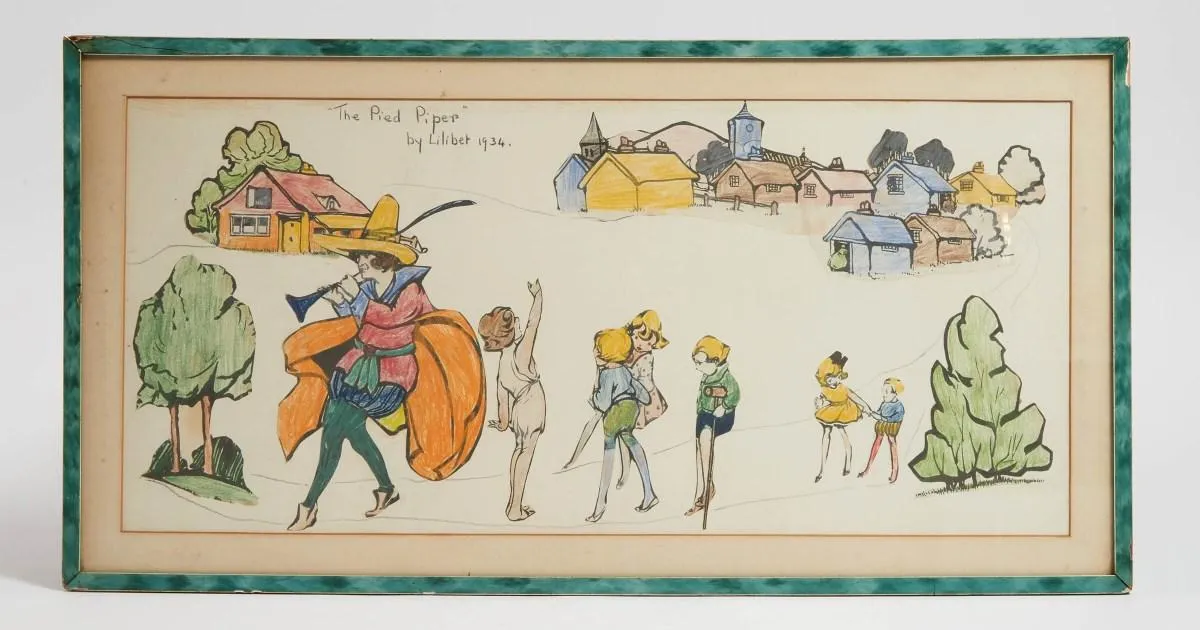
In royal circles, the objects that survive tend to be grand: tiaras, ceremonial swords, state portraits, and glittering gowns. There is something almost startling, then, about a small, brightly coloured paper collage made by a little girl with a pair of scissors and a pot of glue. That little girl happened to be Princess Elizabeth of York, the future Queen Elizabeth II. The collage, created at Christmas in 1934, when she was eight years old, depicts a scene from the legend of the Pied Piper of Hamelin. It has emerged for sale for £6,000 at Waddingtons, a Canadian auction house in Toronto, and it is causing a quiet ripple of excitement among royal collectors, historians, and anyone who simply loves the idea of a queen with a crayon in her hand. The humble materials—paper, cardboard, a careful hand—stand in sharp contrast to the weight of the life that followed. Here is a relic not of state but of childhood. It shows the child who would one day become the longest-reigning British monarch, sitting at a table, tongue perhaps slightly out, absorbed in the simple pleasure of colouring. It is a reminder that before the crown, before the palaces, before the endless public duties and solemn ceremonial roles, there was a girl named Lilibet who simply liked to make things. In an age of carefully managed royal imagery, such an unpolished, unposed, and unguarded artefact feels like a small miracle. It pulls aside the velvet curtain of history and lets us see the future queen not as a bronze statue, but as a child with scissors, glue, and a vision of a fairy tale.
The artwork itself deserves a slow look. It shows the Pied Piper—the mysterious figure who, according to German folklore, led the rats out of Hamelin and later, when cheated of his payment, spirited away the town’s children. In the young princess’s version, the Piper strides along in a charming 1930s storybook style, dressed in a colourful tunic and cap. Behind him trail a row of children, their outlines simple, their faces featureless but full of character. Around them are trees and houses, all drawn by another hand and left for the child to fill in with colour. Elizabeth did so carefully, choosing each crayon with the seriousness of a young artist. She then cut out every figure, every tree, and every house, and arranged them on a larger sheet of paper, creating her own little stage. The result is a handmade diorama, full of the sincere effort that only children can bring to crafts. There is a rustic, innocent charm to it, far removed from the polished illustrations in a published book. Beneath the scene, she signed it “Lillibet”—the affectionate nickname that endured for her entire life, the same name she had used as a baby before she could pronounce “Elizabeth” properly. On the back, her mother, then the Duchess of York, later known as the Queen Mother, labelled it in her own hand: “Painted by Princess Elizabeth of York, Xmas 1934.” The inscription begins with “Eliz”—the beginnings of “Elizabeth”—and is then scratched out, replaced with the more formal title. Why did she correct it? Perhaps she wanted to preserve the record for posterity. Perhaps she simply wanted to be precise. That tiny crossed-out line gives us a jolt of tenderness: a young mother, maybe sitting at a desk after Christmas lunch, carefully fixing the label on her daughter’s little masterpiece. It is a moment frozen in time, both formal and deeply affectionate, and it makes the object feel less like a royal heirloom and more like a family keepsake.
The journey of this collage from royal nursery to auction room is just as intriguing as the artwork itself. For nearly two decades, it stayed within the royal family, a private treasure kept by the Queen Mother. Then, in the 1950s, it was gifted by an unknown member of the Royal Household to James Ryan, who worked for Bishop’s Move, a removals company frequently employed at the palace. The gift may have been a gesture of gratitude, or perhaps a friendly memento from someone who had watched the young princess grow and knew that the family would treasure the connection. Ryan kept it, and the collage eventually passed into a private collection. Now it is being offered for sale by Waddingtons in Toronto, with the specialist Sean Quinn clearly charmed by the piece. He said: “The picture, done at such a young age, was a gift from a member of the Buckingham Palace household in the 1950s to James Ryan, who worked for a company (Bishop’s Move) frequently employed at the palace. It is a charming reminder that our much revered Queen Elizabeth II was once a little girl called Lilibet who liked to colour.” He added that works by Her Majesty are rare, and that he had high hopes for the auction. The asking price of £6,000 might seem modest for a royal artefact, but in the world of royal memorabilia, especially with such a personal item, interest can be fierce. The collage comes with a clear provenance, which adds to its credibility and monetary value, but its true worth is emotional: a small, almost fragile object that carries the weight of history on its cardboard back.
This is not the first time that royal childhood art has appeared at auction, but it remains exceptionally rare. The Queen grew up in a world where few people had access to her beyond her close family, and most personal mementoes were kept in private archives, out of public view. Over the years, a handful of charming exceptions have emerged, each one fetching high prices and generating enormous public interest. These artefacts have a special cultural power because they humanize a figure who was, by necessity, almost otherworldly. The young Elizabeth and her sister Margaret were not, however, particularly known for drawing. Their interests were theatrical. The two princesses loved performing, and during the Second World War they staged a series of royal pantomimes at Windsor Castle to boost morale. They learned lines, helped with costumes, and performed before the royal household and the children of estate workers. It was a way of bringing joy and normalcy to a court living under the shadow of war. The little girl who had once carefully cut out paper figures for her Pied Piper scene had grown into a young performer, using her imagination to lift the spirits of those around her. This early creativity did not translate into a lifelong artistic practice, at least not in public. But it did speak to a deeply felt emotional intelligence and a sense of duty wrapped in play. The collage, when viewed in that light, is not an isolated curiosity. It is a first step in a lifelong habit of using small, thoughtful gestures to connect with others—a habit that would later express itself in handwritten letters, a nod of approval, and a quiet, reassuring presence in times of national grief.
The artistic thread in the royal family, however, did not vanish. The Queen’s son, King Charles III, is a passionate and accomplished watercolour landscape painter. For decades, he has painted the landscapes of the British Isles, from the rolling hills of Balmoral to the gardens of Highgrove. His works have been exhibited, reproduced, and sold to support charitable causes. There is something deeply personal and contemplative about them, a quiet lyricism that is very different from the bright, flat shapes of his mother’s childhood collage. Yet both suggest a need to process the world through close observation and careful recreation—to pause, to look, and to shape anew on paper. The Queen’s later life was famously dominated by two loves: horses and corgis. She was a knowledgeable and passionate horsewoman, attending races, breeding animals, and finding a sense of freedom in the countryside. Her corgis were constant companions, a warm, doggy presence in the corridors of power. Drawing and painting, however, belonged to her childhood. Maybe she never had time to pursue them, or perhaps she simply preferred other forms of expression. But it is pleasing to think that the eight-year-old who clipped out the Pied Piper and his children was tapping into something that would reappear in the next generation. Royal succession is usually discussed in terms of thrones, crowns, and legal powers. Here is a more tender inheritance: a splash of watercolour, a crayon line, a child’s urge to make something beautiful. The collage, then, is not just a relic of Elizabeth’s life; it is a bridge to her son and to a quiet, creative vein in the House of Windsor.
Art experts who have examined the collage have been struck by the child’s skill. Dominic Shepherd, associate professor at Arts University Bournemouth, observed: “It does look extremely competent for an eight-year-old. It is a very 1930s aesthetic of the Pied Piper, and she was good at not going over the lines.” That phrase—good at not going over the lines—could almost serve as a metaphor for the Queen’s entire adult life. She followed protocol, respected boundaries, and never stepped out of the role she was born into. Yet there is a larger, slightly melancholic thought in that simple observation. The little girl who was so careful with her crayons would grow into a woman who had to be careful with her words, her gestures, and her very expressions. The collage was a moment of complete freedom, before the great weight of becoming queen began. It is also a reminder that every person, no matter how elevated, begins as a child. The Queen’s death in 2022 prompted an extraordinary outpouring of grief around the world, in part because she had been a constant presence in the lives of so many. This little piece of paper, preserved by chance and kept by strangers, makes that constancy feel more human. It is not £6,000 worth of paper in any rational sense. But as a relic of a lost royal childhood, as a witness to a mother’s love and a daughter’s creativity, it is priceless. The sale at Waddingtons will likely attract attention from collectors who want to own a fragment of royal history. But its true value, for the rest of us, is to remind everyone that history is not made only of grand events and state occasions. Sometimes it is made of a little girl called Lilibet, sitting at a table at Christmas, colouring in the Pied Piper with all the seriousness of a young artist, completely unaware that the world would one day be watching.