

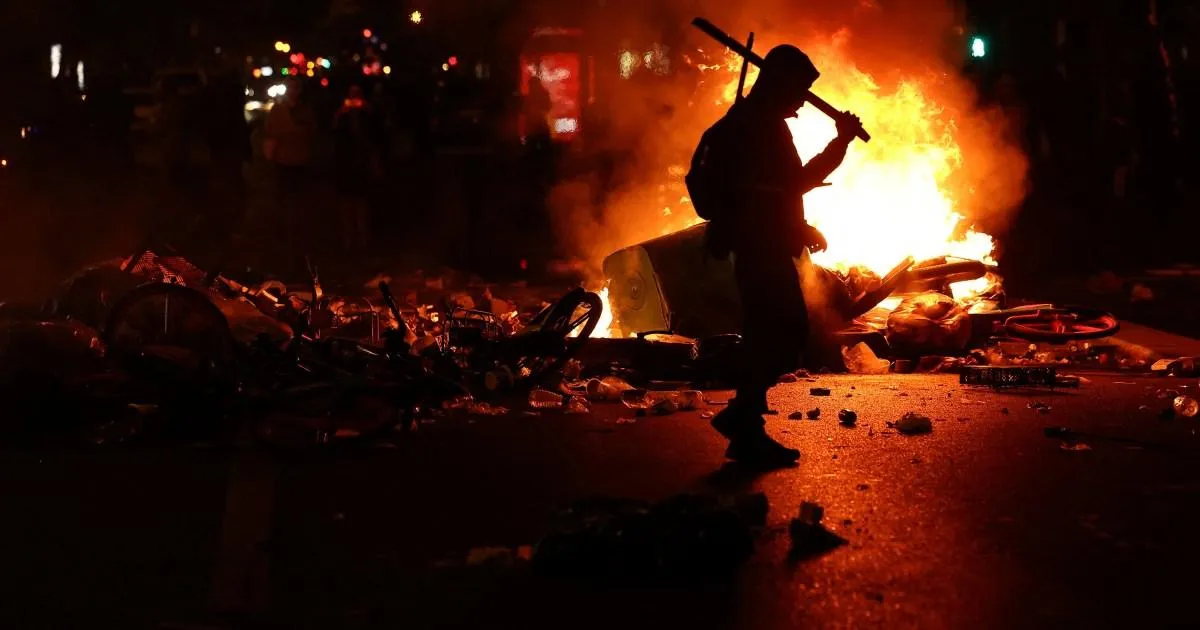
The sirens have fallen silent, at least for now, but the tension in France remains as thick as the smoke that still lingers over streets once filled with angry crowds. After days of unrelenting chaos, new curfews have brought a fragile and uneasy calm to cities across the country, and French police are bracing themselves for yet another wave of violence. Overnight, Paris and Marseille were described as “calm” by Prime Minister Sébastien Lecornu, a word that felt almost foreign after the apocalyptic scenes that had unfolded only hours earlier. Yet the morning light revealed the true cost of the unrest: buildings reduced to charred shells, shopfronts smashed and gutted, statues toppled from their pedestals, and beloved landmarks locked down behind barricades and security cordons. The images are jarring, not just because of the destruction itself, but because they show a country so often associated with beauty, culture, and elegance now struggling to recognize itself in the mirror. France has seen protests before, of course, but this feels different, deeper, more personal. There is a collective sense of disbelief among ordinary citizens, who wake up each day to new photographs of neighborhoods they know and love transformed into battlefields. The curfews have helped, at least in the short term, but no one is pretending the danger has passed. The calm is real, yet it is also fragile, and everyone from government officials to local shopkeepers knows that one spark could set the country ablaze again. As police officers take up their positions on street corners and armored vehicles wait in side streets, the question on everyone’s mind is not whether the chaos will return, but when, and where, and how fierce it will be this time.
Tonight, all eyes turn to the Parc des Princes, where Paris Saint-Germain is set to face Barcelona in a European Champions League match that was supposed to be a celebration of sport and unity. Instead, it has become another flashpoint, another reason for authorities to hold their breath. Officials are seriously considering introducing a curfew around the stadium, hoping to prevent the kind of mass gatherings that have proved so combustible in recent days. If the curfew does not go ahead, a ring of steel will be thrown around the area, with as many as five thousand riot police on duty, supported by armored cars and water cannons. An Interior Ministry source did not mince words, calling this “a hugely sensitive time, with violence likely to break out at any time, especially when large crowds gather.” Thousands of extra officers, including special forces, will be deployed, not just to protect the match itself but to send a message that the authorities are prepared. Yet there is something deeply unsettling about the idea of a football match, a game that brings people together across languages and borders, becoming the potential trigger for further destruction. The stadium, once a place of joy and passion, now sits at the center of a security operation more suited to a war zone. Fans hoping to enjoy the game will find themselves surrounded by checkpoints, pat-downs, and the constant presence of heavily armed police. It is a stark reminder that the unrest has touched every corner of French life, even the moments that were meant to offer escape. The government is walking a tightrope, trying to allow life to continue while preventing the crowds from becoming a powder keg. And beneath the surface, there is a quiet fear that the match, broadcast around the world, could become the backdrop for yet another night of burning cars and broken glass.
For President Emmanuel Macron, the past few days have been a test of leadership unlike any he has faced before. Standing before the cameras, his voice heavy with emotion, he blamed “agitators from far-Left fringe groups, joined by numerous criminals” for plunging the country into what he called “unbridled violence.” It was a speech filled with frustration, anger, and a plea for unity that seemed to hang in the air unanswered. He spoke of businesses looted, public buildings attacked, and town halls defaced, and he asked the question that so many French people were already asking themselves: “Looking at these images, we have all asked ourselves how French people could do this to France.” His words were particularly pointed when he described the burning of Limoges City Hall, the destruction of a tourist office in Lyon, the sacking of Marseille city hall, and the attack on the Prefect’s Residence in Bordeaux. These were not just buildings, he seemed to say; they were symbols of the republic, of the institutions that hold society together. “Nothing justifies it, nothing explains it, nothing excuses it,” he declared, drawing a line in the sand. But even as he spoke, there was a sense that the president was addressing not just the rioters, but a nation that has become deeply fractured. The violence, he suggested, was not a spontaneous eruption but something more organized, more deliberate, fueled by extremists who had hijacked the legitimate frustrations of students and workers. His appeal for unity felt sincere, but it also felt fragile, a hope rather than a solution. For many ordinary French citizens, Macron’s words were comforting, a reminder that the state still stood, that the chaos had not broken the country’s spirit. For others, they were too little, too late, a speech that addressed the symptoms while ignoring the deeper wounds that had been festering for years.
Behind the political rhetoric lies a more uncomfortable truth, one that French police officers have admitted with startling honesty. During the worst of the rioting, law enforcement did not just struggle; they were overwhelmed, caught off guard by the scale and coordination of the attacks. “It was apocalyptic,” said one high-ranking officer. “Law enforcement was unable to contain the multitude of simultaneous attacks occurring across the country, and was quickly overwhelmed by determined protesters.” These are not the words of a force that feels in control; they are the words of men and women who watched their cities slip away from them in real time. The admission is significant, because it suggests that the unrest was not a random series of incidents but a coordinated assault on public order, designed to stretch resources thin and exploit weaknesses. It also raises difficult questions about how prepared France truly is for the challenges ahead. The protests themselves began nearly five weeks ago, sparked by school and university students who took to the streets to demand change in a crumbling education system. What started as a movement with clear grievances has morphed into something far more chaotic, drawing in criminals, extremists, and opportunists who saw an opening to loot, burn, and destroy. The original message has become blurred, drowned out by the sound of breaking glass and the crackle of flames. But the underlying frustrations have not disappeared. Students still face overcrowded classrooms, underpaid teachers, and a system that feels abandoned by the state. Their anger is real, even if it has been hijacked by those who seek only destruction. The challenge for France is not simply to restore order, but to listen to the voices that started it all, to address the inequalities and neglect that made the streets so combustible in the first place.
What makes this moment so heartbreaking is the human toll that statistics and headlines often fail to capture. Behind every burned building is a shopkeeper who spent years building a dream, only to watch it go up in smoke. Behind every damaged monument is a community that loses a piece of its shared history. The students who started the protests are not faceless agitators; they are young people with hopes, fears, and legitimate frustrations about their future. The police officers on the front lines are not robots; they are exhausted, scared, and caught between their duty to protect and their own safety. And the ordinary families waking up to streets filled with debris are not spectators; they are victims of a conflict that has upended their lives. There is a profound sadness in watching a country turn against itself, in seeing neighbors who once shared cafés and markets now eyeing each other with suspicion. The destruction of Limoges City Hall, a building that stood as a testament to local pride and civic life, feels like a personal loss to the people who gathered there for weddings, meetings, and community events. The tourist office in Lyon, once a welcoming gateway for visitors, is now a memory. These are not just statistics; they are places where people laughed, celebrated, and connected. The unrest has left scars that will take years to heal, not just in the physical damage but in the emotional fabric of the nation. It has forced France to confront uncomfortable truths about inequality, alienation, and the fraying of social bonds. It has also reminded us that chaos is not an abstract concept; it is lived, breathed, and felt by real people, often long after the cameras have moved on.
As France braces for what comes next, there is a sense of holding one’s breath. Tonight’s match at the Parc des Princes will be played under the watchful eyes of thousands of police officers, a symbol of both resilience and fear. The curfews may hold, the ring of steel may contain the violence, and the country may take another step toward normalcy. But the deeper questions remain unanswered. How did France, a nation that prides itself on liberty, equality, and fraternity, reach a point where its own citizens would burn its symbols and attack its institutions? What will it take to bridge the gap between those who feel left behind and those who hold power? The protests may be about education, but they are also about dignity, opportunity, and the belief that the future holds something better. Until those issues are addressed, the calm will remain fragile, and the possibility of another eruption will loom over every public gathering. The world is watching, not just to see if Paris can host a football match safely, but to see whether France can find a way to heal itself. It will not be easy. It will require humility from leaders, empathy from all sides, and a willingness to confront uncomfortable truths. But if the country can channel the passion that has filled its streets into constructive dialogue rather than destruction, there is hope. The smoke will clear, the debris will be swept away, and the buildings will be rebuilt. The harder task is rebuilding trust, understanding, and the shared sense of belonging that has been so badly shaken. For now, all France can do is wait, watch, and hope that the night passes peacefully, and that tomorrow brings not more anger, but the beginning of a long and difficult conversation about what kind of nation it wants to be.