

Every parent’s worst nightmare begins in the middle of an ordinary day. In Fujian, southern China, on a Saturday that should have been like any other, a three-year-old girl dressed in pink pyjamas slipped through the protective grill on the window of her family’s 12th-floor apartment. The grill was supposed to keep her safe, a simple barrier between a curious child and the open air. But small bodies can wriggle through gaps that seem impossible, and in a single terrifying moment, the little girl found herself stuck: her head caught in the metal screen, her body dangling far above the ground. She was held only by her head, in a position that no child, no human, is designed to endure. Below her stretched the hard pavement of the street, and above her the window of a home that had suddenly become a place of danger. The footage of the scene is almost unbearable to watch, not only because of the height, but because of the stillness of the tiny pink figure suspended between life and death. It was later reported that her mother had stepped out to buy food, leaving the little girl alone for a short while. It is an ordinary decision, the kind made every day by millions of parents, and it only took a moment for something unspeakable to become possible. How long she hung there is not entirely clear, but to the people who looked up and saw her, time must have stopped. A child’s cry, a neighbour’s glance, a scream that cut through the quiet—somewhere in that normal afternoon, the community was suddenly wide awake. They did not stop to wonder who would blame them or whether they were allowed to act. They simply moved, because every second counted and because nobody could wait for help to arrive.
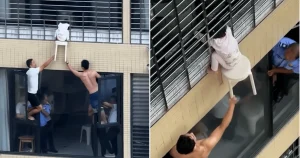
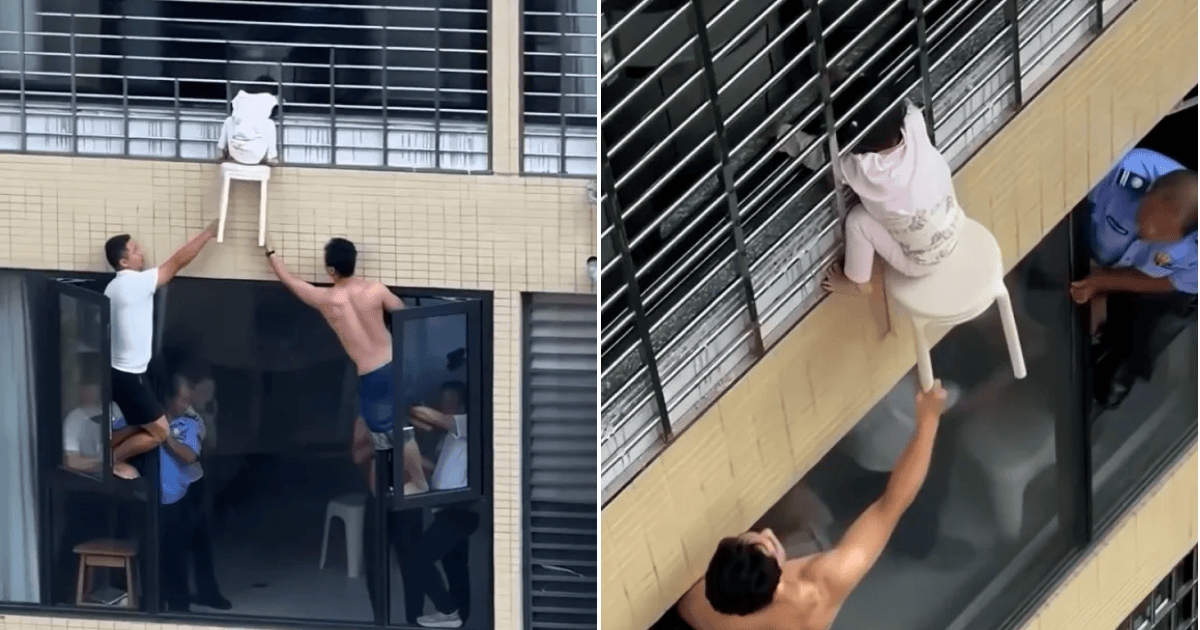
The rescue that followed was not carried out by firefighters or trained professionals, at least not at first. It was carried out by ordinary people: a security guard, neighbours, and probably parents themselves, who looked up and recognised the face of a child in danger. In the footage, they can be seen balancing a chair underneath the girl, desperately trying to take the weight off her neck and head. A child’s head is not designed to support the whole body in such a position. Every second matters, and every ounce of pressure on her neck was a threat to her life. The chair was not a perfect solution—it could not lift her back through the window—but it offered a small support, a few precious moments of less strain, while rescue crews raced to the building. Meanwhile, other bystanders risked their own lives by leaning out of the window directly below the girl. They stretched their arms upward, trying to get closer, ready to catch her if she slipped. They were held by the legs by neighbours behind them, forming a human chain of trust and courage. In that moment, the line between hero and victim disappeared. They were all vulnerable together, but they were not helpless. Their hands were outstretched, not in prayer but in action. The chair shook; arms burned; hearts pounded. The wind pulled at their clothes, and the height made their heads spin, but they did not let go. They knew that a little girl’s life was hanging on their willingness to hold on, to reach further, to stay steady. There was no time to think about what might happen to them if the child fell and pulled them off balance. There was only the child, and the instinct that told them to do everything they could.
While the bystanders held the impossible, the official rescue machinery was already in motion. Firefighters arrived at the building and had to break through the locked door of the 12th-floor apartment. There was no time to wait for a key, no time to negotiate with the lock. With tools and sheer determination, they cut through the door, entered the home, and reached the window from the inside. It was a race against gravity, against the slow weakening of every muscle holding the child, against the chance of a sudden slip. The footage shows the coordinated effort: the crew working quickly, speaking calmly, ensuring that the little girl would not be pulled or pushed in a way that would hurt her. They knew that her head and neck were in a fragile position, and that one wrong move could turn a miracle into a tragedy. Finally, they managed to free her and bring her back through the window, safe inside the apartment. The relief that must have swept through the crowd below is impossible to describe. The girl was taken to hospital as a precaution, but she was unhurt. That word—unhurt—is almost impossible to believe after such a fall, but it was true. A child who had been seconds away from disaster was going to be okay. In the aftermath, the emotions that had been held back came flooding out: tears, laughter, trembling hands, and probably a lot of prayers of thanks. For the mother who returned from shopping to find a crowd and emergency lights, the feeling can only be imagined. It is not difficult to imagine the guilt, the horror, and the overwhelming gratitude. There are no words for the kind of relief she must have felt when she learned that her daughter had survived, not because of luck alone, but because strangers had chosen to stand in the gap between life and death.
These stories never fail to move us because they show the best of human nature in the worst of circumstances. There were no cameras-ready heroics, no time to calculate risk, no thought of reward. The security guard and neighbours who supported the little girl did not have safety harnesses or professional training. They were simply people who refused to stand by while a child fell. The image of a chair balanced precariously on a windowsill, with hands reaching out from below and legs being held by other hands, is a mosaic of human solidarity. Each person had a small role: one to fetch a chair, one to hold a leg, one to call emergency services, one to shout instructions, one to pray. Together, they created a safety net not made of rope but of will. The fact that they were on the 12th floor makes their courage even more astonishing. They had to look down at the dizzying height, feel the wind, and still lean out. They did it because they knew that if the little girl slipped, their hands might be the last chance she had. Even if they could not catch her perfectly, they were determined to try. This is not the kind of heroism we see in movies, with capes and special effects. It is the kind that happens in real life, when ordinary people are suddenly forced to become extraordinary. It is the kind that leaves them shaking afterwards, unable to explain why they did what they did, except to say that it was the only thing to do. It is the kind that reminds us that human beings are more than just individuals passing each other in the street. We are connected, even when we do not know each other’s names.
Across the world, similar moments have unfolded, reminding us that this instinct is universal. In Ilford High Street, east London, a young girl also found herself in danger after dangling from a window ledge for at least nine minutes. The three-year-old had somehow climbed out and was clinging to the ledge above a row of shops. Below, a police officer and a stranger positioned themselves to catch her, while onlookers screamed in horror. One voice yelled “hurry up,” capturing the frantic urgency of everyone watching. When the little girl finally lost her grip and fell, she was caught by a man who had run out from a neighbouring window. He later gave his name as Mohamed Jesil, a dad-of-two, and explained that he had acted “on instinct” after hearing the shouting outside. He didn’t think, he didn’t weigh the risks; he just moved. That is the same instinct that drove the neighbours in Fujian to reach out into the open air, and the same instinct that makes complete strangers risk their own lives for a child they have never met. It is not something that can be taught in a training course. It is something already inside us, buried under daily routine, but ready to surface when a life is on the line. These two incidents, thousands of miles apart, tell the same story: when danger strikes, people run toward it, not away. They hear a cry, they see a small shape in the air, and something ancient and powerful takes over. It does not matter what language they speak or what country they live in. The response is the same. A chair, a pair of hands, a human body used as a cushion—these are not tools. They are the expressions of love that refuses to look away.
Of course, amid the celebration of heroism, there is a quieter lesson. Both little girls were left unsupervised near open windows, and both were lucky enough to survive because someone was there. The mother in Fujian had stepped out to buy food, perhaps only for a few minutes. The parents of the London girl may have blinked for a moment. None of these people are monsters; they are ordinary people who made a decision that could have ended in tragedy. The human response to their mistakes should be compassion, not cruelty. We can use these stories not to shame but to remind ourselves how quickly accidents happen and how important it is to take precautions: secure window guards, teach children about danger, check locks, and never assume that a screen is strong enough to hold. But we should also remember that safety cannot be guaranteed by rules alone. The reason the Fujian girl survived is that her community refused to look away. The reason the London girl survived is that a stranger heard shouting and ran. In a world that often feels divided, these moments of rescue are beautiful proof of connection. They remind us that we are not alone, that a neighbour’s eyes can be our own, and that sometimes the most heroic thing a person can do is simply hold on—to a chair, to a leg, to a child, to hope. We owe these ordinary heroes our gratitude, and we owe the children a safer world. We also owe ourselves the reminder that heroism is not reserved for the brave and the trained. It lives in every parent, every neighbour, every passerby who chooses to act when the moment arrives. The little girl in pink pyjamas went home that day, hurt only by fear and saved by love. And the rest of us are left with a story that asks a simple question: would we have been the ones to hold the chair, to reach out, to catch? We hope so. We pray so. And perhaps, in the end, that hope is the greatest gift of all.