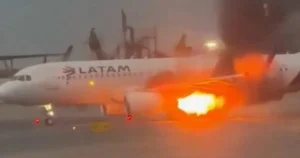


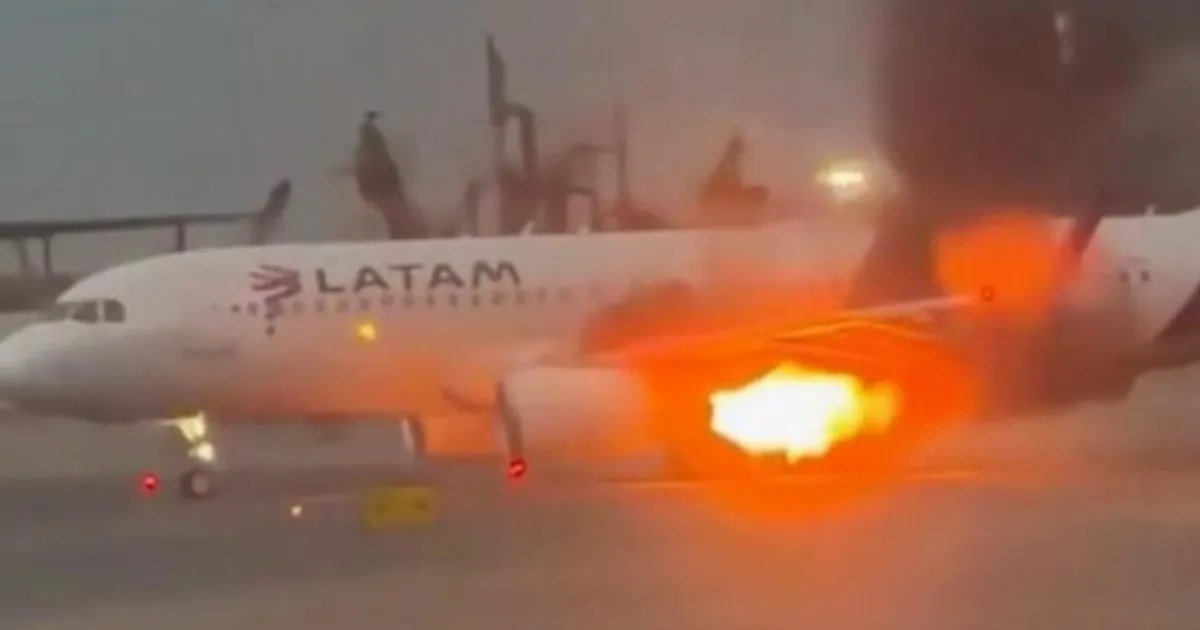
A journey that should have been nothing more than a short hop between two Peruvian cities turned into a heart-stopping ordeal in a matter of seconds. Passengers aboard Latam Airlines flight from Lima to Piura were settling into their seats, perhaps thinking about the meetings, family visits, or quiet weekends awaiting them, when the familiar hum of the Airbus A320 suddenly became something far more sinister. The aircraft was preparing to take off when flames gushed violently from its left engine, transforming the powerful machine into a terrifying fountain of orange fire and thick, choking smoke. One passenger, looking out through the cabin window, captured the scene on video: huge tongues of flame billowing against the glass, while dark smoke flared upward and pressed against the plane’s side. It was the kind of moment that every traveler fears, when the ordinary assumptions of safe, routine flight are shattered and the only thought is getting out alive. Emergency crews responded quickly, and passengers were evacuated from the jet without reported injuries. The footage, shared on social media, shows the engine spitting flame like a flamethrower, a deeply unsettling image of an aircraft designed to fly passenger jets suddenly behaving like a fire-breathing dragon on the tarmac. For those on board, the sight of those flames must have been accompanied by a surge of adrenaline, a desperate hope that the crew would open the doors and guide them to safety. The fact that everyone walked away is a testament to the professionalism of the cabin crew and the effectiveness of emergency procedures, but the mental image of an engine fire before takeoff will not fade easily for the people who lived it.
The airline later described the event in characteristically measured terms, saying that the plane experienced an “unexpected technical event” before departure, as reported by Air Data News. That phrase, while technically accurate, does little to convey the raw terror of watching fire consume part of the aircraft. Latam confirmed that all passengers disembarked as a precaution and stressed that their safety remained the top priority, as all airlines do in such moments. The cause of the fire has not been revealed, leaving investigators and the public with questions: Was it a mechanical fault, a bird strike, a fuel leak, or something else? In the absence of answers, passengers were left with only their experience and the reassurance that they were out on the tarmac, breathing fresh air and watching emergency teams do their work. The airline said that those affected were given assistance, including booking them on the next available flights to their destination. There is something almost absurd about that gesture—after such a brush with disaster, being offered a seat on another plane requires a certain amount of courage, or perhaps resignation, as travelers are expected to climb back into the sky and continue on their way. Yet it is also a reminder of how the aviation industry operates: incidents happen, investigations begin, safety protocols are followed, and the show must go on. The video of the engine fire circulated widely, drawing comments from anxious frequent flyers and aviation enthusiasts alike, all of them united by a common understanding that no amount of technological sophistication can ever make the sight of flames on an aircraft familiar or acceptable.
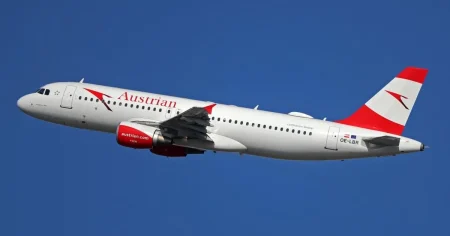
These kinds of incidents, though frightening, are rare, but they do not happen in isolation. On the same day or around the same period, another flight was dealing with its own emergency thousands of miles away. An Austrian Airlines flight, OS82, travelling from Tel Aviv to Austria, declared a mid-air emergency while flying over Romania after a suspected bomb threat. The crew made the difficult decision to divert to Sofia, Bulgaria, forcing the aircraft to land far from its intended destination and thrusting passengers into a sudden, unplanned stop in a foreign city. For the people on that plane, the announcement must have been chilling: the word “emergency,” the change in flight path, the presence of security personnel, and the long, uncertain wait that usually follows such threats. Bomb threats on commercial flights are taken with absolute seriousness, and every diversion is a carefully considered response to an unacceptable risk. While the suspected threat turned out to be a precautionary drama rather than a confirmed device, the psychological toll on passengers is no less real. They were forced to confront the possibility that their flight had become a target, that the ordinary act of traveling could be interrupted by something invisible and sinister. The crew, trained to handle such situations, likely kept their voices calm and their instructions clear, but the passengers’ hearts must have raced as the plane descended into Sofia, unsure of what they would find on the ground. That a suspected bomb threat can be handled so quietly and efficiently is a credit to the systems in place, but it also serves as a stark reminder of the threats that remain part of modern air travel.
Even more dramatic was an incident that occurred weeks earlier, involving a Flydubai flight and a hero whose name deserves to be remembered. Captain Smit Machchhar was hailed as a hero after foiling a hijack attempt that began with an attack on his co-pilot. According to reports, co-pilot Hammam al-Hammami allegedly attempted to hijack and crash the jet, but Captain Machchhar, despite being seriously injured in the attack, managed to reach the cockpit doorknob and open the door, allowing passengers to rush in and subdue the would-be hijacker. The scene must have been chaotic beyond imagination: passengers, suddenly aware that their flight was in danger, leaving their seats and forcing their way into the cockpit, not knowing whether they were preventing a disaster or walking into one. Captain Machchhar’s actions, carried out while wounded, embody the kind of selfless courage that we rarely associate with airline pilots. They are trained to land safely, to communicate calmly with air traffic control, to make split-second decisions in emergencies, but no training can fully prepare someone for betrayal by a colleague and an active struggle over the controls of an aircraft. He did not hesitate to put himself between his assailant and the lives of everyone on board. His injury was real and serious, but he continued to act, reaching for the door, making it possible for passengers to intervene. The passengers who rushed into the cockpit also deserve recognition: ordinary people, untrained in security procedures, who responded to a perilous situation with instinctive bravery. Together, they averted what could have been another catastrophic aviation tragedy, and their story is a powerful reminder of how human courage often emerges in the most desperate circumstances.
These events, separated by time and geography, share a common thread: they are moments when ordinary people are forced to confront extraordinary fear. On the Latam flight, the fear was a fire that could have spread or led to an explosion; on the Austrian flight, it was the invisible threat of a bomb; on the Flydubai flight, it was the unimaginable nightmare of a pilot turned traitor. In each case, the outcome could have been devastating, yet the people involved managed to walk away, to tell the story, to continue their lives. That is partly due to luck, but it is also due to preparation, teamwork, and the quiet professionalism of crews who train for emergencies they hope never to face. It is easy to board a plane and ignore the safety demonstration, to stare at a phone or a book while a flight attendant explains how to fasten a seatbelt and locate the nearest exit. But these are not just bureaucratic formalities; they are the building blocks of survival. When flames appear, when a threat is announced, when a cockpit door is forced open, the difference between chaos and order often comes down to the simple, repeated instructions that passengers have heard a hundred times. The human spirit is resilient, but it is also fragile, and moments like these remind us that we are never truly in complete control of the machines we fly in or the people who fly them. They also remind us of the importance of compassion: airlines must care for passengers after such ordeals, not just with vouchers and rebooking, but with genuine understanding of the emotional scars that may linger.
In the end, what remains after the engines are inspected, the bomb threats are cleared, and the hijack attempts are investigated is a deep, shared appreciation for the value of safety and the courage of individuals. For the passengers on the Latam flight, the image of those flames will likely remain burned into their memories, a stark counterpoint to the banality of airline travel. For those on the Austrian flight, the diversion to Sofia will become a story to tell, a moment when a routine journey became an international drama. For the passengers and crew of the Flydubai flight, the heroism of Captain Smit Machchhar will be remembered as proof that one person’s bravery can save many lives. These incidents also serve as a broader warning: aviation is a complex, high-stakes environment where mistakes and malfunctions can have catastrophic consequences. But they are also reminders that the system, for all its imperfections, is built on layers of redundancy and vigilance. The engine fire in Peru is being investigated, the bomb threat in Europe is being assessed, and the hijack attempt has already led to arrests and questions. Yet through it all, the basic truth of air travel remains: there is always risk, but there is also always hope. As passengers board the next flight, whether from Lima or Tel Aviv or Dubai, they carry with them the examples of those who faced danger and survived. The skies may occasionally be terrifying, but they are still traversed by ordinary people who, when put to the test, find within themselves extraordinary strength. And for every engine that sputters, every threat that is called in, every cockpit that is attacked, there are countless flights that take off and land without incident, carrying dreams and stories and reunions. The goal is to make those safe journeys the only thing anyone ever has to think about, and to learn from the moments when that dream is shattered, so that the next flight can be even safer than the last.