


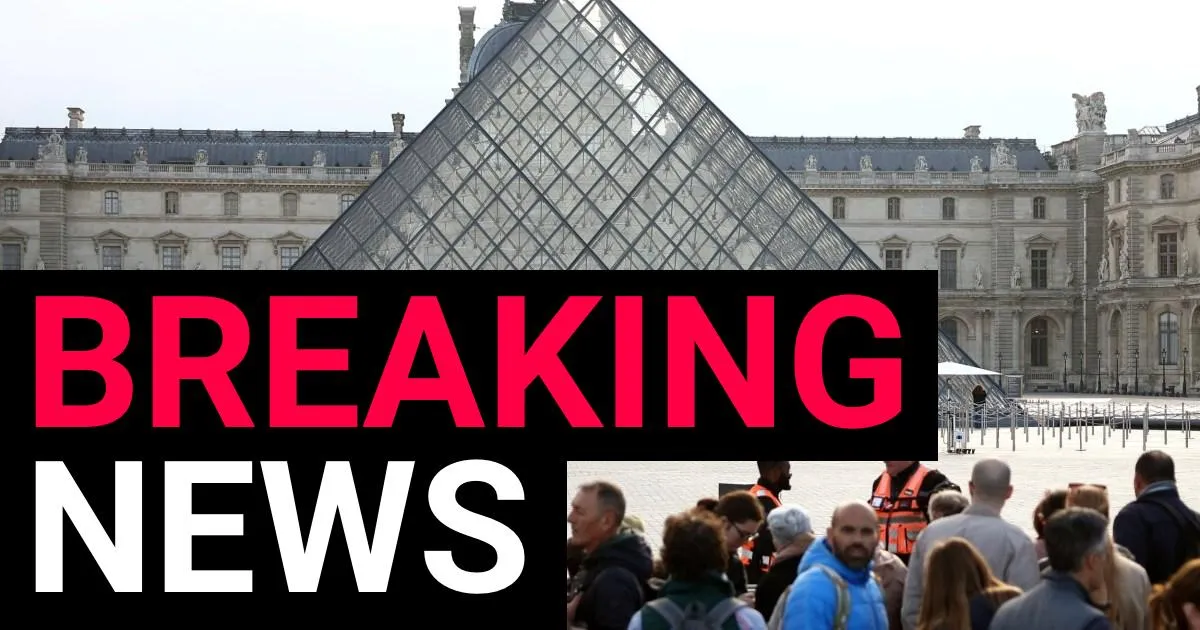
On a grey morning in Paris, the glass pyramid at the Louvre became something no one expected: the backdrop for a protest. A small crowd gathered at the museum’s main entrance, the same spot where millions of tourists line up each year to see the Mona Lisa and the winged victories of antiquity. But these visitors were not carrying guidebooks. They were carrying banners. One, written in English, read: “French public services are falling apart” — a message aimed as much at the world as at the French government. The scene was strangely quiet. There were no smashed windows or burning cars outside the museum, at least not in the images that circulated across the globe. Instead, there was a human wall of frustration. The Louvre, one of France’s biggest tourist attractions, is also one of its most powerful symbols. By blocking access to it, protesters were not trying to destroy anything; they were trying to be seen. They wanted the same visibility that a famous painting receives, even if just for a moment. To stand there, in front of the pyramid, was to occupy sacred ground in a country that values art and reason. It was also to remind everyone that France’s most beautiful spaces belong to all its people, including those who feel abandoned. Tourists stood off to the side, some filming, some frowning. A few tried to ask questions, but language barriers and emotions made answers difficult. The protesters themselves were not a monolith. Some were high school students, wearing backpacks. Others were older, with tired faces and worn coats. They shared one thing: a conviction that ordinary people need to be heard. The museum’s iron gates became a line between two Frances — the France of world heritage and the France of unmet needs. For an hour or more, the two faced each other, not as enemies, but as strangers who shared a country and could no longer pretend to understand one another.
The protest at the Louvre did not come from nowhere. It came after a week of deep turbulence. On October 17, riots broke out in Paris and other French cities, fueled by anger over the rising cost of living and a profound sense of hopelessness among high school students. The teenagers who took to the streets were not just asking for lower prices. They were asking for futures. Many of them come from neighborhoods that feel neglected, from schools that are underfunded, and from families that are struggling to pay for food, fuel, and housing. When they look ahead, they see a country that promises equality but delivers insecurity. The riots that night were chaotic and sometimes destructive. Cars were overturned, shops were damaged, and clouds of tear gas drifted across boulevards. By the time the sun came up, police had made hundreds of arrests across the country. Parents woke up to phone calls. Teachers counted empty chairs. Politicians traded blame. But in the midst of the fury, a quieter, more deliberate action was being organized: a peaceful blockade at the most famous museum in the world. These were not seasoned radicals. Many were students who had never attended a protest before. They were tired of being told to wait, to study harder, to trust that the system would eventually reward them. Instead, they watched prices climb while wages stayed still. They watched their schools struggle to find teachers. They watched their neighborhoods become afterthoughts in national campaigns. The October 17 riots were an explosion of that accumulated pain. Some of the violence was senseless, and a handful of people used the chaos to loot and break things, but that image dominated the headlines. Underneath the smoke was a simpler message: we are tired of being invisible. The hundreds of arrests did not solve anything; they only deepened the anger in some families, who saw their children handcuffed and brought home in police vans. The government called for order. The protesters called for dignity. In between, ordinary people had to decide what they believed, and many began to ask whether the country’s leaders truly understood what was happening.
On the political stage, the reaction was swift and complicated. President Emmanuel Macron addressed the nation in a televised speech, with the weight of the crisis visible in his face. He spoke honestly about the images of violence, saying the French people “all feel anger and shame” at what they had seen. His words were an attempt to share the nation’s grief, but they also contained an unmistakable note of bewilderment: “What is going through their minds?” he asked. “How can French people do this to France?” The question hung in the air, unanswered. That same morning, Macron made a decision that surprised many. He refused to accept the resignation of his interior minister, Laurent Nuñez, who had come under intense pressure for the breakdown in public order. The Elysée Palace explained the decision by saying there was “the necessity for continued leadership of law enforcement at this time.” In other words, the government wanted to project stability. Firing or accepting the departure of the country’s top security official in the middle of a crisis might have looked like panic. It might also have been a sign of accountability. But Macron chose continuity, betting that the French people trusted him more than they distrusted his minister. To his supporters, Macron was being responsible, keeping a steady hand on the wheel while the country navigated a storm. To his critics, he was protecting his own reputation and deflecting blame. Either way, the message was clear: the state would not be destabilized by street violence, no matter how valid the grievances. Yet the president’s speech, for all its gravity, did not offer many specifics. He did not announce new money for schools or explain how families would cope with the cost of living. He spoke as a father of the nation, not as a policy maker. And after the speech, the protesters did not go home. Instead, they went to the Louvre.
To understand the banner at the Louvre, you have to understand what public services mean in France. They are not just bureaucracies. They are the promise that no child is left behind, that a sick person can see a doctor, that a student can become something more than their postcode. That promise has been fraying for years. Hospitals are overcrowded; nurses are exhausted; teachers work in classrooms with no supplies and too many students. The protesters who gathered at the Louvre were not asking for charity. They were asking for a government that honors its own commitments. The message was written in English because it was meant for an international audience, but also because it was a declaration of identity. French public services are part of the country’s soul. When they fall apart, the republic itself feels weaker. Many of the young protesters are old enough to remember the pandemic, when schools were closed and friendships moved to screens. They emerged into a world of inflation, climate anxiety, and political division. They see jobs becoming precarious, rents rising, and the social safety net developing holes. The high school students on the streets are not spoiled teenagers; they are a mirror of a generation that has been told to succeed but not given the tools. The French public services that once lifted families from poverty and educated future presidents are now struggling to keep their doors open. This is not a slogan. It is a lived reality for millions of people. When the banner was raised at the Louvre, it was not an act of vandalism. It was an act of translation, turning private suffering into public words. The tourists who read it may have wondered if the situation was really that bad. But for the people holding the banner, it was not an exaggeration. It was their daily life, written in bold letters and carried into the most visible place they could find.
The blockade at the Louvre was small, almost gentle compared to the fires and tear gas of October 17. But its symbolism was enormous. It was a reminder that unrest does not always look like violence. Sometimes it looks like a group of people standing quietly in front of a world-famous pyramid, refusing to let ordinary life continue until their message is acknowledged. That image was shared thousands of times. It made people ask: Why the Louvre? Why art? Because if even the Louvre can be touched by anger, no place in France is completely safe from the country’s problems. The police kept their distance, but their vans were parked nearby. Inside the museum, staff worried about the day’s visitors. Some were parents with children who had saved for months to see the masterpieces. They stood outside, waiting, wondering if they would ever get in. A few protesters tried to explain themselves; others simply looked at the ground. There was no sense of victory, only exhaustion. Officials warned that more protests could come in the following days. The government tightened security, but it could not manufacture peace by decree. The country was holding its breath. In neighborhoods far from the Louvre, people were still cleaning up broken glass. In schools, students were planning meetings. In ministries, advisers were arguing about what to do next. The protests were not a single event. They were a signal, a symptom, and a warning all at once. And the human cost was being paid everywhere: by the shopkeeper whose windows were shattered, by the student who spent a night in a cell, by the police officer who did not want to confront a teenager, by the family who just wanted to visit a museum and instead walked into a national crisis. The Louvre blockade ended without violence, but the anger that produced it did not disappear.
What happens next is uncertain. France has been through crises before, and the Louvre has survived revolutions, wars, and occupations. It will survive this, too. But the question Macron asked in his speech — “How can French people do this to France?” — may have been the wrong question. The people at the Louvre were not doing something to France. They were doing something for France, if only anyone would listen. They were saying that the country they love cannot be reduced to its monuments and masterpieces. It must also be measured by how it treats its young people, its workers, and its poor. The government’s decision to keep Laurent Nuñez in office may stop the immediate hemorrhage of public order, but it will not heal the deeper wounds. Those wounds will need more than police presence. They will need attention, humility, and a willingness to share power with the voices that have been ignored. The protest at the Louvre was a small event in the grand sweep of history, but it captured something essential: the distance between the France that is admired and the France that is lived. If that distance can be closed, the banner will eventually be a relic of a difficult time. If not, the pyramid will be there, waiting to hold another message. For now, the art is safe, the tourists are slowly coming back, and the city is returning to its rhythms. But beneath the surface, the question still echoes: not “how can French people do this to France?” but “how can France do this to its people?” And until that question is answered, no door, not even the grandest one, will stay closed forever.