
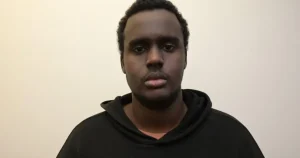

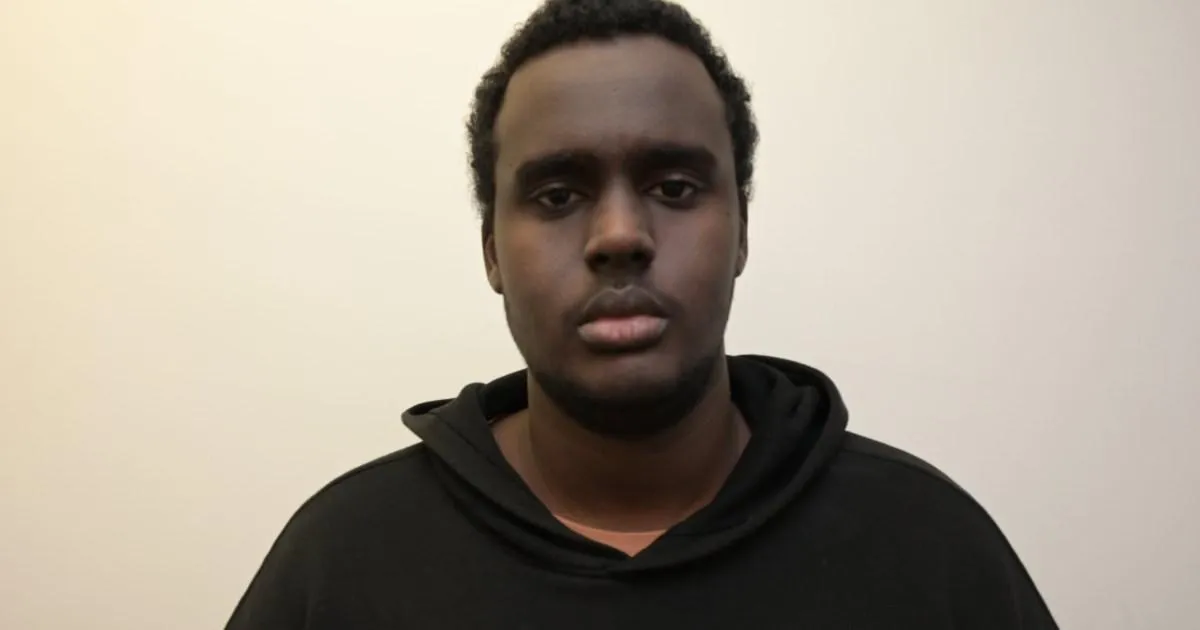
Mohamed Mohamoud was, by many outward appearances, an ordinary young man trying to build a life in a new country. A security guard living in Bristol, he had come to Britain only a few years earlier, hoping to settle near his mother after a childhood spent moving between Somalia and the United Arab Emirates. He was born in Somalia, but after his parents separated, he and his younger brother were taken to live with his stepmother in the UAE when he was just three years old. For most of his childhood, he shuttled between two very different worlds, never entirely rooted in either. In 2020, at around sixteen or seventeen, he moved to Bristol to live with his mother, and by the time of his arrest he had limited leave to remain in the UK until 2027. That precarious status, hanging over his everyday existence, added an extra layer of uncertainty to a young life already marked by displacement. Yet outwardly, he was not the obvious profile of a terrorist. He worked, he lived in an ordinary city, and he kept his thoughts to himself. But over time, hidden from family and friends, he was being drawn into something far darker. By his own admission, he had become fascinated with Islamic State after watching extreme videos on YouTube and TikTok. He then spoke to an AI chatbot that prosecutors said was being used by terrorist recruiters to pick out viable new members. On Friday, at the Old Bailey, that hidden life ended in a moment of devastating finality, as Mr Justice Lickley sentenced him to twelve years in prison, with a further four years on extended licence, for attempting to join Islamic State in Somalia and for preparing acts of terrorism.
The path that led Mohamoud to that courtroom did not begin with a recruiter in a war zone. It began with a screen, a young mind, and the strange, persuasive power of online extremism. Jurors at his trial were told that he had spent time watching extreme videos on YouTube and TikTok, platforms where algorithms can lead vulnerable viewers down increasingly violent and hate-filled paths. His interest in Islamic State grew not through face-to-face meetings or a charismatic mentor, but through conversations with an AI chatbot, a digital tool that terrorist recruiters were apparently using as a gatekeeper to sort the curious from the committed. In a way, this made his radicalisation feel eerily modern: a lonely young man, already searching for identity and belonging, found a cause that offered him certainty, purpose, and the promise of glory through martyrdom. The chatbot did not need to build a personal relationship with him in the traditional sense; it simply had to recognise his readiness and respond in ways that encouraged his fantasies. By the time real human recruiters were involved, Mohamoud had already made up his mind. He wanted to fight on the front line. He wanted to die for the cause. The background he gave in court painted a picture of a fractured childhood and a young man trying to find his place in the world. He was taken from Somalia to the UAE as a small child, lived between countries, and eventually arrived in Bristol as a teenager. His family story, marked by separation and movement, may help explain why a militant group offering absolute answers and total commitment could feel so compelling, even when its ideology was built on violence and hate.
On 30 January last year, Mohamoud’s online fantasy became a physical journey. He left the UK and flew to Somalia, the country of his birth, with dreams of dying as a martyr for Islamic State. It was a journey of extraordinary risk, and it collapsed almost as soon as he arrived. The court heard that he was offered a role as a spy, but he rejected it. He had not travelled thousands of miles to gather intelligence or work in the shadows; he wanted a front-line combat role in the killing zone. There was also another problem. He was worried that family members in the region might recognise him, and that fear, strangely enough, seemed to cut through the ideological fervour. He was prepared to die for Islamic State, but not to let his relatives see him doing it. That small, almost contradictory detail reveals the human mess beneath the extremism: alongside the grand rhetoric of martyrdom, there was still a young man aware of his family, worried about being recognised, unable to fully erase the bonds he had left behind. His efforts to become a martyr in the weeks that followed also fell flat, largely because of counter-terror operations that made it impossible for him to get where he wanted to be. The great adventure he had imagined turned out to be a series of disappointments. By 3 March, just over a month after he had arrived, Mohamoud was back in the UK. The experience was not what he expected. But even then, he did not turn away from the path he had chosen.
What followed was a strange and troubling period. Although he had returned to his ordinary life in Bristol, Mohamoud remained in contact with Islamic State recruiters, and his words to them made his intentions chillingly clear. At one point, he told them: “Any time, you say the word, I will return.” He was not simply drifting away from extremism; he was keeping the door open, waiting for instructions, still willing to go back and complete the mission he had failed to finish. Officers from Counter Terrorism Policing South East arrested him at his home on 20 January this year, and the case quickly moved through the legal system. Mohamoud admitted attempting to join Islamic State in Somalia, but he denied the more serious charge of preparing acts of terrorism. After a three-week trial in August, a jury found him guilty of that charge. At his sentencing, the judge made clear that the court saw his actions as far more than a young man’s foolish mistake. Mr Justice Lickley told him: “You did everything you could to join IS and were prevented by factors beyond your control. I am satisfied if you had joined you would have been used in a combat role.” Those words stripped away any lingering ambiguity. Mohamoud had not simply been a troubled teenager making empty threats online. In the eyes of the court, he was a committed would-be fighter whose failure to reach the battlefield was not due to any change of heart, but only to bad luck and effective counter-terrorism.
In mitigation, his barrister, Dominic Thomas, offered a picture of a man beginning to understand the wrongness of what he had done. He argued that Mohamoud was starting to see his “wrongheadedness” from what he described as a low point in his life, and suggested that there was hope he could change in the years to come. There was also a wry, rather blunt observation that Mohamoud was not really “recruited” in a meaningful sense, because anyone who might have been in a position to recruit him was presumably too busy fighting. The point, perhaps, was that he was never an important operative or a dangerous mastermind; he was a young man who had been caught up in a violent fantasy and who never quite made it to the fight. But the judge was not persuaded to show mercy. The sentence of twelve years in prison, followed by four years on extended licence, reflects both the seriousness of the offence and the court’s duty to protect the public. It also serves as a warning to others who might be tempted to follow the same path. For Mohamoud, the consequences are catastrophic. He will spend many years in custody, and because of his immigration status, even after his release his future in the UK remains deeply uncertain. The life he might have built in Bristol, the ordinary hopes of a young security guard trying to find stability, have been replaced by a long stretch behind bars and a criminal record that will follow him for the rest of his life.
At the heart of this case is a question that is both simple and deeply uncomfortable: how does a young man go from scrolling through videos on his phone to trying to join one of the world’s most brutal terrorist organisations? There is no single answer. Mohamoud’s story includes displacement, family separation, the search for identity, and a vulnerable young person trying to make sense of his place in the world. It also shows how modern extremism has adapted to the digital age, using AI chatbots and social media algorithms to reach people who might never have encountered a recruiter in person. The same technology that connects us to friends, entertainment, and information can also be used to guide someone toward violence. Mohamoud was not a victim, and his sentence reflects choices he made as an adult. But his case is a reminder that radicalisation is rarely a simple story of evil encountering evil. More often, it is a tragedy of isolation and manipulation, of a person who wanted meaning and belonging finding it in the most destructive place imaginable. His dreams of martyrdom, twisted as they were, grew out of a deeper longing for purpose. The rest of us are left with a warning: as long as vulnerable young people are searching for something to believe in, there will be those willing to use every tool available, including artificial intelligence, to turn that search into a weapon.