



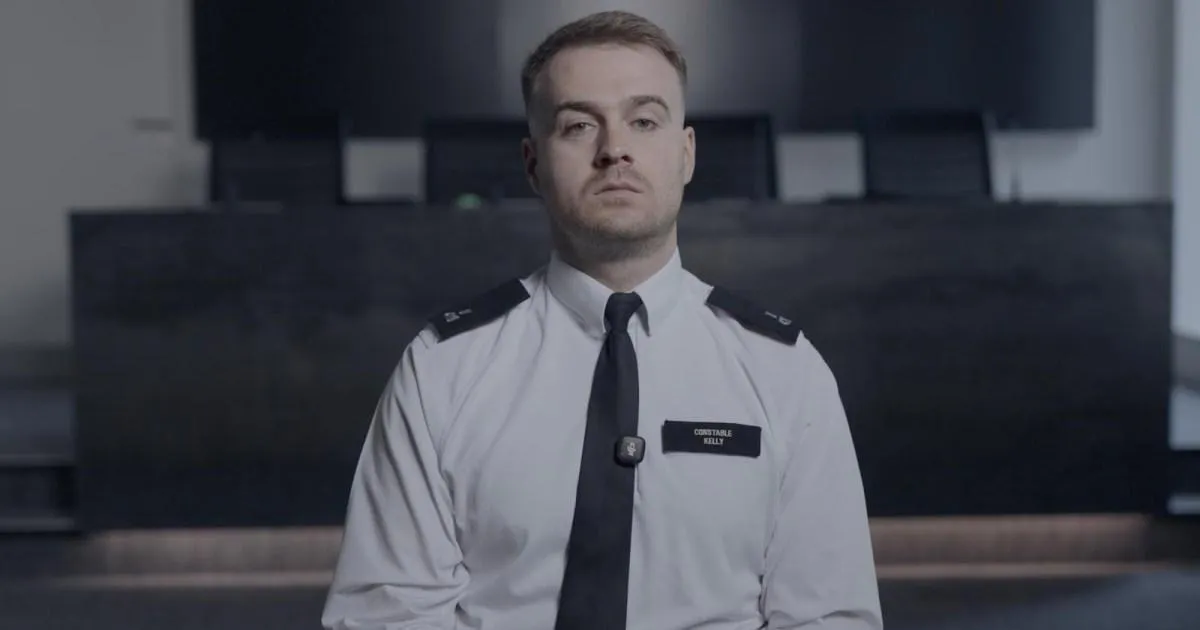
In a city of millions, where crime statistics blur and each case risks becoming a number, there are moments that remind us of the human faces behind the headlines. One such moment unfolded in Lewisham, a district in south London, when a vulnerable man’s home was shattered by the sound of his own front door being smashed in. Three men burst into his house, turning his private sanctuary into a scene of chaos and fear. The victim was not physically injured, but the psychological impact was immediate and profound. When PC Max Kelly arrived, he found a man too shaken to give a clear account, his thoughts scattered by the terror of the raid. The Metropolitan Police officer, a member of the Territorial Support Group, could have filed an incomplete report and moved on to the next call. Instead, he chose to stay, to listen, and to treat the victim’s distress as seriously as the crime itself. Doorbell footage captured the three men forcing their way in, but their faces were not immediately identifiable. The only verbal clue was a phrase shouted in the heat of the moment: “Come on Tyrone, let’s go.” That one word, Tyrone, would become the thread that led to justice. It was a clue so small that many would have missed it, but PC Kelly did not. He had been called to the home of a vulnerable man who had been cruelly targeted, and he understood that this was not just a burglary. It was an invasion of everything the victim held dear, and the memory of it would linger long after the police left.
To understand why this case matters, one must consider the nature of burglary. It is not merely theft; it is a violation of the most personal space a person has. For a vulnerable individual, the aftermath can be devastating. The victim in this case was described simply as vulnerable, but that word carries enormous weight. It may mean elderly, isolated, disabled, or struggling with mental health. Criminals who target such people are not just opportunistic; they are cruel. PC Kelly understood that the victim’s inability to recall the events was not a sign of unreliability but a natural response to trauma. He knew that in a state of fear, the brain prioritizes survival over order, and memories can become fragmented. So he did not rush. He sat with the victim, asked gentle, open-ended questions, and allowed silence to do its work. It was in that quiet, patient space that the victim remembered the shout. The phrase was directed at one of the burglars, a man named Tyrone. It may have been a name spoken in panic, an attempt to urge a companion to flee, but to PC Kelly it was a gift. It was a small crack in the wall of anonymity, and he was determined to widen it until the truth came through. The officer’s empathy was not just a matter of kindness; it was a practical tool of investigation. By making the victim feel safe, he unlocked a detail that would otherwise have been lost. That moment, sitting in a shaken man’s home, was the true beginning of the case.
What followed was an exercise in old-fashioned detective work that no amount of technology can replace. Tyrone is not an uncommon name. London is a sprawling metropolis, and the name appears across different communities, backgrounds, and addresses. Searching for a man named Tyrone in connection with a burglary in Lewisham was like looking for a needle in a haystack, except the haystack was made of police records, arrest logs, and criminal histories. PC Kelly did not flinch. He began systematically working through potential matches, using the doorbell footage as his touchstone. He studied the faces of men named Tyrone, comparing the shape of their noses, the set of their jaws, the way they moved. It was slow, tedious, and mentally exhausting work. Every promising lead had to be checked, every image had to be scrutinized. The officer later admitted that it took time to trawl through all the potential matches, but he was determined to explore every avenue. That determination is the heart of this story. In a profession where resources are stretched and caseloads are heavy, the easy decision would have been to file the case as having insufficient evidence. But PC Kelly refused to accept that. He had given the victim his word, even if only implicitly, that he would do everything possible. And when he finally matched a face in the records to the face in the footage, he knew he had found his suspect: Tyrone Muir, 47, a man with a history of offending. The name had been caught on a doorbell camera, but it was PC Kelly’s patience that turned it into an identification. The work was unglamorous, unseen, and largely unrewarded until the moment of arrest, but it was the kind of policing that makes communities safer.
The arrest, however, was not straightforward. Police officers raided Muir’s home, expecting to find him inside, but the house was empty. It would have been easy to feel defeated. The suspect had slipped away, perhaps tipped off or simply absent by chance. But PC Kelly was not ready to give up. As the raid concluded, he kept his eyes open, scanning the surrounding streets with the same attention he had applied to the records. About ten minutes from the house, he spotted a man sitting on a bench. The man had altered his appearance completely. Perhaps he had shaved or grown facial hair, changed his clothes, or adopted a different posture in an attempt to become invisible. But PC Kelly recognized him. It was Tyrone Muir. The officer moved in swiftly and made the arrest. It was a moment of pure instinct and training, the culmination of all the painstaking work that had gone before. “I couldn’t believe it when I spotted him on the bench and swiftly arrested him,” Kelly later said. But it was not luck. It was the result of a mind that had become deeply familiar with the suspect’s face, a mind that had not stopped working even when the raid failed. The image of Muir on a bench, believing he had escaped, is a reminder that criminals cannot always control the circumstances around them. What they cannot anticipate is the determination of an officer who refuses to let a case go. In that moment, the long hours of staring at records and comparing images were justified. The officer’s sharp eyes, honed by experience and sustained by purpose, had found the man who thought he had disappeared into the anonymity of the city.
The legal process eventually caught up with Muir. He appeared at Woolwich Crown Court on Monday, where he was sentenced to three years in prison. He had already admitted the burglary charge in July, sparing the victim the ordeal of a trial. For the victim, the sentence may offer some comfort, but the emotional scars of being invaded are not erased by a prison term. The knowledge that one of the men who broke into his home is behind bars can help restore a sense of safety, but it does not undo the night when three strangers shattered his door. PC Kelly, for his part, remained characteristically modest. He spoke of the importance of exploring every avenue and the thrill of recognition when he matched Muir’s face to the footage. His words are those of a police officer who genuinely cares about the people he serves. He did not describe the case as a victory for him, but as a duty fulfilled. The sentence also sends a message to other potential offenders: even the smallest clue can be enough to bring them to justice. In an age when criminals may believe that masks, darkness, and changing appearances can protect them, this case demonstrates that determined policing can cut through those illusions. For the victim, there is now a measure of closure, though the memories of that terrifying night will not fade quickly. The three-year sentence is a tangible consequence, a sign that the justice system has taken the crime seriously and that the vulnerable are not forgotten.
The praise from senior officers underscores the significance of PC Kelly’s work. Chief Superintendent Chris Green, who leads the Pan London Taskforce, called the case distressing and noted that the vulnerable victim had been cruelly targeted and may have been further exploited by Muir. He said PC Kelly’s actions demonstrate the best of policing and represent the standards of professionalism and commitment on the TSG. “He refused to give up, identified a small but significant clue and worked hard to safeguard the victim. Criminals should be under no illusion we will pursue every lead to bring them to justice. That is what we are here to do.” These words are more than an official commendation. They are a reminder of the bond between the police and the communities they serve. When a victim is vulnerable, the entire system is tested. In this case, the system worked because one officer chose to go beyond the minimum. He gave a face to a name, a name to a voice, and a voice to a victim who had been silenced by fear. The story of PC Max Kelly is not just about a burglary solved; it is about the quiet heroism that exists in police stations every day, often unnoticed. It is a reminder that justice is not abstract. It is built on small, human acts of attention, empathy, and refusal to give up. And for the people of Lewisham, it is a reason to believe that when they call for help, someone will answer. In a world that often focuses on what is broken, this story is a reminder of what can be achieved when a good person refuses to let a small clue disappear.