

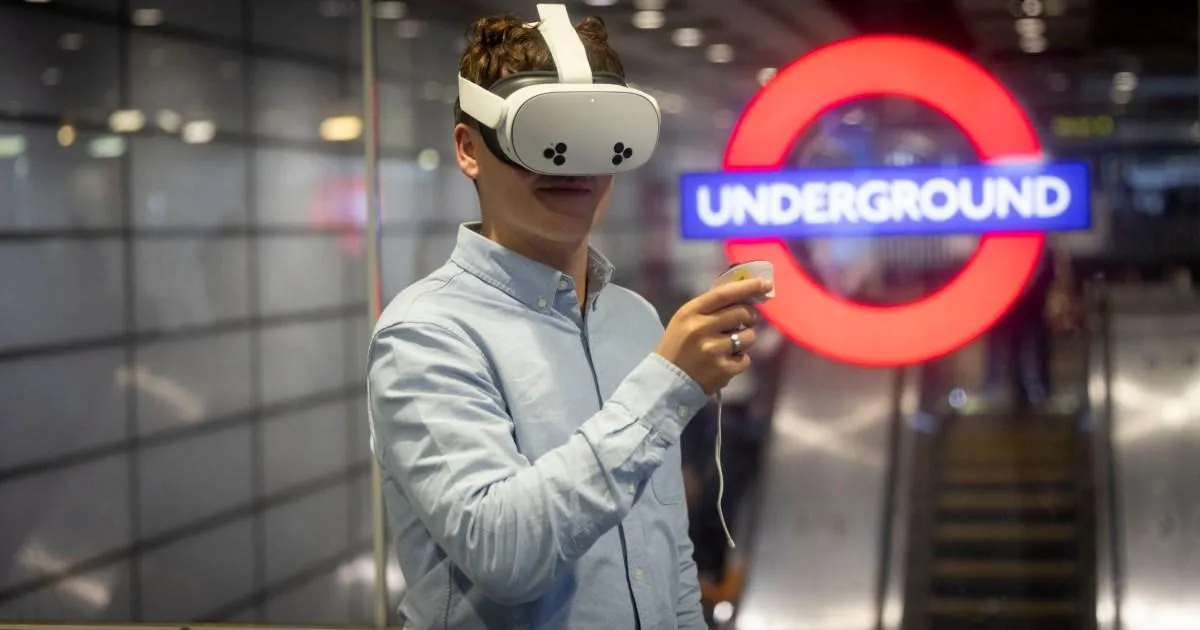
At one end of Euston Station, tucked into the ordinary chaos of rolling suitcases, restless queues and the low hum of announcements, a strange piece of theatre is unfolding. Transport for London staff have set up a modest stall, and instead of handing out maps or answering questions about delays, they are offering commuters a pair of virtual reality headsets. At first glance it might look like some kind of promotional gimmick, but the experience is anything but lighthearted. Once the headset is put on, the outside world disappears and the user is dropped straight into some of the most uncomfortable scenarios that can occur on the transport network. These are situations that far too many Londoners have faced before, either as bystanders or as victims: a woman targeted because of her hijab, a disabled person subjected to cruelty, a fellow passenger made to feel small and exposed by a predatory stare. The shock of these scenes is meant to be felt, not simply watched. But this time, instead of leaving the user frozen and helpless, the simulation guides them toward becoming an active bystander — someone who knows how to intervene in a way that is safe, practical and genuinely helpful. The location matters. Euston is one of the busiest stations in the capital, a place where thousands of people pass through every single day, often with their heads down, focused on their own destinations. It is exactly the kind of environment where harassment can happen in plain sight while everyone looks away. Commuters who stopped at the TfL stall, perhaps out of curiosity, found themselves rooted to the spot, their bodies tensing as the virtual scenes unfolded around them. Shuqi Zhou, one of the first to try it, emerged impressed by how believable it all felt. She described the experience as “very clear on how to follow” and praised the authenticity of the virtual surroundings. “It feels really realistic with all the familiar settings like the bus stops, and even Charing Cross Station,” she said. That familiarity is deliberate. The point is not to transport people to some distant nightmare, but to show them that these things happen on the very routes they travel every day — and to prepare them for the moment they might actually have to do something.
The timing of the initiative is no accident. Between January and August 2026, hate crime offences on London’s transport network rose by 36% compared with the same period the previous year. That is not a minor fluctuation; it is a sharp and worrying increase. And it comes against a backdrop of deep flaws in the way such crimes are reported. Passengers have spoken about a lack of working CCTV, staff who seem disinterested or unsure how to respond, and a widespread lack of confidence that reporting an incident will lead to any positive outcome. The result, almost inevitably, is that many crimes never enter the official record at all. Emma Croxall, head of safeguarding at TfL, acknowledged that offences are underreported on the network, but stressed that the spike in hate crime incidents is real. “We always see an increase surrounding international events,” she explained. “At the moment, we are seeing a lot of faith-based incidents, and we want people to know what to do and how to report this to us.” Her words point to a difficult truth about public transport: it is not a neutral space. It is a shared space where global tensions, cultural biases and personal prejudices often collide in the confined space of a carriage or the crowded platform of a major station. A person can become a target simply because of how they look, what they believe, or what they are wearing. The VR training is an attempt to respond to that reality by changing the behaviour of ordinary passengers. But it also raises a question that hangs over the whole project: why should the burden of responding so often fall on bystanders, when the systems meant to protect people are failing?
Inside the virtual reality experience, the production values are striking enough to make the simulations feel disturbingly real. For hate crime awareness week, TfL created two scenarios: one focused on a hate crime against a disabled person, and another based on race and faith, which depicts a woman being assaulted over her hijab. The realism is not achieved through Hollywood spectacle, but through small, recognisable details — the bleak lighting of a bus stop, the familiar shape of a Tube carriage, the slightly faded colours of a station platform. The effect is deeply uncomfortable. The user is placed directly in the centre of the action, far closer than any normal person would choose to be. It is like a nightmare in which you are present but unable to move, a frozen onlooker watching cruelty unfold in front of you. The heart begins to race, the muscles tense, and the instinct to look away battles with the growing urge to do something. About halfway through, the simulation pauses and presents a clear choice. One option is labelled “Act Like a Friend.” The other is simply called “Intervene.” This is where the training becomes both clever and unexpectedly honest. The safest option — and the one TfL clearly wants to instil in every Londoner — is “Act Like a Friend.” Selecting it does not mean diving into a confrontation with fists or raised voices. Instead, the user is guided to wait for the perpetrators to move on, take careful note of what they look like, approach the victims and offer comfort, and then go on to report the incident. It is a deliberately calm, methodical response. The other option, “Intervene,” is visibly discouraged. When selected, the perpetrators turn on the user with a burst of aggression so venomous that it feels genuinely shocking even in virtual reality. One raises a fist and lines up a punch before the scene cuts out. The lesson is blunt: direct intervention can escalate an already dangerous situation and put the would-be hero in real danger. “Act Like a Friend” is not passive or cowardly. It is strategic. It prioritises the victim’s safety and dignity over the egotistical satisfaction of confronting a perpetrator, and it ensures the incident does not vanish into silence.
The second experience shifts focus to sexual harassment, and in some ways it is even more unsettling because it feels so ordinary. The user is placed on a Piccadilly Line carriage, sitting down as if on a routine commute. Soon a man appears and positions himself directly in front of you. He does not speak. He just stares, and keeps staring, for what feels like an age. He does not break eye contact. He leans forward with a snarl and makes it plain that he is “interested.” There is no physical contact, no shouting, no explicit threat of violence. That is precisely what makes it so frightening. For women, this is hardly a new experience; many have endured exactly this kind of invasive attention on public transport, and know the particular dread of trying to ignore a stare that feels almost like a touch. For men, the simulation offers a rare opportunity to understand how something as simple as prolonged staring can be a form of intrusive sexual harassment, one that can turn a normal journey into an ordeal. Fortunately, the scenario does not leave the user alone. Another passenger notices what is happening and offers to help. Again, the user is asked to choose. The “stay back” option does not mean the passenger abandons the victim. Instead, she keeps a measured distance, quietly noting the time, the station and the man’s appearance, gathering information so she can report the incident afterwards. The “act like a friend” option is even more effective. She physically moves between the user and the man, then starts chatting as if the two of them have worked in the same office for years. It is a small act of social engineering: no accusations, no confrontation, just the unspoken message that the victim is not alone and the harasser no longer controls the situation. This technique is subtle, realistic and far more useful than a dramatic showdown. It teaches that being an active bystander does not have to mean being a superhero. Sometimes the bravest thing a person can do is stand close enough to make a difference.
But for all its immersive power, the VR experience cannot escape a difficult question: does it actually change behaviour in the real world? It is easy to leave the stall at Euston impressed by the technology and moved by the scenarios, but the problems facing the transport network are not only about awareness. London TravelWatch, the watchdog for transport users, estimates that only two out of every five victims of crime on public transport actually report what happened to them. That means the majority of incidents are invisible, unrecorded and unpunished. The VR training may encourage more people to report, but reporting is only useful if the system responds. At the moment there are serious doubts. Too many reports go uninvestigated. CCTV cameras are broken, or not functioning at the moment they are needed most. Too few perpetrators are identified, charged or convicted. For a victim, the knowledge that a report may lead nowhere is a powerful reason not to bother in the first place. There is also the question of reach. The VR headset trial at Euston is a bold idea, but how many busy commuters are actually going to stop and spend five minutes immersed in a virtual nightmare while their train is due to leave? The people who queue up for this kind of exercise are likely to be the ones who already care about these issues. The ones who look away when they see someone being harassed, who cross the platform to avoid involvement, who bury themselves in their phones to block out the discomfort — they are unlikely to volunteer for an experience designed to make them feel uneasy. There is a paradox at the heart of the project: it is a high-tech solution to a deeply human problem. A VR headset can teach a person what to do, but it cannot give them the instinct to step forward in the chaotic seconds when it actually matters.
Perhaps the most honest way to view this initiative is as one small piece of a much larger puzzle. It would be unfair to dismiss it as a gimmick. There is genuine value in allowing people to experience, even briefly, the vulnerability of being targeted simply for who they are, and to rehearse a practical response in a safe environment. The “Act Like a Friend” framework — observe, remember, comfort, report — is a simple but powerful tool that many people will carry with them long after they take off the headset. It challenges the assumption that intervening always means confronting, and it reassures nervous bystanders that they can help without endangering themselves. In a city as vast and diverse as London, where millions of journeys are made every day, that is not a small achievement. But immersive training alone cannot repair a broken reporting system. It cannot make broken cameras work. It cannot train staff to respond with care and seriousness. It cannot guarantee that prosecutors will pursue hate crimes and sexual harassment cases with the attention they deserve. If TfL truly wants to create a culture of active bystanders, it must also be an active institution — one that listens, investigates and acts. The commuter who reports a hate crime deserves to know that their effort matters. The victim who speaks up deserves more than a promise. The VR stall at Euston is a worthwhile invitation to stand up for one another, but it must not be mistaken for the solution itself. The real test will come when a passenger steps off a train, sees something wrong, and chooses to act like a friend. If the system fails them in that moment, no amount of virtual reality will be able to fix what happens next.