


1. A Father, a Daughter, and a Quiet Moment That Silenced a World of Rumour
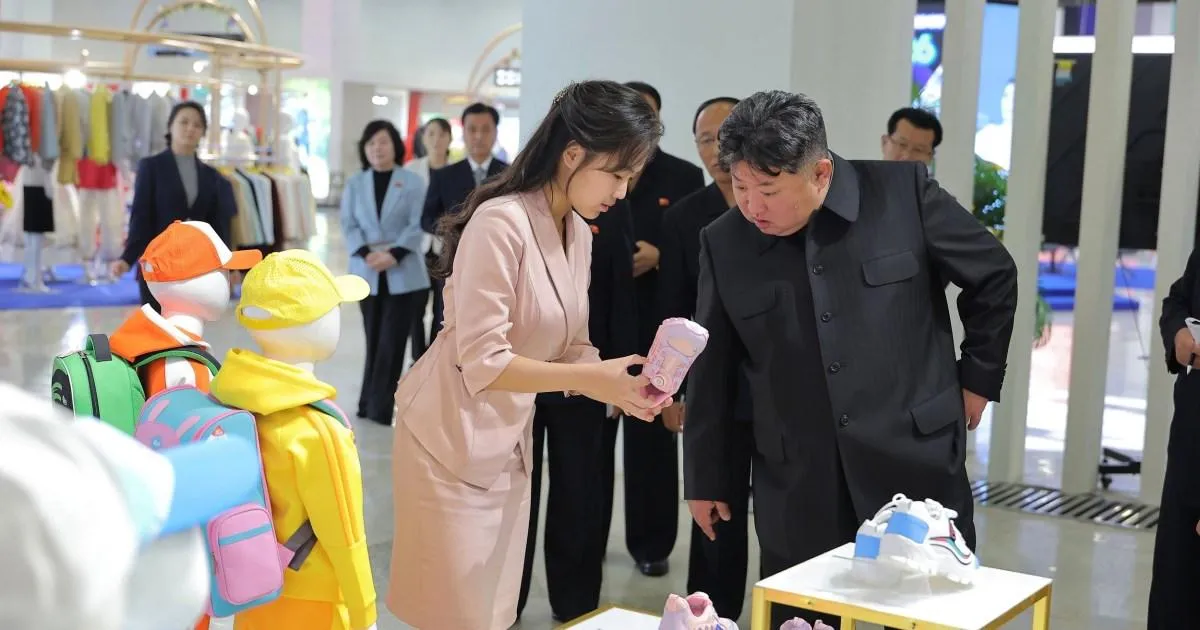
For days, the world had been holding its breath. Social media was alive with terrifying whispers: Kim Jong-un, the supreme leader of North Korea, the man who holds one of the world’s most volatile nuclear arsenals in his hands, had fallen into a coma after a brain haemorrhage. The reports were as alarming as they were unverified, but they spread like wildfire across every platform, feeding a global anxiety that has become almost routine whenever the reclusive dictator vanishes from public view. Then, suddenly, a release of new photographs from Pyongyang changed the narrative. There he was, looking at a clothing and footwear exhibition with his daughter, Kim Ju-Ae. The images, captured by state media and quickly picked up by international outlets, showed father and daughter walking calmly through a cavernous hall, pausing to inspect displays, surrounded by security and officials. It was a deliberately ordinary scene, but in the strange, cloistered world of North Korea, it was a thunderclap. The alleged victim of a catastrophic health crisis appeared not only alive but active, engaged, and on his feet. He had last been seen in public on October 11, and the silence since then had allowed speculation to flourish. But now, with his teenage daughter by his side, Kim seemed to be pushing back against the rumours not with fiery threats or missile launches, but with something far more human: a quiet domestic image, a man doing what any father might do at an exhibition, albeit one supervised by the entire state apparatus. It was a reminder that even the most feared and isolated leaders are still people, still bound to family, still obliged to appear in the world, even if that appearance is carefully staged. The photographs did more than just refute a rumour; they reasserted that Kim Jong-un was still in command, still present, and still very much a central figure in the geopolitics of the Korean Peninsula.
2. The Anatomy of a Rumour: How a Vanished Dictator Ignoites the World’s Imagination
To understand why the rumour about Kim Jong-un’s coma took hold so quickly, one has to understand the peculiar information vacuum that surrounds North Korea. The country is among the most secretive on Earth. State media reports are controlled, foreign journalists have almost no access, and independent reporting is nearly impossible. When its leader disappears from public view for any length of time, the silence itself becomes a story. In this case, Kim had not been seen since October 11, a gap of several weeks. In a normal political system, a leader might be away for any number of mundane reasons—a cold, a holiday, a private family matter. But in North Korea, the absence of a dictator is never mundane. Every day without a new photograph or a visit to some military installation becomes a canvas on which the world paints its darkest fears. The rumour that emerged this time was particularly dramatic: Kim had allegedly been taken to a Chinese hospital for urgent treatment, suffering from a brain haemorrhage and falling into a coma. The story was repeated by accounts on X, formerly Twitter, and picked up by various news outlets, each retelling adding more detail and less certainty. The fact that there was no official denial from either Pyongyang or Beijing only made the rumour more stubborn. It was not the first time such a claim had been made. In 2020, similar reports circulated that Kim was in a coma, and at that time, the speculation was so intense that it was widely suggested his sister, Kim Yo Jong, would take over power should he fail to recover. The 2020 rumours turned out to be unfounded, but they left a residue: a sense that Kim’s health was fragile, that the succession question was always just one bad night away from becoming an existential crisis. And so, when he disappeared again, the world reached for the most dramatic explanation. The fact that Kim has weight problems, that he drinks heavily, that he smokes, that his family has a history of heart disease—all of this fed a narrative of a man teetering on the edge. Yet the new photographs, whatever their staging, serve as a corrective. They do not prove he is in perfect health, but they do show that the rumours of an incapacitating brain haemorrhage were, at the very least, greatly exaggerated.
3. A Body Under Pressure: The Weight of Leadership and the Weight of Health Concerns
Kim Jong-un is only forty-two years old. In most walks of life, a man in his early forties is still in the prime of his life, able to work long hours, play with his children, and plan for decades into the future. But Kim is not an ordinary man. He carries the burden of one of the hardest jobs on the planet, a role that involves total control over a nation, a nuclear programme, and a population of over twenty-five million people. He also carries a body that has shown clear signs of strain. Over the years, his weight has fluctuated dramatically, and the South Korean spy agency has reported that he suffers from diabetes, high blood pressure, and other obesity-related ailments. His lifestyle, by all accounts, includes heavy drinking and smoking, habits that do little to calm a family history of cardiovascular trouble. His father, Kim Jong-il, died of a heart attack in 2011, reportedly after suffering a stroke years earlier. His grandfather, Kim Il-sung, the founder of North Korea, died of heart failure. That genetic shadow hangs over Kim Jong-un, and every time he appears puffy, breathless, or unsteady, the world takes note. When images emerge of him walking with a slightly slower gait or standing with visible effort, they become instant evidence for those who believe his health is deteriorating. But what does it mean to be “unwell” in a country where the leader is also a godlike figure? There is no room for weakness, no public hospital visits, no press briefings on his condition. His health is a national secret, just like his children, his wife, and his personal life. The latest rumours of a brain haemorrhage tapped into a deep and understandable fear: if Kim became incapacitated, the political vacuum would be catastrophic. There is no clear succession mechanism, no elected alternative, no constitutional process that would smoothly transfer power. Instead, there would be a violent competition among a small group of elites, all of whom have access to weapons, money, and the loyalty of various factions. The world has been here before, and every time, it holds its breath. But for now, whatever the truth of his health, the photographs from the exhibition show a man who is not in a coma, not in a hospital, and still very much in control of his own image.
4. The Succession Question: A Sister’s Ambition and a Daughter’s Destiny
For years, the accepted wisdom among North Korea watchers was that if something happened to Kim Jong-un, his sister, Kim Yo Jong, would take over. She is described as his closest confidante, his most trusted aide, and a ruthless political operator in her own right. She has given speeches, met foreign dignitaries, and taken on official roles that put her at the centre of the state apparatus. In a country where women are often sidelined from power, her prominence has been striking. During the 2020 coma rumours, it was reported that Kim’s power would be transferred to her if he failed to recover. She was, for all intents and purposes, the second-in-command. But then something shifted. Last year, reports surfaced that Kim was instead grooming his daughter, Kim Ju-Ae, as his successor. That would be an extraordinary choice, not least because Ju-Ae is only a teenager, a girl of thirteen or fourteen who, until recently, had been kept entirely out of the public eye. The decision to elevate her could be seen as a radical break with tradition, but it also makes a certain sense in a dynastic system where blood ties are everything. Kim Jong-un is not just a political leader; he is the son, grandson, and heir of a familial cult that has controlled North Korea for decades. By choosing his daughter, he is ensuring that the power stays within his own immediate line, rather than passing to his sister and her family. This has all the ingredients for a bitter family feud. Kim Yo Jong is older, more experienced, and clearly ambitious. To be passed over in favour of a teenage girl, one who has only recently begun to appear at official events, must sting. In a normal political system, such a rivalry might play out through backroom negotiations and media leaks. In North Korea, it could play out with exile, imprisonment, or worse. The daughter, Kim Ju-Ae, is thus not just a young girl attending exhibitions with her father. She is a symbol of a potential power shift, a pawn in a family chess game, and perhaps the future leader of a nuclear-armed nation. It is a staggering burden to place on a child, and yet the Kim dynasty has always been built on such burdens. The question is not whether Ju-Ae is ready, but whether the system will hold together long enough for her to inherit it. And if it does not, the struggle between the sister and the daughter could tear the country apart.
5. A Most Unusual Childhood: From Dennis Rodman to Missile Launches
Kim Ju-Ae is believed to be the middle child of three, though the North Korean state has never confirmed even the most basic details about her age, birthday, or full family structure. In a country where official biographies are more mythology than fact, Ju-Ae is a ghostly figure who only occasionally steps into the light. When she does, the world can see that she is no longer a child. She has been described as a teenager, around thirteen or fourteen, and recent photographs show her dressed in formal clothes, walking stiffly beside her father, often with her hands clasped behind her back in a gesture that mirrors his own. But her public life has been strange and sporadic. The first time many people in the West ever learned of her existence was through a bizarre connection: the former NBA star Dennis Rodman, who has visited North Korea multiple times over the years and claimed to have held Kim Ju-Ae when she was an infant. Rodman’s visits, which once seemed like bizarre celebrity diplomacy, now read as a kind of eerie prophecy of the girl’s future. In November 2022, Ju-Ae made her first recorded public appearance in Western media, accompanying her father during an inspection of the launch of a Hwasong-17 intercontinental ballistic missile. That is not what most children do on a day out with their parents. Instead of a trip to a playground or a museum, she was standing on a viewing platform, watching one of the most powerful weapons ever created by her country roar into the sky. Since then, she has appeared at other high-profile events: military parades, visits to factories, and most recently, the exhibition of clothing and footwear. The symbolism is deliberate. Kim Jong-un is not just bringing his daughter to work; he is presenting her to the nation as a future leader. In a state that is obsessed with legacy and blood, the presence of Ju-Ae at his side sends a powerful message to both the North Korean people and the outside world. She is being trained, not in the ordinary sense of education, but in the deadly craft of absolute rule. She will learn to read faces, to command fear, and to carry the weight of a regime that has survived for decades on a mixture of repression, propaganda, and carefully staged ceremony. Whether she wants any of this is irrelevant. In the Kim dynasty, there is no choice. Her childhood was never really her own. It belongs to the state, to her father, and to a future that no person should ever have to inherit.
6. The Photograph That Quieted the Noise: A Conclusion About Certainty and Illusion
In the end, the photographs of Kim Jong-un and his daughter at the Pyongyang clothing exhibition tell us something not just about North Korea, but about our own desire for certainty in an uncertain world. We want to know that the man with his finger on the nuclear trigger is healthy, rational, and stable. We want to believe that the rumours of his demise are either true or false, that there is a clear answer, that the fog of secrecy will lift just enough to let us sleep at night. But the truth is that we rarely know anything for sure about North Korea. The images from the exhibition are almost certainly staged. They were approved by the state, photographed by official media, and released to a world that was desperate for any sign of life. Yet even a staged image contains a grain of truth. It tells us that Kim Jong-un is alive, that he can walk, that he can appear in public, and that he has chosen to show his daughter at his side. It tells us that the rumours of a brain haemorrhage, a coma, and a trip to a Chinese hospital were, in all likelihood, the products of a fevered imagination rather than actual events. It also tells us something more human: that Kim Jong-un, the man who has ordered executions, launched missiles, and starved his people, is still a father. He lives with his family, he makes choices about which children to bring into the spotlight, and he worries, perhaps, about the legacy he will leave behind. For a brief moment, the world stopped talking about war and started talking about a teenager looking at shoes. But the underlying questions will not go away. What will happen to North Korea when Kim Jong-un can no longer rule? Will his sister make her move? Will his daughter be accepted as the next hereditary leader? Or will the whole fragile system collapse into chaos? The photographs do not answer any of these questions. They simply push them a little further into the future. For now, at least, the world can exhale. The dictator is not dead. The rumour is over. But in the cold, closed halls of Pyongyang, the succession drama is only just beginning. And as long as the Kim family rules, the world will keep watching, caught between fear and fascination, waiting for the next disappearance, the next rumour, the next flicker of light from the strangest monarchy on Earth.