


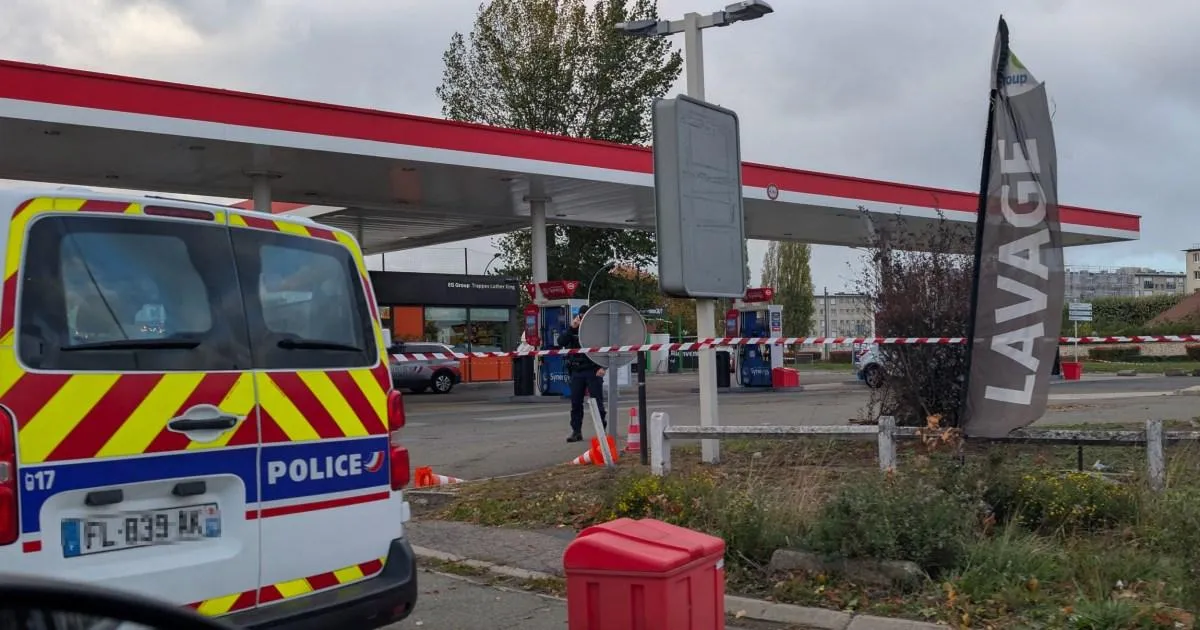
It began like any other late afternoon in the quiet suburban towns of Trappes and La Verrière, about twenty miles from the center of Paris, where the rhythms of daily life usually drown out the noise of national politics. But within fifteen minutes, that ordinary calm was shattered by the sound of gunfire, as a gunman firing from a vehicle unleashed a series of attacks at three separate locations, leaving one person dead and at least five others wounded, including a 12-year-old girl. French authorities immediately described the assault as racially motivated, a chilling characterization that turned a local act of violence into a national trauma. The attacker moved quickly, seemingly choosing his victims not by who they were as individuals, but by what they represented in his own distorted worldview. By the time police arrested him, less than twenty minutes after he had fired his first shots, the damage had already been done: families had been torn apart, a child lay fighting for her life, and a community was left to wonder why they had been targeted so brutally. The suspect, a French man identified only as Kévin T., was quickly taken into custody, and the case was handed over to France’s National Anti-Terrorism Prosecutor’s office, a move that underscored the gravity of what had occurred. President Emmanuel Macron responded with uncharacteristic bluntness, calling the attack a “racist terror attack” and suggesting that the suspect’s own statements pointed to premeditation. “These people were targeted because of their skin colour or perceived religion, and for no other reason,” Macron said. “There is no place for this in France.” His words echoed the disbelief and outrage felt across the country, but for the residents of Trappes and La Verrière, the president’s condemnation could not undo the terror of those fifteen minutes, nor erase the image of a gunman calmly driving through their streets with murder in his heart. The wounded, three of whom were described as having life-threatening injuries, were rushed to hospitals, and by Friday evening doctors were still struggling to stabilize their conditions. The 12-year-old girl, as France’s minister for gender equality and the fight against discrimination, Aurore Bergé, confirmed, was “very seriously injured.” The shock of the attack was compounded by its seeming randomness, with the mayor of Trappes, Ali Rabeh, suggesting that the gunman had fired at passersby in several spots, including near a playground, likely because of their apparent African origin.
The suspect’s arrest brought some relief, but the investigation quickly revealed a far more disturbing picture of a man who had apparently been preparing for violence for some time. Kévin T., born in 1987, was known to French authorities, though his criminal record consisted of four previous convictions that had been automatically expunged under French law, meaning they no longer appeared in standard background checks. That erased history made his transformation into an alleged mass shooter all the more troubling, as it suggested that the justice system had lost track of a man who may have been radicalizing for years. A search of his car uncovered a Sten-type submachine gun, a weapon often associated with paramilitary and extremist groups, along with a canister of tear gas. But it was the discovery at his apartment that truly alarmed investigators: the home had been booby-trapped with three gas cylinders and electrical wires connected to a timer, a crude but potentially deadly trap apparently designed to injure or kill anyone who entered after the attack. The fact that he had planned not only to shoot innocent people but also to leave behind an explosive device showed a level of cold calculation that fit the anti-terror designation. In addition to Kévin T., another person described as a member of his immediate family was also taken into police custody during the afternoon, raising questions about whether he had acted alone or with some form of support. The National Anti-Terrorism Prosecutor’s office confirmed that the person killed in the shooting was a French man born in 2000, a young life extinguished at the very beginning of adulthood, and offered a stark reminder that hate crimes do not discriminate by age. As investigators pieced together the timeline of the attack, they were faced with a troubling narrative: a man driving through working-class suburbs, opening fire on people he perceived as foreign, and doing so with an apparent ideological motive that placed this tragedy alongside the long and painful history of racially motivated violence in Europe. The decision to place the investigation under the authority of the anti-terror prosecutor was not merely procedural; it was a recognition that this was not a random act of criminality, but an act of terrorism rooted in racism, a distinction that carried profound implications for how France would respond.
In the immediate aftermath, political leaders across the spectrum rushed to express their horror and solidarity, but it was President Macron’s words that carried the most weight. By describing the attack as a “racist terror attack,” he acknowledged what many in the affected communities had known from the first moments: this was an attack on people because of who they were, because of the color of their skin, because of the faith they were perceived to practice. Macron’s statement, delivered with visible emotion, sought to draw a clear line between the Republic and the hatred that had driven the gunman. “There is no place for this in France,” he said, repeating a phrase that has become something of a national mantra in the face of extremism, yet one that rings hollow to those who experience discrimination daily. Aurore Bergé, the minister for gender equality and the fight against discrimination, added her voice to the condemnation, saying, “If a racist motive is established, I hope that the whole nation will stand alongside the residents of Trappes, La Verrière, and the victims. We cannot tolerate even the slightest racist remark in the French Republic.” Her words, though intended to offer comfort, also highlighted the uncomfortable truth that racism in France is not a distant phenomenon but a lived reality for many, a reality that sometimes explodes into deadly violence. The mayor of Trappes, Ali Rabeh, went even further, suggesting that the attack might be “probably one of the first attempted mass killings motivated by Islamophobia and racism” in France. His statement resonated deeply because it named the specific animus that appeared to have driven the gunman, an animus directed at people of African origin, at Muslims, at anyone who did not fit the narrow image of what a “true French person” should look like. For the residents of Trappes and La Verrière, many of whom are immigrants or descendants of immigrants, the mayor’s words validated their fear that they had been singled out not for anything they had done, but simply for who they were. The attack transformed their neighborhoods into a symbol of the violent consequences of unchecked hatred, and the presence of national politicians in the streets did little to soothe the raw grief of those who had lost a neighbor, or the anguish of parents who now had to explain to their children why a man with a gun had chosen to fire near a playground.
The human cost of the attack is impossible to measure in official statements alone. Behind every statistic, every mention of “five wounded” or “one dead,” there are real people whose lives have been irreparably changed. The young French man born in 2000 who was killed was someone with a future, a family, and a place in his community, and his death leaves a void that no amount of political rhetoric can fill. The 12-year-old girl, lying in a hospital bed with very serious injuries, faces a long and uncertain recovery, her childhood marked forever by the violence she witnessed and survived. Three others were described as having life-threatening injuries, meaning that the death toll could still rise, that the grief of one family could become the grief of many. The fact that the gunman targeted a playground is particularly appalling, because it suggests a willingness to harm even the most vulnerable members of society, to turn a place of laughter and play into a scene of bloodshed. For the parents of that community, the safety they had taken for granted was shattered in an instant. Every trip to the market, every walk past the park, every glance at a passing vehicle now carries a shadow of fear. The psychological wounds may take far longer to heal than the physical ones, and the children who were present, who heard the gunshots and saw the chaos, will carry those memories with them for the rest of their lives. This is the true face of terrorism, whether it is rooted in religious extremism or racial hatred: it seeks not only to kill and maim, but to terrorize an entire community, to make people afraid to live their ordinary lives. In that sense, the gunman may have failed in his immediate objective, as he was arrested before he could continue his rampage, but he succeeded in inflicting a deep and lasting trauma on a community that now knows, with terrible clarity, that it is seen by some as an enemy in its own country.
The attack also comes at a time of profound tension in France, where the public mood is already strained by economic hardship and social unrest. The shooting occurred just as the country was bracing for another day of protests against the high cost of living, a movement that has drawn hundreds of thousands of people into the streets and has been marked by episodes of violent confrontation with police. Major museums were closing their doors in anticipation of the demonstrations, and the government had deployed a significantly larger security presence across the country in an attempt to prevent a repeat of the previous week’s unrest, which had shocked France with its intensity and destructive fury. In this overheated atmosphere, the racially motivated shooting adds another layer of anxiety, reminding the nation that its social fabric is fraying in multiple directions at once. The protesters marching against inflation are not the same as the gunman who opened fire in Trappes, but both are symptoms of a country struggling to reconcile its ideals with its realities. France has long prided itself on the principles of liberty, equality, and fraternity, on the idea that all citizens, regardless of their origins, are equal before the Republic. Yet the existence of a man willing to murder people simply because of their skin color or perceived religion reveals a dark undercurrent that has never fully disappeared, despite decades of progressive legislation and public condemnation of racism. The government’s response to the shooting, with its emphasis on anti-terrorism and its promise of justice, is necessary, but it is not sufficient. To truly honor the dead and protect the living, France must confront not only the extremists who carry out such attacks, but also the everyday racism, discrimination, and social exclusion that provide the fertile soil in which such hatred grows. That is a far more difficult task, and one that cannot be accomplished by security measures alone.
As France mourns, the coming days will reveal how the nation chooses to respond to this tragedy. The protests will go ahead, the political speeches will continue, and the investigation will proceed, but the deeper question remains: what does it mean for a country to face the reality that one of its own citizens set out to kill his neighbors because of their race? President Macron has promised that the attack will not be tolerated, and the anti-terror prosecutor has taken charge, but the true test of French democracy will be whether it can move beyond condemnation and word into meaningful action. That means protecting vulnerable communities, but it also means addressing the underlying hatred that made such an attack conceivable. It means teaching a new generation that diversity is not a threat but a strength, and that the universal values of the Republic are not just words on a monument but commitments to be honored every day. For the residents of Trappes and La Verrière, the immediate need is for healing, for comfort, for the simple reassurance that their community will not be abandoned. But the broader nation must also grieve, not only for the young man who lost his life, but for the loss of innocence that comes with knowing that such hatred exists in their midst. The gunman may have acted alone, but the hatred that fueled him did not spring from nowhere. It was shaped by a culture in which racism and Islamophobia are too often dismissed, minimized, or rationalized, by a public discourse in which some lives are treated as less valuable than others, and by a history of colonialism and exclusion that has left deep scars. Overcoming that legacy will not happen overnight, and no arrest or conviction can erase the pain of this week. But if France can respond with genuine solidarity, with honesty about its own flaws, and with an unwavering commitment to the equality of all its citizens, then the dead will not have died entirely in vain. The coming days will be difficult, the memories will remain, but out of this horror there is still the possibility of a renewed promise, a promise that France will not let hatred have the last word.