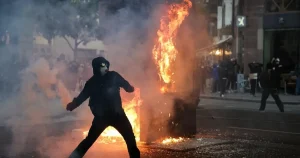

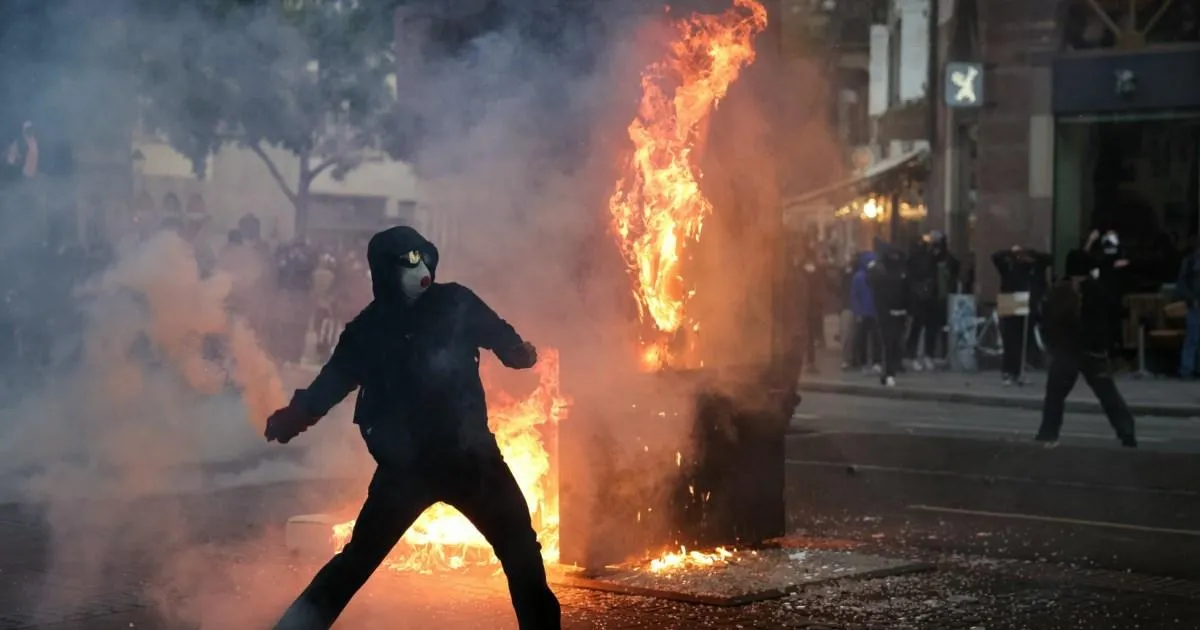
Over a single weekend, France found itself caught between the energy of mass civic participation and the chaos of collective fury. What began as demonstrations with familiar chants, banners, and a palpable sense of frustration quickly evolved into something far more volatile, as scenes of ordinary people standing shoulder-to-shoulder gave way to smoke-filled streets, broken windows, and the unmistakable crack of tear gas canisters. Thousands of protesters poured into cities across the country, and in response, the government mobilized an extraordinary force, deploying some 70,000 officers equipped with tear gas and water cannons in a bid to regain control. Photographs and video footage captured clashes between protesters and riot police, with officers in heavy gear forming lines against crowds that, in places, appeared determined to push beyond the boundaries of peaceful dissent. The turmoil came just days after some of the most serious unrest France had witnessed in decades, when demonstrations that had initially been organized as expressions of anger and solidarity spiraled into scenes of arson, looting, and physical violence. Hundreds of arrests were made that previous weekend, and the atmosphere across the country grew increasingly tense as authorities, politicians, and ordinary citizens grappled with the realization that a movement rooted in genuine grievances had, at least in part, fallen into the hands of a violent fringe. Prime Minister Sébastien Lecornu condemned the destruction, insisting there was “no place” for such behavior, but his words did little to calm the streets. The sheer scale of the anger was undeniable, and many people wondered how a country with such a proud tradition of protest had arrived at this breaking point, where democratic expression and criminal destruction had become almost indistinguishable in the nightly news footage.
At the heart of the unrest, however, lay a set of deeply human concerns that had been simmering for a long time before the first window was smashed. The original demonstrations were led by students, young people who took to the streets not out of a desire for chaos, but out of frustration with the state of their own schools. They demanded better conditions in public school buildings, many of which were aging, overcrowded, and in desperate need of repair. They called attention to a severe shortage of teachers, a crisis that left classrooms without permanent educators and put the quality of their education at risk. They protested budget constraints that had squeezed the public education system for years, and they spoke openly about overcrowded classrooms where learning was becoming impossible. These were not abstract policy complaints; they were lived experiences, and they resonated far beyond the student body. Teachers, parents, school staff, and even lawyers and emergency service workers joined the marches in solidarity, recognizing in the students’ grievances a broader pattern of neglect that affected many parts of French public life. Then, as the demonstrations grew, so too did the list of demands. Anger began to shift toward the skyrocketing cost of living and the rising price of fuel, burdens that hit ordinary families particularly hard and fed a growing sense that President Emmanuel Macron’s government was out of touch with their daily struggles. Reports suggested that more than half a million citizens had gathered at various points to voice their defiance, transforming what had started as a student-led movement into a wider expression of national discontent. The protests became a rare moment of unity across different walks of life, with middle-aged workers, young parents, retirees, and teenagers all finding themselves on the same streets, carrying similar frustrations about a country that, in their eyes, seemed to be leaving them behind.
But peaceful solidarity, no matter how powerful, was soon overshadowed by darker forces. As the days wore on, organized groups and opportunistic individuals began to infiltrate the demonstrations, and the protests steadily descended into riots that left a trail of destruction across France. Buildings were vandalized, their façades marked with graffiti and their windows shattered. Town halls were taken over by crowds in some areas, an almost unthinkable symbol of the state’s authority being challenged in the most direct way possible. An estimated 500 businesses were damaged, many of them small shops and local enterprises that had nothing to do with the political grievances but bore the brunt of the rage. The violence was not random in its effects; it was wounding communities, destroying livelihoods, and forcing residents to wake up to scenes of devastation in neighborhoods they had called home for years. The authorities responded with mass arrests, and by the time the worst of the chaos had slowed, more than 2,700 people had been taken into custody. The justice system moved swiftly, with fast-track trials resulting in 217 convictions by Thursday, sending a clear message that the state intended to hold those responsible accountable. Yet there was also criticism from opposition parties, who accused the government of failing to prepare for the scale of the disorder despite the warning signs. Interior Minister Laurent Nuñez struck a defiant tone, promising an uncompromising response and declaring, “We will not let anything go unchallenged. We will be uncompromising with the vandals, with the looters, and all those who commit acts of violence.” He also pointed to calls for violence circulating on social media from what he described as the far left and radical extreme left, suggesting that further disturbances were not just possible but expected.
Facing the likelihood of more trouble, the government braced itself for another explosive weekend. Interior Ministry official Jean-Didier Berger announced that police deployments would be increased by 20 percent compared to the previous weekend, with officers backed by helicopters to provide aerial surveillance and rapid response capabilities. Curfews were implemented or extended until Monday in parts of Paris, and partial curfews throughout the week restricted the movement of young people in major cities including Marseille, Bordeaux, Nice, and Lyon. The measures were designed to prevent the kind of late-night gatherings that had escalated into violence before, but they also added to the sense of a country under siege, with streets emptied after dark and a heavy security presence visible on every corner. President Macron’s government also made plans to divert demonstrations organized by groups such as trade unions over the weekend, a controversial move intended to protect businesses and public spaces from further damage. Paris, in particular, took on the appearance of a city in crisis. Iconic cultural institutions like the Louvre, the Orsay, and the Picasso museum were closed to the public, their priceless collections shielded from potential harm. The Arc de Triomphe, one of the most powerful symbols of French national pride, was placed under close guard, with officers stationed around the landmark as if defending it from an advancing army. Even the police themselves admitted to feeling the strain, with some officers telling French media that they were not trained to deal with crowds of this size and intensity. The scale of the challenge was enormous, and despite all the preparations, there was a palpable anxiety that the worst might still be to come.
When the weekend finally arrived, the scenes that unfolded were both predictable and shocking. Nearly 800 protests comprising more than 400,000 people were planned across France on that single day alone, with around 110,000 marching in Paris. It was a staggering demonstration of public engagement, proof that the anger had not faded. Yet, from the very start, the gatherings carried an undercurrent of danger. Individuals wearing hoods and face coverings moved through the crowds, their identities concealed and their intentions unclear. At least 135 people were arrested during the day, many found carrying fireworks, ball bearings, and a range of items that could easily be used as weapons. The police were heavily outnumbered in certain areas, and when grenades were launched, officers clad in riot gear responded with tear gas, firing canisters into the crowd in an effort to disperse them. Water cannons were later turned on the gangs, powerful jets of water sending people scrambling in a desperate attempt to escape the force of the spray. Even in zones where protests had been banned, chaos broke out. In Bordeaux, the Place de la Bourse, a beautiful and ordinarily peaceful public square, became the site of a confrontation despite a city-wide shutdown and the cancellation of public transport. In Nice, police ordered the dispersal of several hundred people who had gathered for a demonstration at Place Masséna, another prohibited gathering that authorities were determined to break up. The scenes were confusing and exhausting, with peaceful protesters caught between state forces and violent elements, while trade unions criticized the protest bans as violations of freedom of expression, arguing that punishing everyone for the actions of a few was not the answer.
For France, this crisis arrives at a moment of deep political uncertainty and national reflection. President Macron, a centrist leader who has always positioned himself as a reformer, now finds himself in the final stretch of his presidency, navigating a country that seems more divided than ever. His second term, which began on May 14, 2022, is scheduled to end on May 13, 2027, meaning the coming years will be defined not only by his agenda but by the fallout from this unrest. Beyond the statistics, beyond the arrests and the trials and the politicians’ statements, there are real people trying to make sense of what has happened to their communities. There are students who simply wanted a fair chance at an education, parents who wanted their children to learn in safe and welcoming classrooms, workers who were struggling to make ends meet, and families who felt their government no longer heard them. And there are also business owners sweeping up broken glass, police officers questioning their own readiness, and ordinary citizens wondering whether France can heal the wounds that now run so deep. The rioting has forced the nation to confront uncomfortable questions about social cohesion, economic inequality, and the limits of protest in a democracy. It has also reminded everyone that when grievances are ignored for too long, they do not simply disappear; they find expression in the streets, sometimes peacefully, sometimes violently. France has long prided itself on being a place where people are not afraid to raise their voices, but this weekend’s events have shown that those voices can easily become a roar that shakes the very foundations of the system. The coming months will reveal whether this moment becomes a turning point toward meaningful change or a warning sign of even greater instability ahead. For now, the country remains tense, its cities guarded, its people left to wonder what has become of their nation and what still lies ahead.