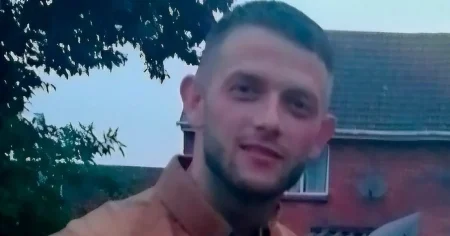
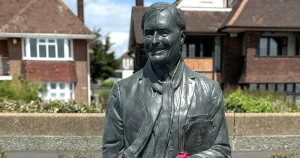


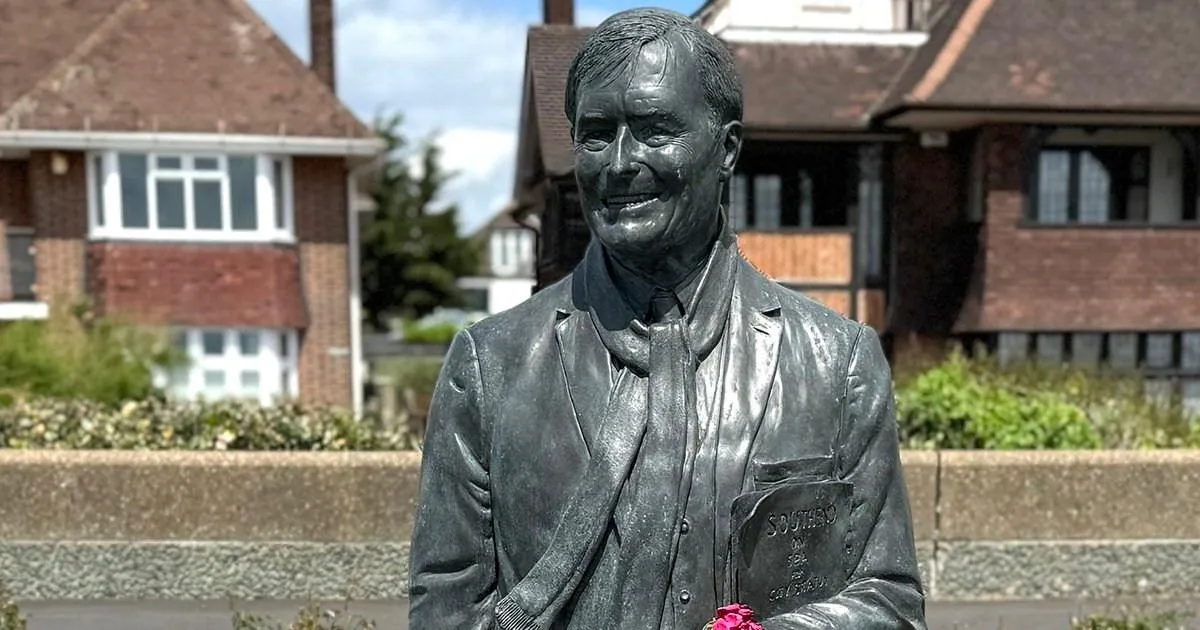
It was meant to be a week of quiet remembrance, a moment to pause and reflect on a life spent in public service. Instead, the family of Sir David Amess found themselves confronted with a vile and sickening image on social media: a man spitting repeatedly on the murdered MP’s statue on Southend seafront. The video, since deleted, surfaced just days after the fifth anniversary of his death, and it cut deep into the wounds that time has never fully closed. Essex Police confirmed that a man in his thirties was arrested on suspicion of a public order offence and criminal damage, and was taken into custody for questioning. For the Amess family, who have already endured the unimaginable horror of losing a husband and father in the most brutal way imaginable, this latest act of contempt felt like another blow. It was not just an attack on stone and bronze; it was an attack on the memory of a man who spent nearly forty years trying to make life better for others. To spit on his statue is to spit on the very idea of decency, kindness, and community that Sir David embodied every single day of his political life.
The background to this moment is one of unspeakable tragedy. Sir David Amess was murdered on October 15, 2021, during a constituency surgery at a Methodist church in Leigh-on-Sea, where he had been meeting with members of the public. He was sixty-nine years old and had served as the Conservative MP for Southend West for nearly four decades, after first entering Parliament in 1983. His killer, Ali Harbi Ali, was a radicalised fanatic inspired by so-called Islamic State, who was later sentenced to a whole-life order for the murder. What made Sir David’s death so particularly heartbreaking was the nature of his work: he was not a remote, inaccessible politician, but a man who opened his doors to anyone who needed help. Constituency surgeries are a cornerstone of British democracy, a moment when an MP sets aside the grand debates of Westminster to listen to the ordinary concerns of ordinary people. Sir David was killed in exactly the kind of humble, unglamorous setting that defined his career. He was there to serve, and he paid for that service with his life. Five years later, his family is still navigating a world without him, still coping with the daily absence of a man who brought warmth, humour, and genuine care to everything he did.
When the family saw the video of a stranger spitting on his statue, their grief was compounded by disgust. Through a spokesperson, they said they were “deeply upset by what they have seen” and welcomed the police investigation. But they also responded with the kind of grace and wisdom that Sir David himself would have recognised. They said, “David believed passionately in freedom of expression and the right to disagree. He understood that people would hold different political views, sometimes profoundly so. But disagreement should never be an excuse for abandoning basic standards of decency and respect.” Those words carry a powerful weight in an age of casual online cruelty, where outrage is often performed for likes and shares, and where public figures are treated as fair game for mockery or hatred. The family went on to remind people that Sir David was murdered because of the extremism of another individual, and that five years on, they continue to live with the consequences of that terrible loss. That sentence alone should give anyone pause. For them, this is not abstract politics. It is the permanent, aching reality of losing a beloved family member to violent radicalism. And yet, even in the midst of that pain, they have chosen to call for decency rather than revenge, dignity rather than anger.
There is something deeply unsettling about watching a person defile a memorial to someone who was murdered by an extremist. It speaks to a culture that has lost sight of basic humanity. We can argue about policy, about politics, about the future of the country; Sir David, the family reminds us, would have absolutely wanted that. He lived for the cut and thrust of debate and believed that disagreement was a sign of a healthy democracy. But there is a line between passionate disagreement and disrespect, and this video crossed it in the most despicable way. Spitting is an act of visceral contempt, often designed to demean and humiliate. To do it to the memory of a man who was stabbed to death while trying to help his constituents is not just vandalism; it is an attempt to erase the dignity of a victim and reopen wounds that should be allowed to heal. It also says something troubling about the world we live in, where political hatred has become so toxic that even the dead are not spared. The irony is that Sir David was known for his personal kindness and his willingness to work across party lines. He was liked and respected by politicians of all stripes, not because he was soft, but because he was sincere. He treated people with respect, even those who disagreed with him. To see his memory treated with such cruelty is a heartbreak for everyone who believes in a politics of grace.
Southend seafront, where the statue sits, is a place of everyday life. It is where families go to eat ice cream, where couples walk along the pier, where children laugh and run along the beach. It is not a place for hatred. The statue of Sir David was placed there because he loved Southend passionately and campaigned for it to be granted city status, a dream that was realised shortly after his death when the town was officially made a city in his honour. The memorial is a way of keeping him close to the community he served for so many years. It stands as a reminder that politics is not just about power, but about presence, about showing up, about being part of the fabric of a place. When someone spits on that statue, they are not only insulting an individual; they are insulting a community, a town, and the values that hold us together. They are also insulting every victim of terrorism and every family who has ever lost a loved one to senseless violence. It is an act that feels desperate and pathetic, the gesture of someone who has nothing meaningful to say and so resorts to petty cruelty. The fact that it was filmed and posted online makes it even worse, because it suggests a desire to perform hatred for an audience, to turn a moment of grotesque disrespect into cheap entertainment.
As the police investigation continues, there is some comfort in the fact that the man has been arrested and will face the consequences of his actions. But no sentence will undo the hurt that has been caused, and no apology could repair the damage to a family that has already suffered too much. What matters now is that we, as a society, choose a different path. We can honour Sir David Amess not by silencing disagreement or demanding uniform political thought, but by remembering that underneath every policy debate there is a human being. We can remember that he gave his life in the service of others, and that the greatest tribute we can pay to him is to treat one another with kindness, patience, and respect, even when we are on opposite sides of an argument. The family’s words should echo in our minds: disagreement should never be an excuse for abandoning basic standards of decency and respect. In a world that is increasingly divided, angry, and quick to dehumanise, that is a lesson we desperately need to learn. Sir David may no longer be with us, but his values can still guide us, if we let them. And we must let them, because anything less would be yet another insult to a good man, a devoted father, a dedicated servant of the public, and a soul who deserved far better than this world gave him.