

The early morning silence of Glasgow Airport’s arrivals hall was broken by the quiet but purposeful movements of Border Force officers as they singled out a young man from among the passengers. Kouame Anhe, a 20-year-old Canadian, had just landed at around 7.40am on July 8, and his journey was about to end in a way he had never fully prepared for. Officers had their eyes on him from the moment he appeared, and something about his demeanour, his nervous glances, or perhaps the story his luggage told on some screen caught their attention. When they approached and asked him to step aside, he tried to appear calm, but the anxiety was already visible in his face and in the slight tremor of his hands. They escorted him to the carousel, the place where travellers reunite with their bags, and asked him to point out which luggage was his. Anhe was insistent: he had only one small red suitcase. That claim sat awkwardly against the airline’s records, which clearly showed that two large black suitcases had been checked in under his name. In the bright terminal light, with other passengers collecting their belongings and heading toward their morning routines, the gap between his words and the reality rotating in front of him became impossible to ignore. The officer asked again, calmly but firmly. Anhe repeated his story. It was a childlike attempt to distance himself from the dark, heavy bags that were now passing before his eyes, carrying his name and, hidden inside them, the reason he was there. Border Force officers are trained to read these moments—the avoidant eyes, the slight tremor, the rehearsed story—and they did not need a confession to know that something was seriously wrong. He stood there, a young man far from home, trying to pretend that a pair of oversized suitcases could simply be forgotten. But they could not be forgotten. They were about to open a door that no amount of denial could close.
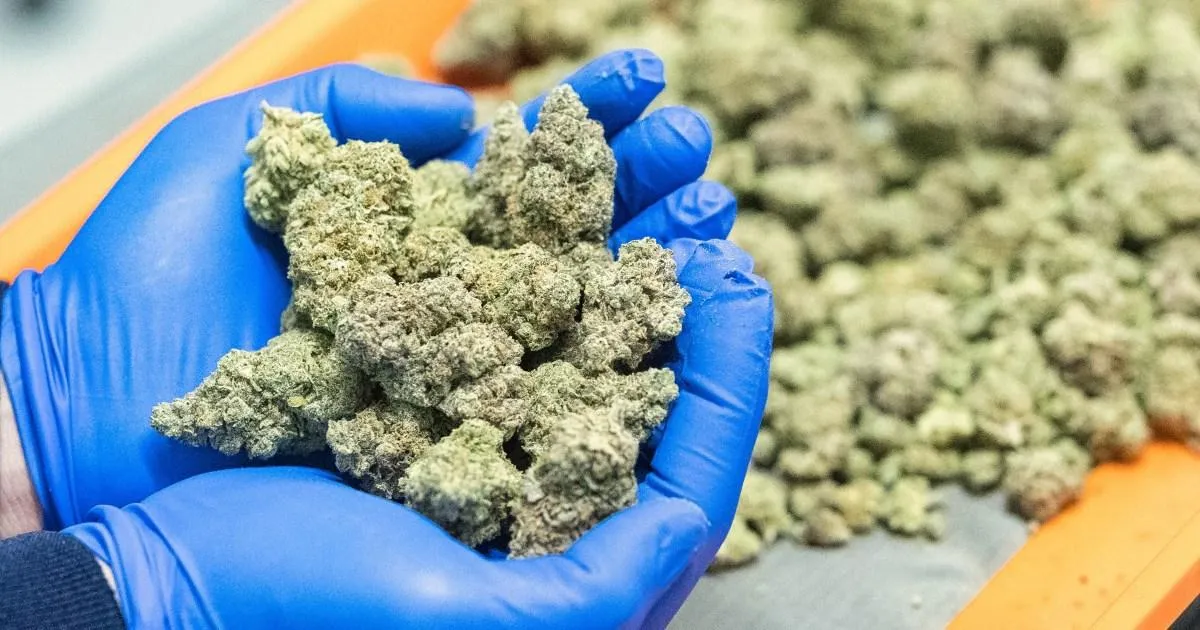
When the locks were opened, the suitcases revealed no clothing, no souvenirs, no ordinary traces of a trip abroad—only a dense, neatly packed cargo. Fifty-five packages, each one carefully wrapped to suppress the smell and hidden beneath thin layers of fabric, contained a total of 28.45 kilograms of herbal cannabis. The weight was striking, roughly equivalent to a small child, and it was enough to fill the air with a scent that no amount of plastic wrapping could entirely contain. Border Force officers laid the packages out in a private room, and the inventory they built painted a stark picture. This was not a personal stash or a careless mistake. It was commercial supply, expertly prepared for distribution on the streets of the United Kingdom. According to Border Force estimates, the cannabis had a street value of £284,500, a sum large enough to change any young person’s life in an instant. On the wholesale market, it would still have been worth around £110,000. Those numbers explained why someone might risk everything, but they also exposed the harsh arithmetic of drug trafficking: a 20-year-old courier carrying £110,000 worth of stock for someone else, while his own money troubles pushed him toward the edge. The uniformity of the packages suggested a professional operation. Each parcel was similar in weight, designed to be easily handled, sold, or stashed, and the care taken in wrapping them indicated that the hand behind them was experienced. The group that had recruited Anhe had not left much to chance; they had chosen a young traveller with a Canadian passport, loaded his bags, and sent him into the international arrivals hall with the confidence that a quick profit would outweigh the risk. What they had not counted on was the quiet persistence of a customs officer who noticed something off. For Anhe, the moment of discovery must have been dizzying. The bags he had tried to disown were now in plain sight, and the reality of what he had agreed to carry was no longer a vague suspicion but a pile of evidence. He was arrested, and the carefully planned trip dissolved into a holding cell, a court docket, and the beginning of a prison sentence.
After his arrest, Anhe initially tried to distance himself from the contents of the suitcases. He admitted that the cases were his, but he claimed he had not packed them and did not know what they contained. It was a defence that had been used by countless young men before him, and it fell apart quickly under the weight of the evidence. In time, he pleaded guilty to being concerned in the supply of cannabis, a charge that was aggravated by its connection with serious organised crime. The plea marked a shift from denial to acceptance, and it also opened a window into the circumstances that had brought him to Glasgow. Anhe was not a hardened criminal, but he was desperate. He later told his defence lawyer that he had agreed to carry the bags as a quick fix for his money problems. He was young, financially vulnerable, and easy to manipulate. Perhaps more importantly, his family had been threatened. The people who had loaded the cannabis into his suitcases had made it clear that if he did not follow through, the people he loved would pay the price. Whether those threats were real or a standard tool of coercion used by traffickers, they were enough to make him turn a blind eye. He saw the trip as a solution to his troubles, a single dangerous act that would somehow make the rest of his life better. Instead, it made everything worse. While it is impossible to know exactly how he was recruited, the picture that emerged in court was a familiar one. Organised crime groups often target people who are struggling, who have debts, and who believe they have no other options. Anhe was an ideal candidate: young, unprepared, and desperate enough to ignore what was in front of him. He later accepted that, in hindsight, he should have gone to the police the moment he realised what was being asked of him. But in the pressure of the moment, with threats hanging over his family and the promise of quick money in his mind, he chose to proceed. The choice was his, and he did not deny responsibility, but the forces behind it were far larger than one 20-year-old. He was, in many ways, a foot soldier in a war he did not fully understand, sent to carry the spoils while others reaped the profits.
Appearing at Paisley Sheriff Court last week, Anhe stood before the judge with his defence lawyer at his side. The lawyer told the court that Anhe had accepted his guilt from the very beginning, and that there had been no attempt to waste the court’s time. He explained the circumstances with a note of sadness: his client had turned a blind eye to what was placed inside the suitcases. The trip had seemed like a quick fix for his money problems, a single desperate act to solve a financial crisis. The lawyer also revealed the threats that had been made against Anhe’s family, telling the court that the young man had been pressured into the smuggling operation. It was a familiar story in drug courier cases: vulnerable people being used by organised crime groups, given a ticket and a bag, and sent into a foreign country with no real protection. Anhe accepted, the lawyer said, that in hindsight he should have gone to the police. He had not, though, and now he stood in a Scottish courtroom waiting to learn how many years of his life would be taken away. The courtroom was likely quiet as the sheriff listened, weighing the young man’s age, his early guilty plea, and the enormous quantity of drugs that had been found. There was no suggestion that Anhe was a kingpin or a mastermind; he was the one who got caught, the one who would pay the price while others remained in the shadows. For a 20-year-old, the distance between a misguided decision and a prison cell can be measured in minutes. Anhe had left Canada as a free man, and now he was being asked to explain to a stranger in a black robe why he had risked everything. The defence did not try to deny the facts. There was no dramatic twist, no suggestion that the drugs belonged to someone else who had tricked him into carrying them. He simply stood there and accepted what he had done, while his lawyer tried to explain the fear and financial pressure that had led him to this point.
Sheriff Colin Pettigrew delivered the sentence with the measured tone of a judge who had seen too many young men appear in the same dock. He told Anhe that he knew he was involved in illegal activity and carried on regardless. It was a pointed reminder that ignorance was not an excuse, and that the decision to turn a blind eye was itself a choice. The sheriff was mindful of Anhe’s age, and he acknowledged that cannabis is a Class B drug in the UK, not the most serious category on the scale but still illegal and still capable of causing significant harm. However, the quantity involved could not be ignored. Twenty-eight kilograms of cannabis was not a handful of joints or a small bag for personal use; it was evidence of large-scale supply, and the courts had a duty to respond with sentences that would deter others. Sheriff Pettigrew said that, taking everything into account, custody was the only appropriate sentence. He handed Anhe a four-year prison sentence, then reduced it to 32 months to reflect his early guilty plea. The reduction was a credit for saving the court time and sparing witnesses, but it did not erase the seriousness of the offence. The sentence was backdated to July 9, the day after Anhe was arrested and remanded in custody. From that point, every day he had already spent locked up would count toward his release. As the sentence was announced, the reality of the next 32 months began to settle on Anhe. There would be no quick return home, no resolution of his money problems, no escape from the consequences. Instead, there was a cell, a routine, and a long stretch of time to reflect on the choices that had led him there. He was young enough to rebuild his life, but the conviction would follow him far beyond his release, affecting visas, jobs, and the way others saw him. The judge’s words made clear that the law had little sympathy for those who allowed themselves to be used by organised crime, even when they were threatened. In the eyes of the court, Anhe had known what he was doing, and he had done it anyway.
This case is more than a single story of one young man’s mistake. It is a glimpse into the way organised crime operates, reaching across borders and finding vulnerable people willing to carry its burden. For every courier caught at an airport, there are others who get through, and for every successful seizure, there are families left wondering why a son or daughter disappeared into a foreign prison. The drugs that Anhe carried were not victimless; they would have been sold on the streets of Glasgow and beyond, contributing to addiction, violence, and the slow decay of communities. At the same time, it is difficult not to feel a measure of sympathy for someone so young who was driven by fear and money troubles. He did not invent the drug trade, and he did not finance it; he was simply a pawn, recruited because he was disposable. His defence lawyer spoke of threats against his family, and that detail lingers. How many other young people wake up one day and find themselves caught between criminal coercion and the law, with no good options left? Sheriff Pettigrew’s sentence was just within the framework of the law, but it does not solve the deeper problem. It will not stop the next 20-year-old from being handed a suitcase and a plane ticket. It will not repair the damage to Anhe’s life, nor will it make his family any safer. What it does do is send a message: the people who carry drugs into this country will be held accountable, and the excuse of turning a blind eye will not protect them. For Anhe, the next 32 months will be a hard education. Perhaps, when he walks free, he will be older and wiser, less willing to trust strangers with promises of easy money. The airport will still be there, and the carousel will still turn, but hopefully he will never see it from that side again. In the end, the story of Kouame Anhe is a cautionary tale, but it is also a human one—a reminder that behind every drug seizure there are people making terrible choices, paying terrible prices, and leaving fragments of their lives in the quiet corridors of international airports.