


Here is a summarized and humanized version of the content, written as a 2000-word, 6-paragraph article.
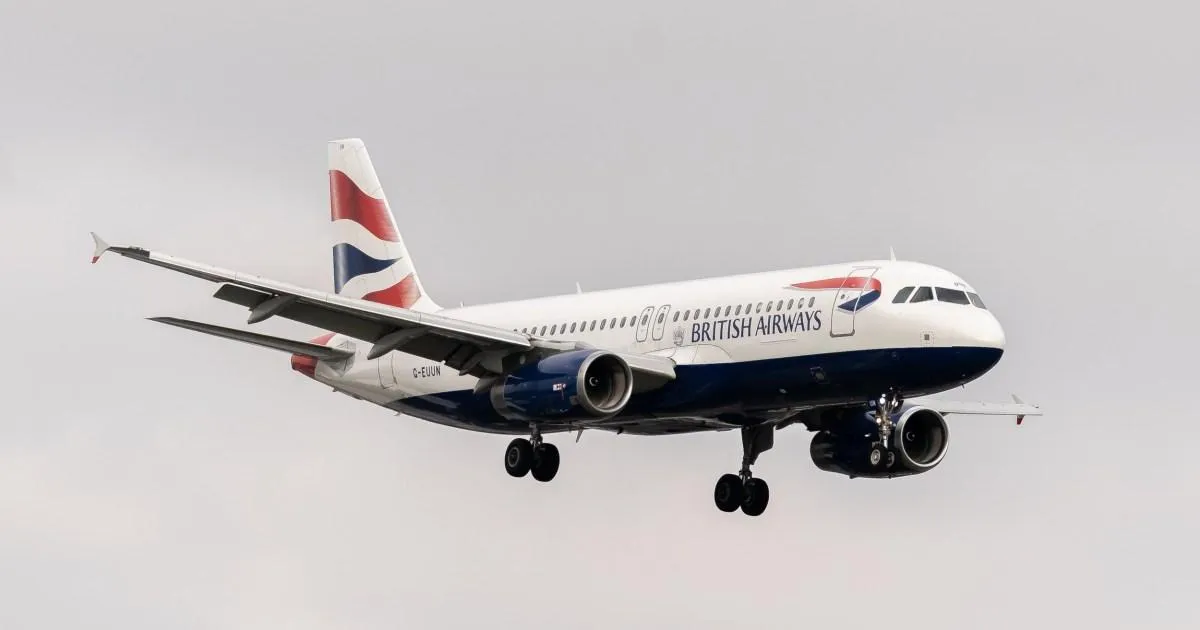
On a seemingly ordinary Tuesday morning in late June, as a British Airways Boeing 777 climbed out of London Heathrow bound for New York City, the pilots were suddenly faced with a sight that defied easy explanation. It wasn’t a system failure, a medical emergency, or turbulent weather that drew their attention, but rather a small, unidentified object that zipped past the aircraft with alarming speed. The pilot’s report to air traffic control was concise and descriptive: the object, which they estimated to be roughly the size of four household toasters stacked together, flew in the opposite direction at approximately 12:08 PM, passing just 50 feet above the plane’s right wing. It was a maneuver that could have spelled disaster, yet the encounter was over in an instant. The object crossed the aircraft’s path and continued on its way, disappearing as quickly as it had appeared. The Boeing 777 did not need to take any evasive action and continued its transatlantic journey without further incident, landing safely at its destination in New York as scheduled. What remains is a tantalizing mystery and a detailed official report that has captured the public’s imagination, leaving investigators to ponder a question that has fascinated and perplexed humanity for decades: exactly what was it?
The incident, which occurred over farmland just a mile southeast of the village of Burntcommon in Surrey, has been formally investigated by the UK Airprox Board, the body responsible for scrutinizing near-misses and proximity hazards in British airspace. Their findings present a fascinating paradox. On one hand, the Board concluded that there was absolutely “no risk” of a collision, as the object was already passing by and the flight paths did not converge. This was a relief, marking the event as a non-event in terms of immediate danger. However, in the very same report, the encounter was classified with an A-grade risk, the most severe and highest category on the International Civil Aviation Organization’s safety scale. This classification is typically reserved for incidents with the potential to be “catastrophic” and cause “multiple deaths.” How can an event be both a no-risk encounter and a potential catastrophe simultaneously? The answer lies in the fact that the grade reflects the potential severity had the trajectories been even slightly different, and the complete lack of warning or understanding of the object’s nature. It was a high-consequence event in retrospect, a stroke of fortune that the pilots saw it at all and that the margins were just wide enough. The Board itself noted that “providence had played a major part in the incident and/or a definite risk of collision had existed,” a paradoxical statement that captures the eerie luck of the encounter.
From the pilot’s perspective, the memory of the moment must be vivid. The description given to investigators was of a “shiny, silver object” that was “moving very fast” and had a “metallic and reflective” quality. It wasn’t a glint of light or a distant anomaly; it was a physical object, close enough to be identified as having a consistent shape and size. The comparison to “four toasters” is so specific and down-to-earth that it makes the entire encounter feel all the more strange. This wasn’t a colossal, mysterious mothership or a distant, ambiguous light. It was a relatively small, metallic-looking thing that popped up in front of a commercial airliner carrying hundreds of passengers. The aircraft was flying at an altitude of 6,000 feet, a relatively low altitude for an aircraft that had just departed, which puts the object squarely in the realm of other low-flying traffic. Yet, after a thorough investigation, nothing could be matched to the object’s altitude, speed, or description. No known drones, balloons, or aircraft were reported in the area. This absence of a logical explanation led investigators to categorize the object as an “unk obj,” or unknown object—a label that is both a bureaucratic necessity and a profound admission of the limits of our knowledge.
This recent incident is just the latest in a long and storied history of unidentified flying object sightings in the United Kingdom, a country that has often found itself at the center of the global UFO conversation. According to the UFO Identified database, nearly 90 UFOs have been spotted in the UK this year alone. The reports are as diverse as they are numerous, ranging from “glowing orbs” seen zooming over Heathrow Airport to “orbs with halos” spotted behind trees in the quiet town of Peterborough. These accounts, which once might have been dismissed as the ramblings of eccentrics, are now taken seriously enough to be logged and analyzed. The British government itself once dedicated significant resources to this question, operating a dedicated UFO desk within the Ministry of Defence (MoD). For years, a small team of civil servants was tasked with collecting, analyzing, and investigating reports from the public, military personnel, and civilian pilots. This official channel, however, was shut down in 2009, a victim of budget cuts and a governmental assessment that the resources could be better deployed elsewhere. The closure did not mean that UFOs ceased to exist, but rather that the official filter through which they were processed was removed, leaving sightings to be handled by civilian groups and the occasional local police report.
One of the most prominent figures from that era of official UFO investigation was Nick Pope, a former civil servant who spent years probing these reports in the 1990s. Pope, who passed away recently, spoke about the nature of these sightings with a blend of scientific skepticism and open-mindedness that defined his career. He was quick to point out that the vast majority of reported UFOs have entirely mundane explanations. “In the end, we found about 80% or so of these sightings were misidentifications,” he explained, citing common culprits like stray paper lanterns, weather balloons, and unusual cloud formations. A further 15% had insufficient data to make any kind of determination, leaving a mysterious 5% that defied all conventional explanations. But he was equally careful not to jump to conclusions about that final fraction. “That 5% doesn’t mean extraterrestrial,” he emphasized, “but as I always remind people, neither did we rule that out. It means unknown, no more, no less.” This measured perspective is a powerful counterweight to the breathless speculation that often accompanies such stories. It acknowledges the mystery without giving in to fantasy, a reminder that the scientific and investigative process is often more about defining the boundaries of what we don’t know than about proving a specific theory.
For its part, British Airways has responded to the incident with a corporate statement that is both reassuring and non-committal. “We take matters such as these extremely seriously, and our pilots report these incidents so authorities can investigate them and take appropriate action,” a spokesperson said. This underscores the reality that for the airline, the protocol worked as it should. A potential hazard was identified and reported, ensuring that the relevant authorities could analyze the data and implement any necessary safety measures. The investigation by the Airprox Board has concluded, leaving the classification of an A-grade risk on the record, but no imminent threat to aviation safety. The story, however, resonates far beyond the boardrooms of BA or the meeting rooms of the safety regulators. It speaks to our enduring fascination with the unknown. The image of a “shiny, silver object the size of four toasters” racing alongside a 200-ton jet full of people is a potent one. It is a reminder that even in our hyper-connected, technologically advanced world, there are still things that appear in our skies that we cannot identify. The mystery is a hook for the imagination, prompting questions that range from the absurd to the profound. The MoD’s UFO desk may be closed, and the official reports may be filed away, but the questions they provoke are deeply human and they are not going anywhere. Whether the object was a classified military drone, an unusual atmospheric phenomenon, or something else entirely remains an open question, a small, shiny enigma floating in the vast blue expanse over the English countryside.