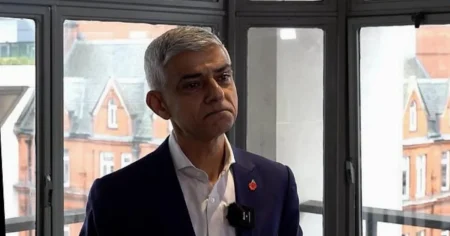




On a raw autumn afternoon in Gosport, a seaside town on Hampshire’s southern edge, the air felt heavier than usual. Police vans were parked on kerbs, shopkeepers were drawing their blinds early, and clusters of people with flags and loud voices were drifting through the streets. Among them was Dec Lea, a right-wing political activist who describes himself as “unapologetically British.” He had taken part in an anti-immigration protest near the Haslar Immigration Removal Centre, a sprawling former naval hospital that has become the focus of a fierce national argument about who belongs in Britain and who does not. After the chanting had died down and the crowd began to disperse, Lea did what countless people do on a Sunday: he headed for a nearby Wetherspoon pub. The Star, on Gosport High Street, is the kind of boozer that has become a British institution—slightly worn-in, carpeted with patterns that seem to have been designed by someone with a grudge against easy cleaning, serving pints that are cheap and chips that are reliable. It ought to have been a place where a man could lower his shoulders, take a deep breath, and return to ordinary life. But as Lea approached the entrance, a member of staff stopped him. The reason, he was told, was the small red poppy pinned to his jacket. Lea could not believe it. There was no Union Jack patch on his sleeve, no political slogan embroidered on his chest; there was only the little paper flower that millions of Britons wear every November to honour the dead. “I’m not wearing any Union Jack material or anything to identify that I’m English other than the poppy,” he said in a video posted to X, his voice shaking with a mixture of anger and bewilderment. “And The Star Wetherspoons denied entry because I was wearing a poppy. This is absolutely outrageous.” In the footage, he points across the road to a Union Jack flag hanging from a lamppost outside a Ladbrokes betting shop and says, simply, “We’re in England.” The worker, according to Lea, had cited the “England stuff” as the reason for turning him away. It was a confrontation that felt almost absurdist in its Britishness: a man trying to enter a pub while wearing a symbol of remembrance, blocked by a poorly worded security policy in a town already frayed by protest.
But what happened outside The Star did not occur in a vacuum, and it cannot be reduced to a simple story of a pub banning poppies. The protest that Lea had joined was organised by a group calling itself Gosport Patriots, which had formed specifically to oppose plans for the Haslar site. In the days leading up to the event, members shared flyers on a private Facebook page insisting that “everyone is welcome on Sunday. Put all differences aside and stand shoulder to shoulder.” The wording was warm, inclusive, almost gentle—but the reality on the streets was far more raw. The demonstration drew a counter-protest from the local branch of Stand Up to Racism, and the two sides faced off in the tight, cold streets near the removal centre. According to eyewitness accounts, some of the protesters chanted “deport the lot,” while another, fouler chant was also heard. The air was thick with anger, fear, and the kind of righteous certainty that makes people forget that their neighbours may feel differently. In such an atmosphere, the pubs in the area became nervous islands. Some simply closed their doors. Others, including The Star, tried to remain open but tightened their entry rules, instructing staff to refuse admission to anyone wearing anything that might be interpreted as political insignia. It was a decision born of fear, not malice, but it was applied with an inflexibility that soon produced exactly the kind of conflict it was designed to prevent. When a veteran in his Sunday clothes, wearing a poppy on his lapel, is told that his symbol of remembrance might be too political, the policy stops being sensible and starts being wounding. The local Stand Up to Racism group later argued that The Star was not banning poppies specifically, but rather refusing entry to anyone with political badges—a point they made in an attempt to calm the brewing row. But in the heat of the moment, nuance was drowned out by hurt.
The employees working inside The Star that afternoon were caught in an impossible trap. They were not politicians or philosophers; they were bar staff, kitchen workers, and security personnel trying to get through a shift without someone starting a fight. The video footage shared online shows one staff member trying to explain the decision to Lea with a patience that is almost painful to watch. “It’s a blanket, anything that could—I’m not saying it is—that could be perceived as political,” the employee says. Then, reaching for an example that was meant to demonstrate even-handedness, they added: “If that group down there, if they came down with Pride badges, we’ll also be turning those away.” The comparison was logical in a narrow, risk-management sense. Indeed, one can imagine a meeting earlier that day in which a manager laid out a simple set of rules: no flags, no slogans, no badges, no political clothing, just turn away anybody who looks like they might be looking for trouble. But logic is a poor defence when hearts are involved. A Pride badge is a statement of identity, certainly, but it is one that carries its own political charge. A poppy, on the other hand, is not normally worn to express a position on immigration or to challenge the government; it is worn to remember people who died in war. To place it in the same category as a campaign badge felt, to many, like a category error of the worst kind. Yet the staff member was simply doing what had been asked of them. They had no desire to hurt anyone. They were likely just as frightened and exhausted as everyone else. The real tragedy is that a pub, which is supposed to be a neutral space where people from different walks of life can sit together and disagree over a pint, had become yet another front line in a culture war. And the people bearing the consequence were not the organisers of the protest or the counter-protest, but ordinary workers and ordinary customers who just wanted to go home without being part of someone else’s symbol war.
Lea was not alone in his fury. As his video began circulating online, other voices emerged from the crowd of those who had been turned away from The Star. A veteran, whose account was reported by The Sun, said he had also been barred from entering the pub while wearing a poppy. He described the management’s attitude as seeing remembrance as “too political.” On the well-known Wetherspoon complaints Facebook group—a strange corner of the internet where people usually go to complain about warm beer, slow service, and unappetising meals—the thread quickly filled with customers claiming that the pub had “banned” them for wearing red poppies. Whatever the truth of each individual case, the pattern was clear: on that particular Sunday, in that particular pub, the wearing of a poppy had been enough to get a person stopped at the door. For a veteran, the experience was not merely inconvenient. It was a small, sharp betrayal. The poppy is one of the few remaining symbols in British public life that is genuinely shared. It is worn by royals and trade unionists, by army generals and schoolchildren, by Brexiteers and Remainers alike. It is sold by the Royal British Legion in train stations, supermarkets, offices, and indeed in Wetherspoon pubs themselves, where for years the company has proudly supported the Poppy Appeal. To be told that this symbol of sacrifice was too political to be allowed into a pub—a pub owned by a chain that sells poppies at its own bars—was like being turned away from church for carrying a Bible. The outrage was not simply about Dec Lea, a man who is no stranger to controversy. It was about the quiet, ordinary people for whom the poppy is a sacred and private thing: the elderly widow who has worn one every year since 1944, the young soldier who wears it in memory of friends, the child who pins one to a school blazer without fully understanding why it matters. When a symbol of collective grief is mistaken for a political banner, the grief itself begins to feel politicised. That is the true wound.
Wetherspoon’s official response came quickly, but it was written in the measured, cautious language of corporate crisis management—and it did little to soothe the raw emotions of the moment. A spokesperson for the company insisted that there was no ban on poppies, pointing out that Wetherspoon has been a “long-standing supporter of the Royal British Legion Poppy Appeal” and that poppies are sold in its pubs, including The Star. “There is no ban on poppies in Wetherspoon pubs,” the statement said firmly. The reason for the refusals, the company explained, was security. On the day of the demonstrations, The Star had introduced “standard security measures” on the advice of the police. With crowds gathering in the town and tempers flaring, staff had been told to be vigilant and to exclude anyone wearing items that could be perceived as politically provocative. The statement acknowledged that “some members of the public, including some wearing poppies, did not gain entry to the pub,” and noted that The Star had closed to all customers at 5pm on the advice of police and remained closed for the rest of the evening. It ended with an apology to “any regular customers who have been inconvenienced by Sunday’s events” and a promise to welcome everyone back the following day. On its own terms, the response was reasonable. A company cannot abandon its duty of care to its staff and customers; it cannot ignore police advice; it cannot allow a pub to become the flashpoint for a violent confrontation. None of that is disputed. But the word “inconvenienced” landed badly. For a veteran who had been turned away at the door for wearing a poppy, an apology for inconvenience felt like an apology for spilling a drink. The deeper emotional truth—that a symbol of remembrance had been mishandled, that people had been made to feel unwelcome in their own country—was not addressed. Wetherspoon also pointed to its dress code, which requires customers to be “fully-clothed” and to dress in a way that will not cause offence to employees or the public. Yet a poppy causes offence only if somebody chooses to be offended by it. In a divided society, that choice is being made more and more often, and the result is that the things we once shared are being pulled apart.
At the heart of this strange, sad little episode is a question far bigger than one pub or one activist: what does a poppy actually mean? For some, it is a simple act of remembrance, a way of honouring the dead and acknowledging that freedom has a cost. For others, it is a badge of national identity—a quiet assertion of Britishness in a world that feels increasingly unsure of itself. For still others, it has become a political symbol, whether because they wear it as a statement or because they refuse to wear it as a protest. The honest answer is that the poppy contains all these meanings at once, and its power comes precisely from that ambiguity. It is a memory, a prayer, a flag, and a wound all folded into a few square centimetres of paper. And when a society is as polarised as Britain is now, ambiguity becomes a target. The demonstrators outside Haslar were not marching to remember fallen soldiers; they were marching about immigration. The counter-protesters were not marching against remembrance; they were marching against racism. But when a man wearing a poppy is stopped at the entrance to a Wetherspoon pub and told that his poppy might be perceived as political, all those different currents crash into one terrible wave. The staff were trying to avoid conflict; the customer was trying to exercise his right to be a normal British citizen on a Sunday afternoon. Both were acting on their own sense of rightness, and both ended up feeling betrayed. Perhaps the only way forward is to meet these moments with more honesty and less outrage. We need to say, “I understand why you were scared,” and also, “I understand why you were hurt.” A symbol of remembrance should never be a reason to turn someone away from a pub, just as a pub should never feel the need to become a fortress during a protest. We are all stuck with the messy, difficult work of living together in a country that is divided in many ways but still shares a common history and a common hope. If the poppy means anything at all, it should remind us that those who gave their lives did so in the belief that we would find a better way of settling our differences than fighting over them. Turning that belief into reality—one pint, one conversation, one door left open at a time—is the hardest, and most urgent, act of remembrance there is.