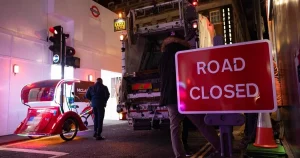


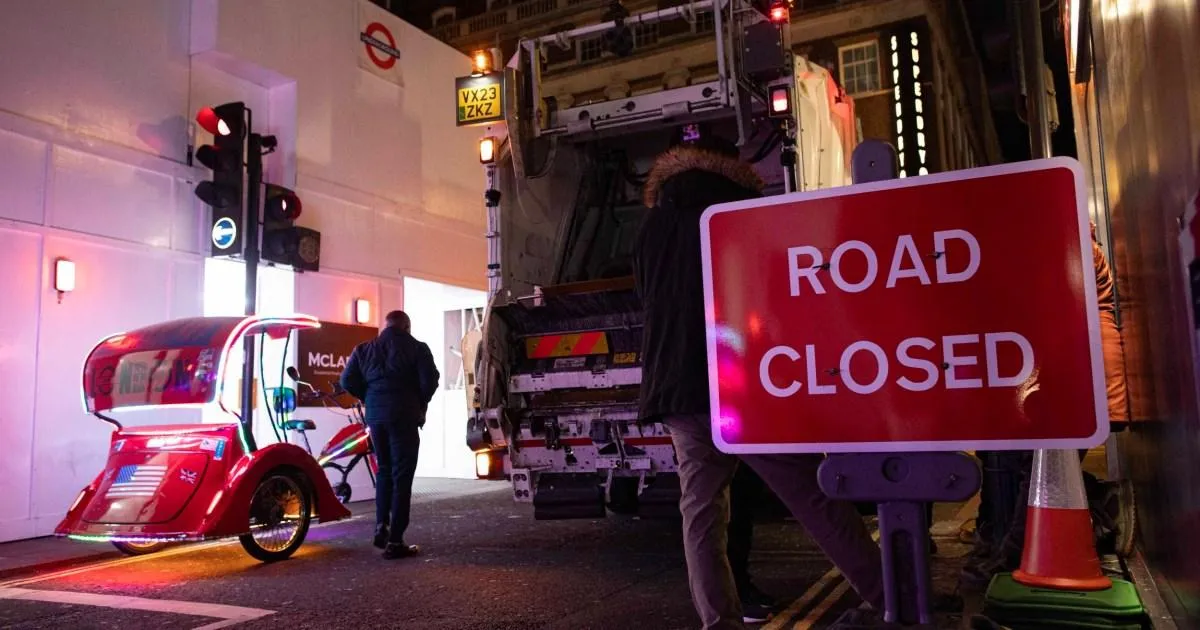
Oxford Street, the beating heart of British retail and one of the most famous shopping destinations in the world, has finally taken its long-awaited leap into a new era. From early morning today, a half-mile stretch of this iconic London artery is officially closed to traffic—a move that the Mayor of London, Sadiq Khan, believes will place it on the same global pedestal as New York’s Times Square or Barcelona’s La Rambla. When reporters arrived at the scene this morning, dozens of construction workers in high-visibility jackets were already busy setting up roadblocks along the route, transforming what was once a roaring river of red buses, black cabs, and delivery vans into a quiet, open canvas for pedestrians. The section from Orchard Street to Great Portland Street is now entirely traffic-free, and in a striking detail that underlines how serious this change is, even bicycles are banned from the zone. For decades, this exact stretch of Oxford Street has been the subject of endless debate, ambitious plans, and abandoned promises. But today, those decades of talk have turned into tarmac. Khan, who was on the street to mark the historic moment, called it a truly momentous occasion for the capital, and his excitement was palpable. “There has been talk of pedestrianising Oxford Street for decades,” he said. “After so many false dawns, and now working with a government that shares the scale of my ambition, I’m proud that we’re finally unlocking a new era for the street.” It is a bold vision, and one that promises to reshape not just the street itself, but the entire experience of visiting central London.
The history of Oxford Street is a history of reinvention. For centuries, this has been the nation’s high street, a place that has adapted to changing times, weathered economic storms, and helped shape British culture along the way. The grand department stores that line the route—John Lewis, Debenhams, Selfridges, and the many flagship retailers that have come and gone—have always been more than just shops; they are landmarks, meeting points, and even workplaces for generations of Londoners. Now, the street is being reimagined once again, and this time the vision is dramatically different. The pedestrianised section will eventually become a piazza, a continental-style open space where outdoor tables from restaurants and cafes spill onto the pavement, and where visitors can linger rather than rush. Khan’s own words paint a picture of what he hopes this transformation will achieve: a world-class pedestrian space where flagship retailers sit alongside new shops and workplaces, and where exciting new experiences—from sport to fashion to cultural events—draw people in from around the globe. He is adamant that this is not just about aesthetics or tourist selfies; it is about economic survival and growth. “Revitalising Oxford Street will boost jobs and economic growth in the capital,” he said, adding that it will unlock the full potential of the West End and help build a better, greener, and more prosperous London for everyone. For supporters, this is the long-overdue arrival of a cleaner, quieter, more human-friendly Oxford Street—a place where the act of shopping becomes a pleasure rather than a battle against traffic and exhaust fumes.
But change on this scale never comes without friction, and the practical realities of removing traffic from such a central artery are already raising serious questions. For one, buses and taxis are no longer allowed to use the street, which means thousands of daily commuters, shoppers, and tourists must adjust to new routes, new stop locations, and longer walks. Transport for London has published detailed plans showing that bus routes 7, 94, 98, 139, 390, N7, N98, N113, N137, and N207 will all be redirected down Wigmore Street and Henrietta Place, running behind the John Lewis store before rejoining Oxford Street at Great Titchfield Street, on the other side of Oxford Circus. The exception is route 139, which will continue along Regent Street instead. For passengers, this means an extra 100 to 200 metres of walking to reach the new bus stops—a distance that might sound small on paper but can feel significant when carrying heavy shopping bags, pushing a buggy, or navigating the crowds of central London. To ease the transition, staff will be deployed near the new stops and along Oxford Street to help bewildered travellers find their way. There is also the broader concern that the closure will simply push traffic into the surrounding streets, creating congestion nightmares in areas that were already struggling. Critics have been quick to warn that the West End, already infamous for its constant road closures and gridlock, could become even more hostile to drivers and delivery vehicles. The banning of taxis, in particular, has provoked anger among black cab drivers, who see it as another blow in what they describe as a war on motorists. The tension is not just about convenience; it is about who the city is for, and how the competing needs of drivers, pedestrians, businesses, and residents can ever be balanced.
Sadiq Khan’s personal connection to Oxford Street adds an unexpectedly emotional layer to this story. Long before he was the Mayor of London, he was a teenager hanging around the shops, spending his money and his time in this bustling neighbourhood. He has spoken openly about working at Debenhams, Barratts shoes, Peter Jones, and John Lewis, a retail apprenticeship that gave him an intimate understanding of the street’s rhythms, its workers, and its customers. That personal history seems to have shaped his determination to see the pedestrianisation project through. “I spent a lot of time here as a teenager shopping,” he said, with a nostalgic smile. “I worked at Debenhams, Barratts shoes, Peter Jones, and John Lewis as well. It’s so important we support these shops and jobs.” His words echo the hopes of many business owners along the route, who see the traffic-free future as a lifeline rather than a threat. John Lewis, whose flagship store falls squarely within the newly pedestrianised zone, is among the most prominent supporters of the change. The company has served Oxford Street for more than 160 years, and its chief operating officer, Naomi Simcock, described the move as one of the most exciting changes the street has ever seen. She revealed that John Lewis has invested millions in refurbishing its flagship store, adding a new 300-seat restaurant, a revamped sports department, and ambitious festive plans. “Retailers need to step up too,” she said, acknowledging that the pedestrianisation alone is not enough; businesses must also reinvent themselves to give people more reasons to visit. It is a hopeful vision, one in which the closing of the street to vehicles becomes an opening for something more human—a place where people can stroll, sit, eat, and linger, rather than simply hurry through.
Yet for every supporter, there is a sceptic, and the voices of those who oppose the change are not easy to dismiss. Cab driver Geoff, 57, who has spent more than two decades working in the West End, previously told Metro that the centre of London has become a nightmare for drivers, with constant road closures and what he perceives as a deliberate effort by the mayor to penalise anyone on four wheels. “The planned pedestrianisation will make things worse for everyone,” he said. “This is an own goal for tourism; it will just make their lives more difficult.” His frustration is shared by a foreman working on a redevelopment near Chapel Place, just off Oxford Street, who predicted that getting vehicles in and out of the area would become a massive pain. “The traffic is already terrible; this will only make this worse,” he said. “Yes, tourists will have a nice stretch of road to hang out in. But as soon as they leave the pedestrian zone, it’s going to be bumper-to-bumper traffic and stress all the way.” These criticisms highlight a deeper tension: the same changes that make a place more pleasant for pedestrians can make it more difficult for the people who live, work, and deliver goods there. The challenge is not whether to pedestrianise, but how to do it without simply displacing the problem to the streets around the edges. Taxi drivers, shopkeepers, construction crews, and residents all have legitimate concerns, and the next few months will reveal whether Khan’s bold experiment can deliver the promised benefits without leaving anyone behind. The city is watching, and so is the rest of the world, because the fate of Oxford Street is often seen as a barometer for the health of the high street itself.
In the end, the pedestrianisation of Oxford Street is more than a transport policy or an urban planning project; it is a statement about the kind of city London wants to be. For centuries, as Khan himself noted, Oxford Street has reinvented itself, adapting to changing times and helping shape British culture along the way. It has survived the Blitz, the rise of the shopping centre, the arrival of online retail, and countless economic crises. Now it faces a new test: can a street that was built around the car, the bus, and the taxi learn to thrive without them? The mayor is betting that it can, and he is encouraging everyone to explore and enjoy the newly traffic-free street, to see it not as a loss of convenience but as a gain in quality of life. “I encourage everyone to explore and enjoy the newly traffic-free street, as we create a new vibrant destination that welcomes Londoners and visitors from around the world,” he said. The next chapter will be written slowly, with all the mess and unpredictability of real urban life. There will be disruptions, complaints, and likely some early teething problems. But there will also be moments of simple joy: a child riding a scooter down the middle of the road, a couple sharing a coffee at a pavement table, a tourist taking a photograph without a bus roaring past. The piazza that eventually rises from this construction site will be a physical symbol of a larger idea—that cities are for people, not just for traffic. Whether it becomes the next Times Square or simply a cleaner version of the old Oxford Street remains to be seen. But one thing is certain: the street will never be the same again. The barriers have gone up, the buses have been diverted, and the silence where engines once growled is now filled with the sound of footsteps. After decades of talk, Oxford Street is finally becoming a place to be, not just a place to pass through.