

It was a crisp November afternoon when Simon Dinsdale, a seasoned detective from Essex, sat down for lunch with his daughter Kate in Ipswich. She was in her twenties, excited about an upcoming Christmas party, yet a shadow of worry crossed her face as she held up a local newspaper. The headlines screamed of two missing young women: Gemma Adams, twenty-five, and Tania Nicol, nineteen, who had vanished on the streets just weeks apart. Simon’s internal response was immediate and chilling. “I remember thinking, well, they are dead,” he recalls. “Women who were settled, who had family in Ipswich, do not just completely drop off the map.” But these women were especially vulnerable—both were sex workers who operated on the streets, with addictions that left them at the mercy of the night. Their families were desperate, and local police had been scouring the area with leaflets and appeals. As Simon sipped his tea, he had no idea that within weeks, he would be plunged into the darkest investigation of his career, one that would haunt him forever.
The days that followed were a blur of escalating horror. Gemma’s body was discovered in a waterway near Ipswich, then Tania’s, each found six days apart. Then, in rapid succession, three more women vanished and were later found murdered: Anneli Alderton, a young mother who had been seen on a train, Paula Clennell, and Annette Nicholls, all dumped in woods and fields around the town. The tiny rural force of Suffolk Constabulary was suddenly confronting a serial murder investigation of a magnitude it had never faced. “It was a shock when Anneli’s body was found because no one had realised she was missing,” Simon remembers. The force lacked the resources, so reinforcements were called. On December 12, 2006, Simon was at home off-duty when his boss called, ordering him to Ipswich for a secondment. He didn’t come home until April. “I took my entire investigation team,” he says, filling hotel rooms across the town. As detective superintendent, he became the Senior Investigating Officer for Annette and Paula’s murders. They began working sixteen-hour days in whatever space they could find at Suffolk Police headquarters, often briefing in the canteen. “Two young women go missing and nothing is seen or heard for nearly a month,” he recalls. “Then, over four days, another three bodies are found dumped. Five young women murdered by the same person in a very short space of time. We had to stop the killer doing it again.”
One of Simon’s first tasks was to inform Gemma’s family that her body had been found. He describes these visits as “the agony” – a term used in the police for the moment you must tell someone that a loved one is dead. “It is desperately sad,” he says. “The family are victims as well, just as much as the poor girl that’s lost her life. And when you mention the word ‘murder’, that brings even more disbelief and so many questions.” Gemma had been described by her parents as “bright and bubbly,” a woman who loved the Brownies, grew up playing the piano and riding horses. Now she was a victim of a killer who seemed to be hunting the streets. Simon, with 25 years’ experience, had done this before, but never like this. “Someone was killing people,” he says. “You’ve got to find them and get the evidence to lock them up. That is a huge job to be involved in, one of national importance.” The pressure was relentless, and so was the world’s attention. TV crews and international media camped outside police headquarters. “I’m briefing my guys in the canteen,” Simon remembers, “and I look over my shoulder and the crime correspondent for Sky is sitting there having his bacon and eggs. And Fiona Bruce is there. It was utterly surreal. I thought – I bet they’re bleeding listening.”
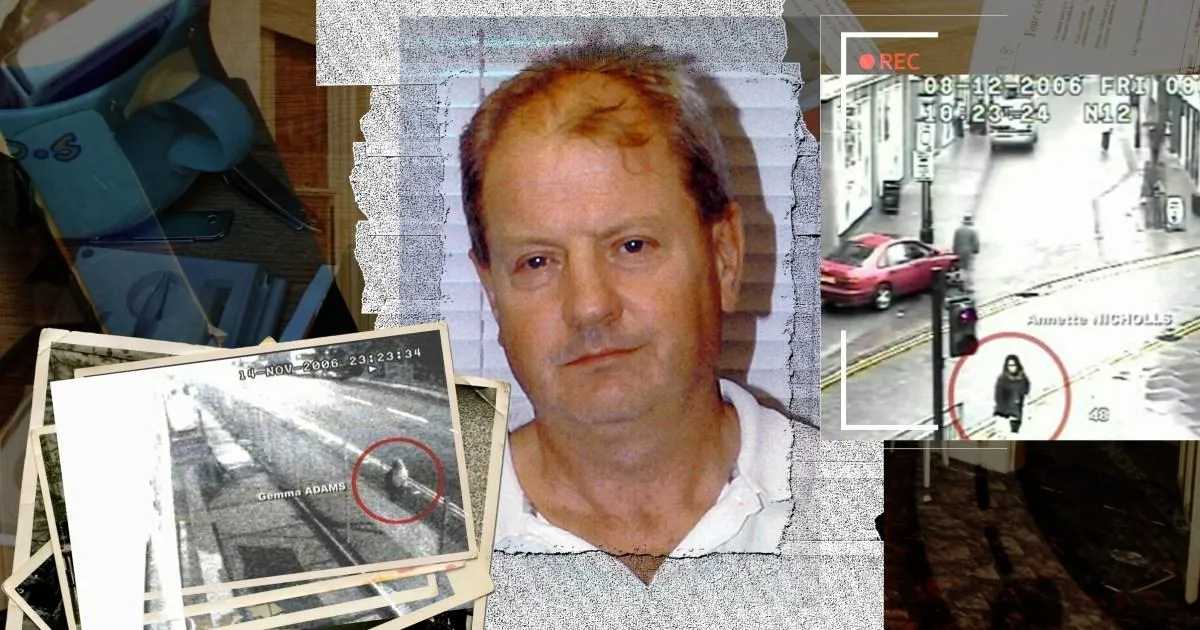
The investigation intensified. Detectives flooded the area with officers, mounted roadblocks, examined thousands of CCTV images, and collected DNA from hundreds of men. They urged women involved in street sex work to stay off the streets while the killer remained at large. Seven weeks after Tania Nicol was reported missing, investigators identified a DNA match on three of the victims: Steve Wright, a forklift truck driver who lived near the women’s beat and frequently paid for sex. Unknown to the police, he was a quiet, unassuming man. One woman who had encountered him five years earlier called him a “cruel, nervous, perverted and quiet little man.” Wright was arrested the next day, but that was only the beginning. “That’s the easy part,” Simon says. “It’s: ‘You’re nicked’. Thereafter, you’ve got to prove it. Knowing someone has done it and proving it are two completely different things.” The case took over a year to bring to court. “It is an enormously intensive investigation,” Simon explains, “to take every single piece of evidence you are going to rely on and stress-test it to the point that it proves beyond reasonable doubt this person is responsible. It was a huge piece of work.”
After a six-week trial at Ipswich Crown Court in February 2008, Steve Wright was found unanimously guilty of murdering all five women and sentenced to life imprisonment. He never admitted the murders. “The investigation was a huge learning curve for me, and I did feel a certain amount of professional pride after he was convicted,” Simon says. But that pride is tempered by a deep-seated unease about how the victims were portrayed. At the time, headlines referred to them as “prostitutes” before mothers, sisters, and daughters. Their disappearances were initially viewed through the lens of their lifestyles—street sex work and drug addiction—rather than their humanity. “The thing that should always be made very clear is that those five women were victims,” Simon insists. “They made some mistakes in their lives. None of them grew up wanting to be a sex worker. Not one of them really wanted to be so badly affected by drugs that they had to sell themselves to buy them. They were victims first and foremost.” He adds, “It does bother me that even today the case is regarded as ‘the prostitute murders’, like they were disposable. One of them was a mother, one was pregnant when she was murdered. They did not deserve that.”
Simon’s concern has only deepened with time. After a breakthrough in DNA technology and new witness evidence, Wright was sentenced in February to a further 40 years for the kidnap and murder of seventeen-year-old Victoria Hall, and the attempted kidnap of another woman, more than twenty-five years ago. The judge told him he would die in prison. For Simon, the case needs further investigation. He believes Wright may have killed other women. “He was arrested when he was 48. You don’t suddenly start murdering people in your forties. He is a predatory serial killer. My concern now is, are any of my former colleagues going to talk to him and ask him what else he has done? There is no doubt in my mind that he has killed other people.” The quiet terror of those five women, and of Victoria Hall, may not be the whole story. Simon’s voice carries the weight of a man who has seen too much, but who still cares deeply about the truth. “Those women were not disposable,” he says. “They were daughters, mothers, sisters. We owe it to them to keep asking questions.” As he reflects on the case, he is reminded of that November lunch with Kate, and how a simple newspaper headline could set off a chain of events that would define the rest of his life. ‘I’m just glad we got him,’ he says quietly. ‘But I can’t shake the feeling that there are more names out there. And they deserve justice too.’