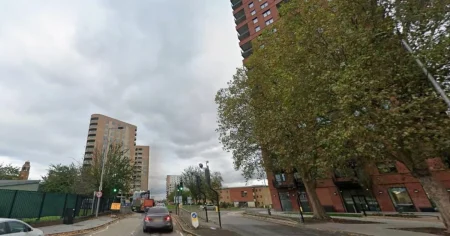

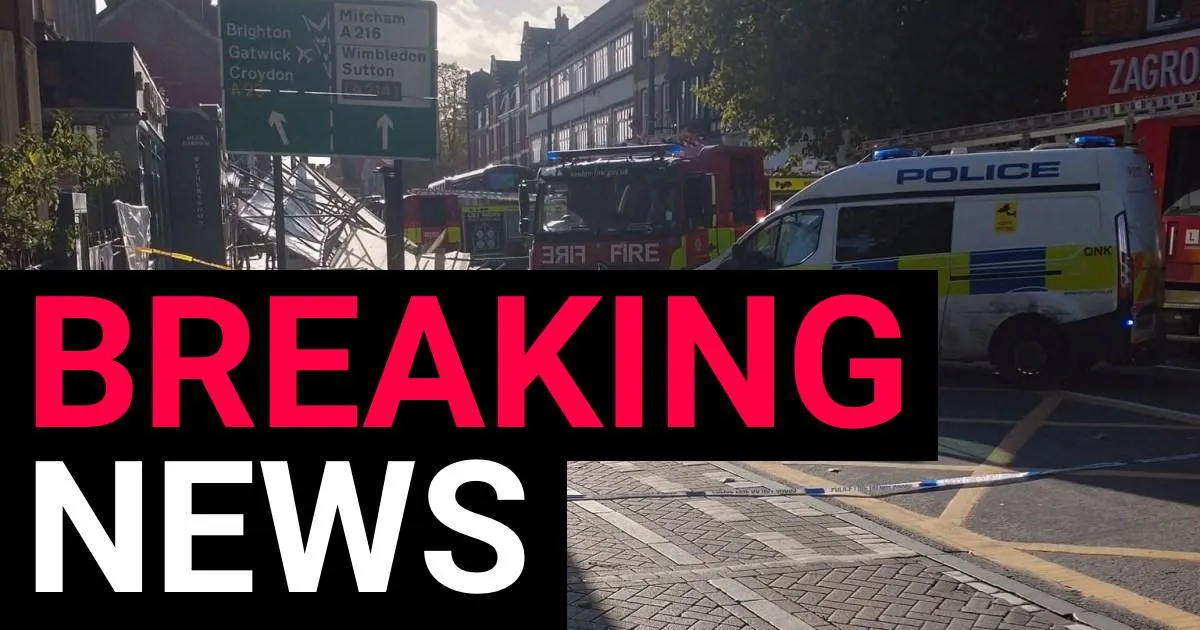
On an ordinary Sunday afternoon, Streatham High Road was doing what it always does: keeping the rhythm of the city going. People were walking between shops, waiting at bus stops, pulling up hoods against the gathering wind. Storm Boelo had already made itself felt across the country, but there is something about a familiar street that lulls you into thinking you are safe. At around 1.30pm, that illusion shattered. A section of scaffolding outside a building site on the high road gave way under the force of violent gusts. Heavy metal poles, boards, and protective coverings came crashing down, striking two pedestrians who happened to be walking past at that exact, unforgiving moment. The collapse happened in seconds, but its consequences will last far longer. The two people were trapped beneath the wreckage, pinned in a tangle of industrial materials that had suddenly become deadly. Others on the street reacted instinctively. Passersby did not stop to think about their own safety; they ran toward the fallen structure and began pulling at the debris with their bare hands, trying to free the injured. The images from the scene show the twisted remains of the scaffold spread across the middle of the road, a shocking intrusion of metal and fabric into everyday life. Neighbours described the scene as distressing, and it is easy to understand why. This was not a distant news report from somewhere else. It was a busy London street, with ordinary people going about their lives, when the storm brought their world to a sudden, frightening halt.
The immediate aftermath must have been chaotic and heartbreaking. There would have been shouts, cries, the clatter of debris still shifting in the wind, and the urgent sound of footsteps as people rushed to help. The two pedestrians who were struck by the scaffolding had been walking along a road they probably knew well. Perhaps they were heading home after visiting friends, or running a Sunday errand, or simply out for a short walk to escape the confines of their homes. In a matter of moments, all of those ordinary intentions were overtaken by an emergency no one could have expected. The people who managed to pull them out of the wreckage were not professional rescuers. They were shopkeepers, shoppers, neighbours, strangers. They were the kind of people who, when confronted with something terrible, do not look away. They pushed through the tangle of poles and coverings, trying to reach the voices underneath. The distress felt by witnesses was not just about the physical damage, but about the human reality of seeing people in danger and not knowing whether they would be all right. In the photographs, the scaffolding lies across the asphalt like the skeleton of an enormous creature, a surreal reminder of how much force the storm was carrying. The road, so often filled with traffic and life, became a place of halted time, where the only thing that mattered was the rescue unfolding amid the debris.
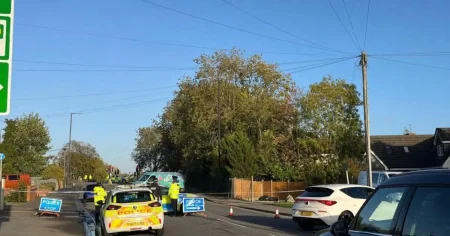
By the time official emergency services arrived on the scene, the most urgent part of the rescue had already been carried out by members of the public. The London Fire Brigade confirmed that firefighters responded to an incident involving collapsed scaffolding on High Road, Streatham. They reported that two people had been trapped under the scaffolding and had been rescued before the Brigade arrived. Both people were taken to hospital by the London Ambulance Service. The Brigade’s control officers received the first of five calls at 1.31pm, and crews were mobilised from Tooting, Lewisham, West Norwood, and surrounding fire stations to the scene. That kind of response is a reminder of the readiness of emergency services, but it also shows how crucial the actions of bystanders were in those first critical minutes. The London Ambulance Service also sent a significant number of resources, including ambulance crews, an incident response officer, and paramedics from the hazardous area response team, or HART. These are highly trained specialists who deal with complex and dangerous situations, and their presence underscores the seriousness of the incident. The fact that both patients were treated at the scene and then transported to a hospital suggests that the injuries required urgent medical attention, though the full extent of what happened has not been made public. In the midst of a raging storm, with winds still howling and debris scattered across the road, the coordination between firefighters, paramedics, and the public became a lifeline for those two people.
But this incident was not an isolated piece of bad luck; it was part of a much larger picture of destruction and disruption sweeping across the United Kingdom. Storm Boelo continued to batter the country with remarkable intensity, and the effects were felt far beyond Streatham High Road. More than 82,000 homes were still without power as the storm raged on. Families sat in cold, dark houses, unable to cook, heat their homes, or charge their phones, waiting for the winds to ease and the lights to return. The Met Office reported that wind speeds had widely reached 60 to 70mph, particularly within the amber warning zone that had come into force at 9pm on Saturday. Those are not just numbers; they are the kind of speeds that uproot trees, tear off roof tiles, send garden furniture flying, and turn everyday structures like scaffolding into dangerous projectiles. The high road in Streatham was not alone in feeling the force of the storm. Across the country, people were dealing with fallen branches, flooded roads, delayed trains, and damaged buildings. But there is something especially unsettling about a collapse on a busy urban street. It reminds us that the structures we rely on—the scaffolding that marks a building under construction, the glass windows we walk past, the street signs we glance up at—are not permanent guarantees. They are materials, held together by human design, vulnerable to the immense power of nature.
In moments like this, the true character of a community is revealed. It would have been all too easy for people to stay back, to wait for professionals to arrive, to assume that someone else would handle it. But that is not what happened. The passersby in Streatham High Road became the first responders. They risked their own safety to help people they did not know, because that is what human beings are capable of doing when faced with another person’s suffering. The neighbours who described the scene as distressing were not just expressing fear; they were expressing a deep sense of connection, a recognition that the people caught in that scaffolding could have been any of them. There is a quiet heroism in ordinary people doing extraordinary things without thinking about it. The emergency services, of course, played their own vital role, and their professionalism and speed deserve recognition. But the rescue that day was a shared effort. It happened because someone walking nearby heard the crash and decided to run toward it instead of away. It happened because people worked together, pulling at metal, clearing coverings, offering reassurance, holding space for the injured until help arrived. In a city that can sometimes feel anonymous, this was a reminder that community still exists, especially in the most difficult moments.
As Storm Boelo continues to move through the UK, and as forecasters warn of further extreme weather on the horizon, the story from Streatham High Road remains a powerful reminder of how fragile life is. The article that first reported this incident also linked to other sobering headlines: a four-year-old girl who died after falling from a London tower block, mountain rescuers battling horrific storm conditions in search for a lost man, and warnings of a ‘Godzilla El Niño’ threatening havoc after the storm mayhem. These stories are connected by a common thread of vulnerability. They remind us that weather is not just a backdrop to our lives, but a force that can change everything in an instant. For the two people who were taken to hospital from Streatham High Road, the storm will never again be just a matter of wind and rain. It will be tied to the moment their ordinary Sunday was torn apart. They are in the care of hospital staff now, surrounded by professionals working to help them recover. Their names have not been released, and their futures are uncertain. But what is certain is that they were not alone when it happened. They were surrounded by people who cared, who acted, who fought to pull them out of the wreckage. In the days to come, the scaffolding will be rebuilt, the street will be cleaned, and life on Streatham High Road will return to something approaching normal. But for those who were there, and for all of us who hear their story, the memory will linger. It is a story of peril and panic, but also of courage and compassion. It is a reminder to check on our neighbours, to take storm warnings seriously, and to remember that in the middle of any storm, the most powerful force is the willingness of people to help one another.