


Paragraph 1: The Quiet Royalty of Britain’s High Streets
There is a kind of royalty that doesn’t wear crowns or sit on thrones, yet it holds communities together with quiet, steadfast dedication. In Britain, where the high street has been through decades of turbulence — shuttered shops, shifting shopping habits, and the relentless rise of online giants — the people who keep the heart of the neighbourhood beating are often overlooked. But now, some of the country’s best “bossmans” are finally getting the kind of recognition usually reserved for kings and queens. Four of Britain’s leading royal portrait artists, whose brushes have captured Queen Elizabeth II, King Charles III, the Prince and Princess of Wales, and Princess Anne, have turned their attention away from palaces and toward the everyday heroes of our streets. They have immortalised a café owner, a pub landlord, a takeaway proprietor, and a corner shopkeeper in a new exhibition called Local Royalty, which will be unveiled at London’s Saatchi Gallery. Commissioned by Coca-Cola GB and free to the public, the exhibition marks 175 years since the birth of the modern British high street in 1851, during the Victorian shopping revolution. The timing feels particularly meaningful, as new research reveals just how much these independent businesses are taken for granted. Nearly four in five Britons believe local business owners are underappreciated, and 83 percent think they face challenges unlike anything seen before. Meanwhile, 80 percent of people want to see them celebrated more often. These are not just statistics; they are a reflection of a national affection for the shopkeepers, publicans, and fry cooks who make a street feel like a home. The portraits on display are more than paintings — they are thank-you letters, woven in oil and colour, to the people who keep Britain’s towns alive. The artists, who have spent years studying the faces of monarchs and heirs, have discovered that the dignity, warmth, and character they sought in royal sitters is just as present in a woman behind a fish counter or a man stacking shelves at dawn.
Paragraph 2: Pindy Kaur, the Fish and Chip Queen of the North
Among the first of these local royals to receive the full portrait treatment is Pindy Kaur, the force behind the Ocean Fish Bar in Barnsley. Her family-run takeaway has become a much-loved institution in the South Yorkshire town, but it wasn’t always that way. When Pindy took over the struggling shop in the 1990s, it was a far cry from the thriving community hub it is today. Over more than 25 years, she has poured her heart, energy, and an extraordinary generosity of spirit into the business, turning it into a favourite gathering place for locals who know they will always be greeted with a warm smile and a properly cooked meal. She has fed generations of families, celebrated their joys, and comforted them on difficult days, all through the simple, profound act of serving good food. The artist chosen to paint her is Nicky Philipps, a name synonymous with royal portraiture — she has produced three portraits of the late Queen Elizabeth II. For Philipps, the experience of painting Pindy was a revelation. She deliberately kept the background minimal, because, as she put it, this story is not about a fancy setting or elaborate props. It is about a woman who feeds her locality with a generosity of spirit, who keeps the community’s body and soul together year after year. “Pindy is clearly the fish and chip queen of the north,” Philipps said, and the title fits perfectly. The painting captures more than a likeness; it captures the essence of a woman who has become a pillar of her community. In a world where so much has changed, the Ocean Fish Bar remains a constant — a place where the batter is crisp, the chips are golden, and the person serving you genuinely cares. That is a kind of royalty no crown can confer. Pindy’s story is a reminder that the true backbone of Britain is not found in boardrooms or parliamentary chambers, but in the small, unglamorous spaces where people show up every day to serve their neighbours with pride and love.
Paragraph 3: Kaual Patel, the Corner Shopkeeper with an Open Shelf and an Open Heart
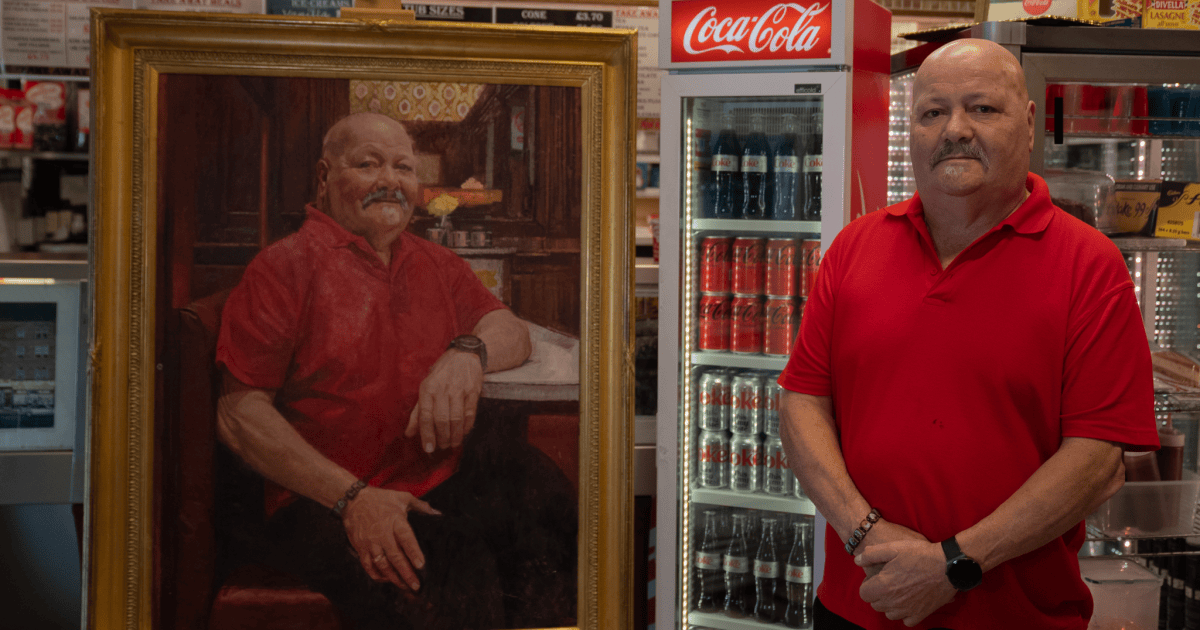
In Catford, south-east London, another local royal has been given the artistic honour usually reserved for aristocracy. Kaual Patel runs Torridon Convenience Store, a corner shop that has been part of the fabric of the neighbourhood since his father bought the business in 1984. Kaual took over in 2000, but he inherited far more than a shop — he inherited a legacy of trust, familiarity, and community service. For more than two decades, he has been the first face many locals see in the morning and the last before they head home at night. He is the person who knows that Mrs. Jones likes her newspaper saved, that the kids from the school across the street are allowed to buy sweets only after they’ve finished their homework, and that a kind word can turn around someone’s entire day. But Kaual has done something even more remarkable: he has used his corner shop as a platform to champion independent producers. With a simple but powerful promise — “If you’re a local producer, there’s a space on my shelf for you” — he has turned a convenience store into a celebration of small businesses, giving local artisans, bakers, and makers a place to shine. The artist tasked with immortalising him is Nick Bashall, who previously painted Princess Anne. Bashall’s portrait of Kaual is a testament to the quiet dignity of the man behind the counter. In an age of faceless online shopping, Kaual represents the opposite: a real person, with a real name, who looks you in the eye and remembers your story. The corner shop is often described as the heart of a neighbourhood, and in Catford, that heart beats with remarkable strength. The research supporting the Local Royalty exhibition found that almost half of Britons would struggle to live without their local corner shop, and it is easy to see why. Places like Torridon Convenience Store are not just places to buy milk and bread; they are anchors of community life, spaces where human connection is still the most important product on the shelf. Kaual’s portrait honours not just one man, but every independent shopkeeper who has ever unlocked a door at 7 a.m. and served the neighbourhood until late, asking for nothing in return but a little loyalty and kindness.
Paragraph 4: Gino Verecchia and the Century-Old Café That Fed Glasgow’s Soul
Further north, in Glasgow, the royal treatment has been extended to Gino Verecchia, whose family has run the University Café since 1918. For more than a century, this unassuming café has served generations of Glaswegians, surviving wars, economic crises, and the ever-changing landscape of the British high street. It is a place where time seems to stand still, where the gelato recipe has remained unchanged for a hundred years, and where Scottish favourites are served with a side of history. The café’s reputation has even reached the late celebrity chef Anthony Bourdain, who once sampled its battered haggis — a dish that perfectly encapsulates the café’s unique blend of Italian tradition and Scottish soul. Gino, who has carried the family torch into the modern era, was painted by Gareth Reid, an artist who previously portrayed King Charles III when he was Prince of Wales. The choice is fitting, for Gino is, in his own way, a monarch of his domain — the custodian of a legacy that has fed students, workers, families, and famous visitors for over a hundred years. The University Café is more than just a place to eat; it is a living museum of Glasgow’s social history, a witness to countless first dates, job interviews, celebrations, and quiet moments of reflection. Gino’s portrait captures not just the man, but the weight of a family story that has been passed down through generations. In an era when so many independent businesses are forced to close their doors, the survival of the University Café is a triumph of resilience and tradition. It reminds us that the high street is not just a collection of shops, but a repository of collective memory. When we lose a place like this, we lose a piece of ourselves. But when we celebrate it, as the Local Royalty exhibition does, we acknowledge that the people who keep these institutions alive are as worthy of artistic honour as any monarch. Gino’s face, rendered in oils, becomes a symbol of every immigrant family that built a new life in Britain through hard work, good food, and an unwavering commitment to their community.
Paragraph 5: Simon “Slugger” Dafforn-Jones and the Pub That Holds Dittisham Together
In the idyllic village of Dittisham, Devon, the local royal is a pub landlord known to everyone as “Slugger.” Simon Dafforn-Jones has run the Ferry Boat Inn for almost 20 years, following in his father’s footsteps and becoming as much a part of the landscape as the river that flows beside the pub. The Ferry Boat Inn is the kind of establishment that defines a village — a place where locals gather to celebrate, commiserate, argue about football, and toast absent friends. It is a warm, welcoming haven where the landlord knows everyone’s name, and everyone knows his. The artist chosen to paint Simon is Jamie Coreth, the celebrated portraitist behind the first official joint portrait of the Prince and Princess of Wales. For Coreth, painting a pub landlord was not a step down from royal commissions, but rather a continuation of a proud artistic tradition. “Honouring everyday people is a continuation of the same tradition that portrait painters have engaged in for centuries,” he said. When he met Simon and stepped into the Ferry Boat Inn, he understood instantly why the pub had been chosen for such an honour. “As soon as I went and met Simon, saw this pub, I understood why he was chosen by Coca-Cola,” Coreth remarked. There is something deeply authentic about a pub that has been run by the same family for two decades, where the beer is poured with care, the conversation flows freely, and the landlord is as much a friend as a businessman. Simon’s nickname, “Slugger,” hints at a personality that is approachable, sturdy, and full of character — exactly the kind of person who keeps the heart of a community beating. Pubs have faced enormous challenges in recent years, from changing drinking habits to the impact of the pandemic, and yet places like the Ferry Boat Inn endure. They endure because of people like Simon, who understand that a pub is not just a business, but a vital social institution. His portrait is a tribute to every landlord and landlady who has ever pulled a pint, listened to a regular’s troubles, and kept the lights on in a beloved local.
Paragraph 6: A Royal Exhibition for the True Backbone of Modern Britain
The Local Royalty exhibition, running at London’s Saatchi Gallery from October 28, is more than just a display of artistic talent — it is a national act of gratitude. As Britain marks 175 years since the modern high street began taking shape in 1851, the exhibition invites us to look again at the people who keep those streets alive. The survey of 2,000 consumers behind the exhibition found that 87 percent of Brits consider independent businesses an essential part of British life, and 79 percent believe their communities would be worse off without them. Yet these same businesses are often taken for granted, struggling against rising costs, online competition, and changing consumer behaviour. The research also revealed that nearly half of Britons would struggle to live without their local corner shop, followed by cafés (37 percent), takeaways (35 percent), and pubs (31 percent). These numbers tell a story of deep emotional attachment to the small businesses that shape our daily lives. Dusan Stojankic, of Coca-Cola Great Britain and Ireland, captured the sentiment perfectly: “Independent businesses are the backbone of modern Britain. This exhibition is an ode to the people who keep them thriving. Put simply, they are local royalty.” And that is exactly what these portraits convey — not just likenesses, but love. Each business owner will receive their finished portrait, a lasting memento of their contribution, along with a donation to a local charity of their choice. The gesture is small compared to the decades of service these individuals have given, but it is a meaningful recognition of their worth. The exhibition asks us to rethink who we consider important, to look beyond titles and status, and to see the heroism in a café owner who wakes up at dawn, a shopkeeper who stocks shelves for the tenth time that week, a pub landlord who stays late to make sure everyone gets home safely, and a takeaway owner who feeds the neighbourhood with pride. They may never sit on a throne, but they rule the streets where we live, work, and love. In their faces, painted with the same care and skill as the faces of kings and queens, we see the true face of Britain — resilient, generous, and quietly magnificent. The Local Royalty exhibition is not just a collection of paintings; it is a mirror held up to the nation, showing us who we really are and who we should truly celebrate.