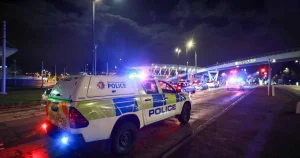


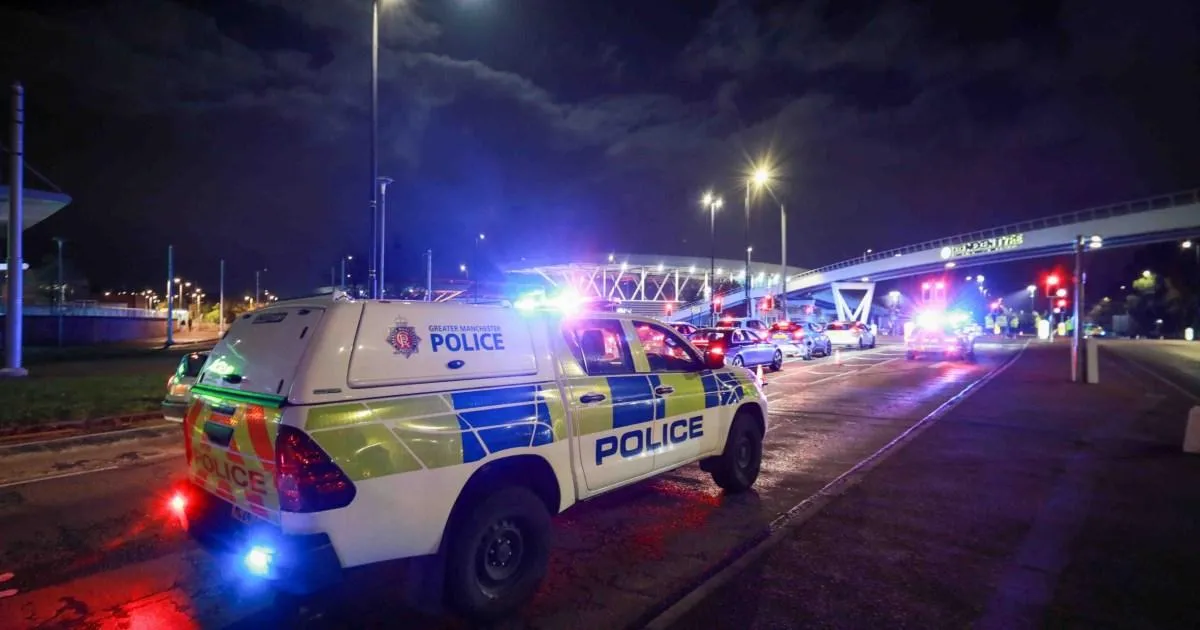
A woman is now fighting for her life after reportedly falling from a height near Manchester City’s Etihad Stadium, an incident that turned a familiar corner of east Manchester into a scene of urgent rescue and quiet disbelief. Emergency services were called to the junction of Alan Turing Way and Ashton New Road, close to the Premier League ground, at around 6.50pm on Sunday evening. What had probably started as an ordinary late-October night, with lights glowing in the stadium and people making their way home through the streets around the ground, suddenly changed when reports came in of a woman falling from height. Paramedics and police officers arrived within moments, and the woman was swiftly taken to hospital. Greater Manchester Police have since confirmed that she remains in a critical condition, and the phrase has been repeated by everyone from official spokespeople to local residents trying to make sense of the news. The woman, who has not yet been named, is said to have suffered serious injuries in the fall, and every available resource has been focused on stabilising her. For her family and friends, the hours since the incident must have passed in a blur of fear, confusion and desperate hope. The exact circumstances are still unknown, and the investigation is in its early stages, but the human reality is already painfully clear: a woman’s life has been interrupted in the most dramatic and frightening way, and the people who love her are facing an agonising wait. For the wider community, the shock of seeing a police cordon thrown across a well-known junction, with officers, detectives and forensic teams working under the glare of lights, was visceral. This was not a matchday incident, and it did not involve any of the usual football-related drama. It was a personal tragedy unfolding in a public place, and it served as a stark reminder that the landscapes we pass every day, the bridges we cross, the roads we drive down, are also places where lives can change forever in an instant. As the night wore on, the initial chaos of sirens gave way to a more solemn atmosphere, with investigators methodically going about their work while the city carried on around them.
The police response was swift and comprehensive, with a large cordon quickly put in place around the scene. The area around the junction of Alan Turing Way and Ashton New Road is a major gateway to the Etihad, and on a Sunday evening it is not usually the focus of such intense emergency activity. Yet within minutes of the first reports, the pavements were sealed off and the public were being guided away from the area. Perhaps the most striking detail was the closure of the footbridge that links the stadium to Manchester City’s football academy. That bridge, which is used by players, staff, academy prospects and supporters, was reportedly taped off, adding to the impression that this was a complex and sensitive investigation. Crime scene investigation officers were seen arriving as the evening light faded, and witnesses described detectives working methodically at the scene, their movements careful and deliberate as they searched for anything that might help explain what had happened. One witness reported seeing detectives and crime scene investigation officers working at the scene, their white suits and forensic kits standing out against the darkening streets. The presence of forensic teams, often seen on television dramas but rarely encountered in everyday life, gave the incident a gravity that was difficult to ignore. For the people who lived nearby, the scene was both fascinating and disturbing. Some stopped to watch from a distance, while others simply wanted to get home and away from the unsettling sight of police tape and evidence markers. The footbridge, normally a functional and unremarkable piece of architecture, had become the centre of a mystery, and its closure was a symbol of how seriously the authorities were treating the case. Every piece of information was being gathered, every possible witness identified, and every angle examined. The investigation, as the police would later say, was ongoing, and that phrase covered a great deal of painstaking work taking place behind the cordon. There were no immediate answers, no easy explanations, and the silence that settled over the area was a far cry from the usual sounds of a city moving through its evening.
Greater Manchester Police later issued a statement confirming the gravity of the situation. A GMP spokesperson said: “At around 6.50pm last night (25 October), officers were called to reports of a woman falling from height on Ashton New Road, Manchester. Sadly, she was subsequently taken to hospital where she remains in a critical condition. Enquiries are ongoing.” The official words were brief, but they carried a weight that was felt across the city. The phrase “critical condition” is one that hospitals and police use with great care, and it left little room for comfort. For the woman’s family and friends, the wait for news must be agonising, made worse by the public nature of the incident and the inevitable speculation that follows. The police statement did not say how the fall happened, and it would be inappropriate to speculate. What is known is that a woman’s life has been turned upside down in a matter of moments, and that the consequences are now being measured in the quiet, anxious corridors of a hospital ward. The investigation will now focus on establishing the facts, reviewing any available CCTV footage, speaking to anyone who was in the area at the time, and determining whether there are any suspicious circumstances or whether this was a tragic accident. Until those enquiries are complete, the public is likely to be left with more questions than answers. It is also likely that specially trained officers will be supporting the woman’s family, helping them navigate the terrible uncertainty of the coming days. What is certain is that the emergency services did everything they could, and that the thoughts of everyone who witnessed the aftermath are with the woman and her loved ones. In the meantime, the police will continue to appeal for information, knowing that even the smallest detail from a passerby could prove significant.
The location of the incident adds a particular poignancy. The Etihad Stadium is one of the most recognisable landmarks in Manchester, a place where tens of thousands of people gather to celebrate sporting success, to cheer on their heroes and to feel part of something bigger than themselves. Built for the 2002 Commonwealth Games and later becoming the home of Manchester City, it has hosted concerts, community events and unforgettable football matches. The footbridge that was taped off on Sunday night is more than just a piece of infrastructure; it is a link between the stadium and the academy, between the present and the future of a football club that has become synonymous with ambition and achievement. On a normal day, it is crossed by players, coaches, young hopefuls and fans, each with their own story and their own dreams. To see it closed off under a cloud of emergency lights, with detectives walking across it in forensic suits, was a jarring contrast. It was a reminder that the areas around our great sporting venues are not just stages for entertainment, but real places where real people live, work, walk and, sometimes, suffer personal crises. The junction of Alan Turing Way and Ashton New Road is a working part of east Manchester, bordered by homes, businesses and the infrastructure of a modern city. On Sunday evening, that ordinary space became the site of an extraordinary emergency, and the familiar landscape took on a darker, more serious aspect. The tragedy is not diminished by its proximity to a famous football ground, but the setting does make it resonate differently, because so many people feel a connection to that part of the city. The stadium, which had stood silent and floodlit in the background, seemed almost to be bearing witness to the sorrow unfolding at its gates.
For the local community, the incident has been a profound shock. East Manchester is an area that has undergone enormous change over the past two decades, much of it linked to the presence of the Etihad Stadium and the wider regeneration of the neighbourhood. The streets around the ground are home to a mix of long-standing residents and newcomers, and on non-matchdays they are often quiet, with families walking dogs, children cycling to school and commuters making their way home. Sunday evening was no exception until the sirens began to cut through the dusk. The arrival of a large police cordon, crime scene investigators and photographers was enough to make anyone stop and wonder what could have happened. Some people stood in small groups, speaking in hushed tones, trying to make sense of the scene. Others watched from windows and doorways, their faces lit by the glow of their phones as they tried to find information. Social media was soon buzzing with questions, but no one had answers. The woman’s identity remained unknown, and that anonymity made it easier for the imagination to fill the gap. She could be anyone. She could be a mother, a daughter, a sister, a friend. She could be someone who lived in one of the nearby houses or someone who had come to the area for reasons unknown. In the absence of facts, the only certainty is the human cost. The witnesses who saw the aftermath will carry the memory with them. The police officers who arrived at the scene will be affected too. And the wider community, which has seen more than its share of hard times over the years, will pull together in the quiet way that communities do, offering support and solidarity where they can. It is one thing to hear about a tragedy on the news, but quite another to see the aftermath unfolding on your own street.
As the investigation continues, the focus must remain on the woman fighting for her life in hospital. Every hour that passes in a critical care unit is precious, and the hopes of everyone touched by this incident will be with her and her family. The police have not yet released further details about her identity or the exact nature of her injuries, and it is likely to be some time before the full picture emerges. What can be said is that the incident has left a mark on the city, a reminder of how suddenly life can change and how fragile our presence in this world really is. It has also shown the professionalism and compassion of the emergency services, who responded quickly and treated the woman with the urgency her condition demanded. For now, the cordons have been lifted and the footbridge will eventually be crossed again by footballers and fans, but the memory of that Sunday evening will linger in the minds of those who were there. The investigation by Greater Manchester Police will continue, with detectives examining evidence, reviewing footage and appealing for anyone with information to come forward. In the meantime, the wider community can only wait, hope and reflect on a tragedy that unfolded in the shadow of a stadium built for celebration. Our thoughts are with the woman and all who love her, and with everyone who was affected by the events of that night. It is a stark reminder that behind every police statement and every news headline there is a human story, one that deserves dignity, empathy and time. Whatever the outcome, the woman will not be forgotten, and the quiet junction of Alan Turing Way and Ashton New Road will always be remembered as the place where a life was changed in an instant.