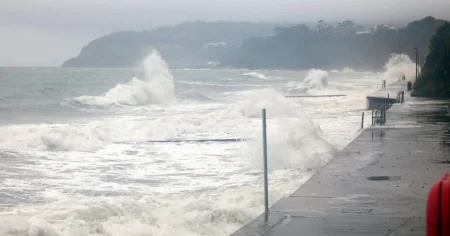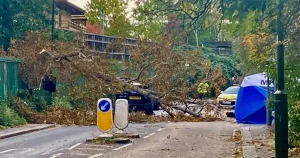


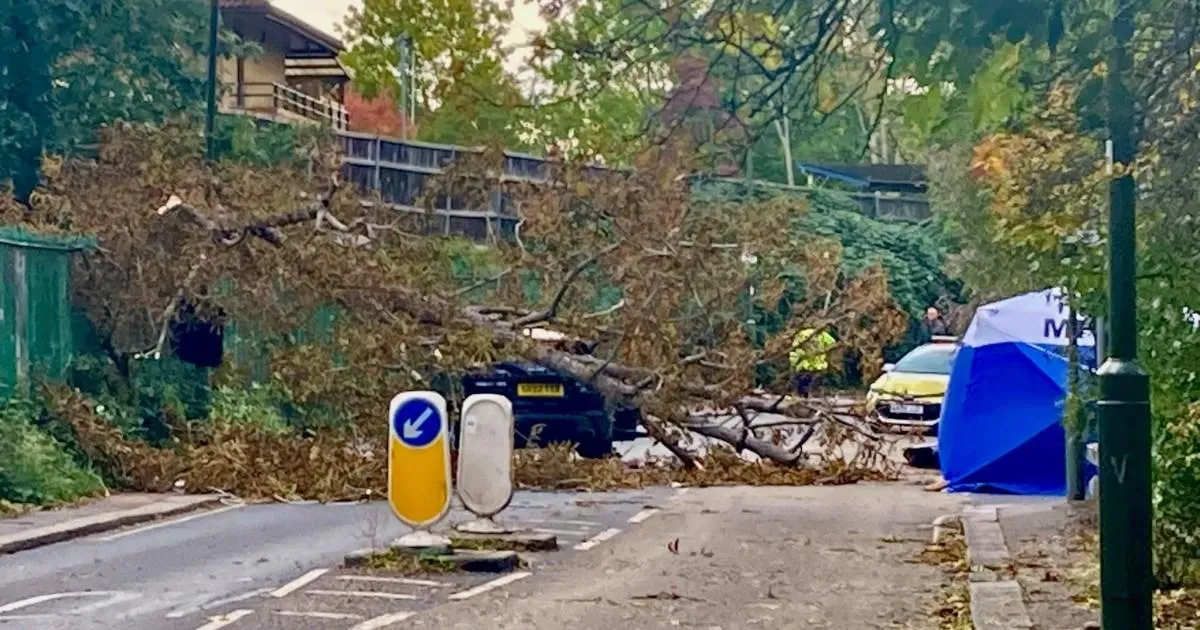
On Sunday afternoon, as Storm Boelo swept across the United Kingdom with gusts of up to 84 mph, a stretch of Dollis Road in Mill Hill, north London, became the scene of a tragedy that no forecast could have truly prepared anyone for. James Abiwon, a 29-year-old tech sales executive, was driving along the road at around 12.30pm when a large tree, loosened by the ferocious wind, crashed down onto his car. The vehicle was flattened in an instant. Emergency services arrived quickly—police, paramedics, firefighters, and an air ambulance—but there was nothing anyone could do. James was pronounced dead at the scene. The young man who had been making his way through ordinary Sunday traffic had been a son, a cousin, a boyfriend, a friend, a colleague, and a mentor. He had just won an award as Business Development Representative of the Year at his company. He was a semi-professional footballer with Aldershot, a musician with a YouTube following of 40,000, and a person described by his cousin Tyrrell Okolo as “a master of everything.” He was on the verge of his 30th birthday, with plans for a padel tournament that would bring his loved ones together in celebration. That a life so full of promise and energy could be extinguished by a falling tree in a storm seemed impossible, and yet the tree lay across the road, and James’s car was beneath it. The wind had been howling all weekend, bending branches, rattling windows, and sending debris into streets across the country. But for James, and for the people who loved him, the storm stopped being weather and became the reason their world came apart.
The worst part came minutes later, when the people who loved James began to arrive on Dollis Road. His family reached the scene after the crash and found themselves facing a sight that would never leave them. His girlfriend arrived and was, in the words of one witness, “in bits.” His best friend came down the road, shaking. A 39-year-old woman who had heard the helicopter overhead and gone outside to see what was happening described the scene with painful clarity. “A tree covering the whole road, and you could just make out a car beneath. You just could not get at it,” she said. The tree was so enormous and the car so thoroughly crushed that there was no way to reach James. His family and friends could do nothing but wait, hope, and stare at the wreckage. At one stage, his possessions could be seen covered in blood. “It was impossible to get the tree off; the car was totally flattened,” the witness said. “They were just waiting and hoping he would come out, but the damage was awful. No one could have survived that.” Later, James’s aunties and other relatives arrived, and they were inconsolable. The woman who watched it all unfold said she had not been able to get the image out of her mind. “He was obviously so well loved. We have just lost one of our community,” she added. What should have been a normal Sunday journey had become a place of collective grief, where friends and strangers stood together in disbelief, unable to process how quickly everything had changed.
The tributes that followed painted a portrait of a man who seemed to contain multitudes. James had earned a first-class degree from the University of Essex and built a successful career in technology sales, culminating in the award he had just won. His cousin Tyrrell remembered him as “a massive family man” and “a master of everything.” His friend Kwame Affum, who had known him since the age of 13, said the news left him “heartbroken.” Kwame had played padel with James on Friday, just two days before the accident. On Sunday, another friend messaged James about money they owed for the court, and when he did not reply, the alarm bells began to ring. “I’m trying hard to get my head around this,” Kwame said at the scene. “He loved sport; he was a good footballer and supported Arsenal. He was just good at everything. He got a first at uni and was doing brilliantly at his job. He had just won an award. He was full of energy and talent. He was going to celebrate his 30th birthday in two weeks. It just seems impossible this has happened.” James’s passions were many and he pursued each one with total commitment. Footbal, music, padel, mentoring, and family all had a place in his life. He was not simply one thing; he was a person who invested himself fully in every pursuit and every relationship. To hear his friends speak, it was clear that James had a rare ability to make people around him feel energised, supported, and valued. That is why the shock of his death was so profound, and why the memories they shared were so vivid.
The aftermath of the accident was chaotic and heartbreaking. The road was closed off for hours while emergency services worked at the scene. The Metropolitan Police confirmed that a man in his 20s had died after a tree fell on the car he was driving during Storm Boelo, and that he was pronounced dead at the scene. The tree had been so huge and the car so flattened that there was no way to reach James in time. One witness described the branches spread across the entire road, with the outline of the car just visible beneath them. Locals noted that traffic on the road had been particularly heavy at the time of the accident because a nearby street had been closed due to roadworks, funnelling more vehicles toward the exact spot where the tree stood. A neighbour whose house overlooked the scene said, “If it had been 10 minutes later, it could have been me. That poor young man being in the wrong place at the wrong time in such a way is a tragedy. All our hearts go out to his family and friends.” The randomness of the event was impossible to accept. A few minutes earlier or later might have meant James passing safely. A different route, a slower car, a gust of wind that came seconds later—any of those small changes could have rewritten the day. Instead, the tree came down at the precise moment James was beneath it. Eventually, the tree was cleared, leaving behind a large crater where its roots had been ripped from the ground. The road reopened, but the scar in the earth remained. Flowers and cards began to appear at the site, placed by people who wanted to mark the loss and show their respect.
Amid the grief, James’s community found a way to honour him. The padel tournament he had been looking forward to as part of his 30th birthday celebrations will now go ahead in his memory, with all proceeds going to his family. It is impossible to imagine a more fitting tribute for someone who loved sport and friendship the way James did. Kwame and their friends had spent so many hours together on the court, laughing, competing, and sharing small moments of ordinary happiness. Their last time with James was on Friday, when they had no reason to believe it would be the final game. The tournament will now become a memorial event, a way for the people who knew him to come together and remember the sound of his voice, the energy he brought to every match, and the warmth he showed to everyone around him. Instead of joining James on the court, they will be there because of James, and in his name. The money raised for his family will not bring him back, but it will help ease some of the practical burdens that follow a sudden and devastating loss. Flowers may fade, and the crater in the road may eventually be filled, but the decision to celebrate his life in the way he would have wanted—through sport, friendship, and togetherness—offers a small light in an otherwise very dark week. It is a way of saying that James was not just a victim, but a person whose presence mattered deeply to those who knew him.
James’s death was one of the most tragic consequences of a storm that swept across the UK, following Storm Austen on Friday and bringing winds that reached 84 miles per hour. In Scotland, a 60-year-old man was also killed by a falling tree in Dumfries and Galloway. Others were injured across the country. But statistics about the storm cannot convey the particular, irreplaceable nature of what was lost. James Abiwon was a man with a future full of promise: a career that was rising, a birthday to celebrate, a family who adored him, and friends who had known him since childhood. His cousin called him “a master of everything”; his friend said he was “good at everything.” Those phrases might sound like the exaggerations of people in shock, but they were repeated independently by different people because that is who James was. His life was not measured only in awards or followers or football matches. It was measured in the love he gave and received, in the guidance he offered to those who looked up to him, and in the ordinary moments he shared with the people who mattered most. The tragedy on Dollis Road will remain in the memories of everyone who witnessed it, and in the hearts of all who loved him. The tournament will be played, the flowers will be laid, and the crater will heal. But James will not drive along that road again. His 30th birthday will come and go without him. And yet, because of the way he lived, his story will continue—in every friend who remembers his energy, in every family member who carries his love, and in every young person he mentored. That is his legacy, and it is one that no storm can take away.