

The trial unfolding at Winchester Crown Court has exposed a case of betrayal so profound that it is almost impossible to comprehend. Philip Young, a former Conservative borough councillor, is accused of spending thirteen years orchestrating the sexual abuse of his wife, Joanne, without her knowledge—drugging her, photographing her, and advertising her online to strangers who wanted to rape and assault her. Prosecutor Sarah Jones described how the idea of seeing his wife raped by other men had become “fixed in his brain,” and how Young then “set about finding a way to realise his fantasy without her knowing.” Joanne, who has waived her right to anonymity, had believed she was in a faithful, conventional marriage. She described her sexual tastes as “vanilla,” and her understanding of marriage as traditional and monogamous, “us two, kind of, till the end.” There was, the prosecutor said, no way Young would ever have thought that such abuse would be acceptable to her. Yet, for all those years, he was living a secret double life, using photographs taken without her knowledge to advertise her on swinging sites, Grindr and Craigslist, inviting strangers to take part in a crime she would never remember. The gap between the marriage Joanne thought she had and the one Young was secretly engineering is at the heart of this horrifying case. Behind the legal arguments and the charges, there is a woman whose home was not a sanctuary but a hunting ground, and whose beloved husband was, in the most literal sense, her abuser.
At night, after the couple had shared what she thought was a harmless nightcap, Joanne would fall into a drugged sleep. She would later wake to find herself blindfolded and handcuffed, with no memory of what had happened and no idea that her body had been used while she was unconscious. In fact, Young had been spiking her drinks with sedatives, and he recorded her more than 200 times without her consent between 2010 and the end of the alleged abuse. He also published “obscene” material relating to her more than 500 times. The scale of the violation is staggering: not just one attack, but years of them, hidden behind the ordinary façade of a family home and a marriage that Joanne experienced as loving and stable. She was a mother of three, going about her daily life, while her husband curated a catalogue of abuse that was available to other men online. The images he posted to advertise his offer showed her inanimate, tied to the bed and blindfolded—hardly the picture of an enthusiastic participant. Yet Young allegedly used those images to present the situation as a consensual “kink” shared by the couple. The reality was that Joanne was being rendered unconscious so that she could not consent—or even know what had been done to her. This was not a fantasy gone wrong; it was a calculated, years-long campaign of rape and assault. It is difficult to imagine the shock of waking up in one’s own bed, restrained and confused, and being told nothing—or, worse, being led to believe that nothing had happened. Joanne lived that nightmare repeatedly, unaware that her own husband was the architect of it all.
Young did not simply wait for chance encounters. According to the prosecution, he deliberately sought out strangers of any age or race, but wanted them as close as possible to home, so that when circumstances were right they could be “seized upon immediately.” Three of the men who took up his offer lived in Swindon, where the couple lived, and the assaults allegedly took place between 2016 and 2023. The court heard that a packet of sedatives from India addressed to Young was intercepted by customs in 2015; when police asked about it, he denied all knowledge. Analysis later showed that Joanne was exposed to a cocktail of sedatives, including ketamine and zolpidem, right up until 2024. The “nightcap” they shared, the prosecutor said, was used to plunge her into a state where “anything could be done to her by whoever answered and she was unaware or unable to recall.” The men who abused her are not accused of drugging her—that was Young’s job—but the effects were obvious. Anyone who saw her, according to the prosecution, would have been able to see that she was unconscious or incapacitated. Yet they went ahead anyway. The careful planning, the international order of sedatives, the hoarding of photographs and videos—all of it points to a man who treated his wife not as a person but as an object available for his gratification. The level of premeditation is chilling. Young did not act on impulse; he spent years building a system that allowed him to abuse his wife with almost no risk of discovery. He hid behind her trust, her sleep, and her memory loss, turning her vulnerability into his opportunity.
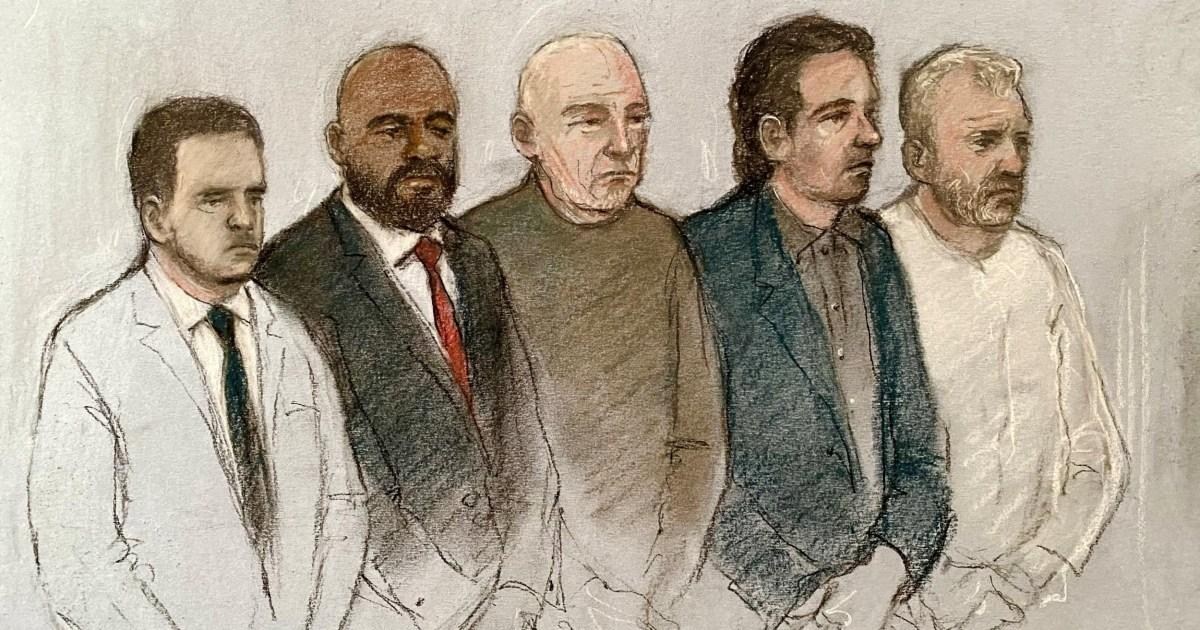
One incident in 2023 brought Joanne dangerously close to discovering the truth. Blindfolded and groggy, she felt someone else’s hand on her wrist while Young was having sex with her. She was “shocked,” she told the court, because she had no idea anyone else was in the room. She heard Young say to the person, “Get down,” and the person ducked. The next day, Young apologised—but only for inviting someone to watch, not for the years of rape that had already taken place. In that moment, Joanne realised that what she had stumbled upon was not an isolated incident but something far bigger. The prosecutor put it simply: what Joanne already considered a gross invasion and a betrayal of trust was, in fact, “far, far more invasive and shocking.” That discovery eventually led to the prosecution of not only Young but also several other men. Four men are now on trial at Winchester Crown Court: Richard Wilkins, 62, who denies one rape and one assault; Connor Sanderson-Doyle, 32, who pleads not guilty to sexual assault and sexual touching; Mohammed Hassan, 38, who denies sexual touching; and Norman Macksoni, 48, who denies one count of rape. A sixth man, Dean Hamilton, 47, has already admitted sex assaults and one rape. Three of the accused are seen in videos taken by Young, and those videos are likely to form a central part of the evidence. For the jury, watching them will be an ordeal; for Joanne, knowing they exist must be unbearable. The fact that she has chosen to face this in court, with her name attached, speaks to an extraordinary strength.
Some of the defendants are expected to argue that they believed Joanne had consented because her husband told them she was part of a consensual kink. But the prosecution points out that there was no information from Joanne to support that claim. The photos Young posted showed her unconscious or restrained; there was no evidence that she had ever communicated with any of these men, let alone agreed to sex with them. A husband cannot give consent for his wife, especially not a wife who is drugged, blindfolded and tied down. The legal question for the jury is whether these men “truly believed they had consent,” whether they hid behind what they were told while enjoying the opportunity provided by Young, or whether they simply did not care. The judge and prosecutor have already warned the eight men and six women on the jury that they will have to watch “depressingly awful, sordid material”—videos, the prosecutor said, that they cannot unsee and may not be able to forget. It is a heavy burden for any juror. But it is also a necessary one, because the case raises urgent questions about how the criminal justice system deals with cases where consent is claimed through coercion, deception and incapacitation. In a society that increasingly understands that consent must be freely given, informed and ongoing, this trial is a stark reminder that some men still operate as though a woman’s body is theirs to share. Young’s actions were not an aberration from his public life; they were a secret parallel existence that he maintained for over a decade, and the men who responded to his advertisements now find themselves having to answer for their own choices.
At the end of the trial, Young will be sentenced for his crimes. He has already pleaded guilty to 56 sex offences, as well as making indecent images of children and possessing extreme porn. But sentencing can never undo the damage done to Joanne. For thirteen years, she lived in a marriage that she believed was safe, while her husband was secretly orchestrating her rape. The fact that she has chosen to speak out, and to allow herself to be named, is an act of extraordinary courage. Her case is a stark reminder that domestic abuse is not always physical violence visible to the outside world; it can be hidden in plain sight, inside a marriage, in a family home, under the cover of trust. It is also a reminder that violence against women is a systemic emergency. The Metro’s This Is Not Right campaign, run with Women’s Aid, was launched to address exactly this kind of horror—the relentless epidemic of abuse that women face every day. If you or anyone you know has been raped, or is in danger, help is available. In an emergency, call 999. If you have been attacked, try to preserve evidence: do not wash, change clothes, or shower, and keep what you were wearing in a plastic bag. You can call Rape Crisis’s 24/7 Support Line on 0808 500 2222, or use their online chat. There is no time limit on reporting rape, and you can access support even if the abuse happened years ago. No one should have to carry this alone. Joanne did for thirteen years, unaware that the man who promised to love and protect her was the one breaking her trust in the most brutal way imaginable. Now, the court must decide whether the other men who entered her home and her body will also be held accountable. The trial continues, and with it, the hope that justice, however late, will be done.