

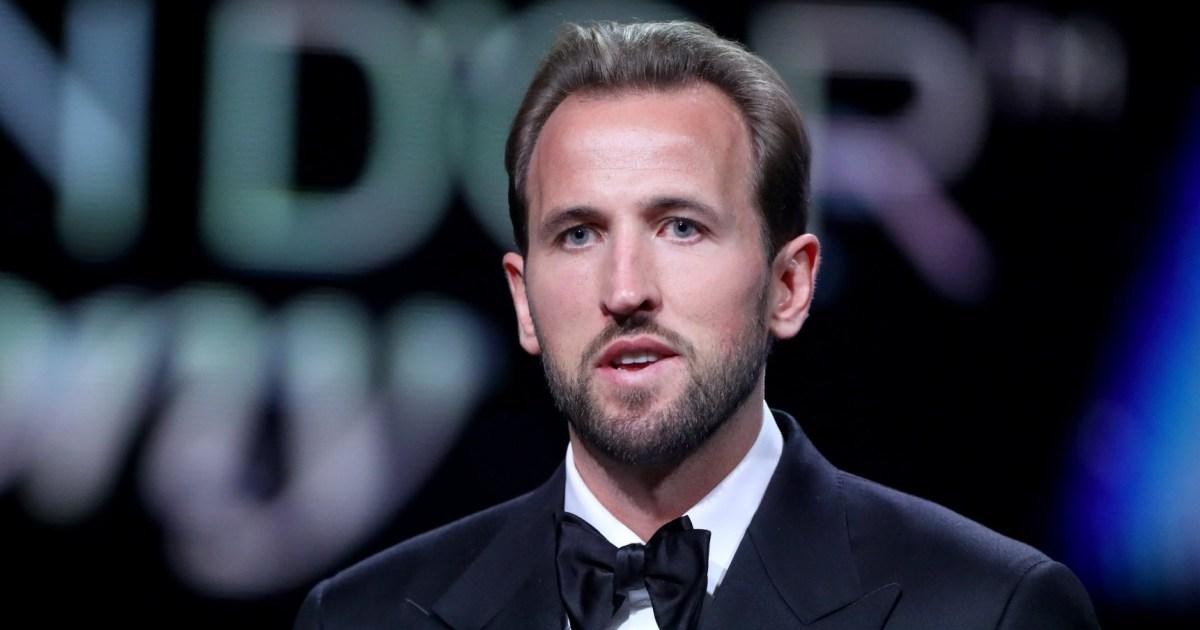
On a glittering Monday night in London, the football world paused to witness something that had not happened in a quarter of a century. Harry Kane, the England captain and Bayern Munich striker, stood at the London Palladium as the Brazilian legend Ronaldo prepared to announce the winner of the 2026 Ballon d’Or. For years, Kane had been the quiet, relentlessly consistent scorer, the boy who grew up dreaming of this exact moment. And when his name echoed through the theatre, the crowd erupted. Kane later admitted his heart was pounding, that he was silently praying his childhood idol would say his name. “What a legend,” he said, his voice still carrying the disbelief of a dream made real. “Ronaldo was one of my idols growing up, so for him to be the one to present me the award, it’s a dream come true.” But even that phrase did not fully capture it. He called it “beyond my wildest dreams.” The image said everything: a 33-year-old footballer who had scored more goals than almost anyone on the planet, finally holding the golden ball that had always seemed just out of reach. The last Englishman to do so was Michael Owen in 2001, twenty-five years earlier. In that time, generations of English fans had watched others take football’s highest individual crown. Now one of their own had done it. The cheers at the Palladium were not just for the award, but for a career built on sacrifice, discipline and an almost machine-like appetite for goals. Yet the emotion on Kane’s face was anything but mechanical. It was the face of someone who had waited, worked and believed for so long that the moment felt unreal. With his friends and family in the audience, he did not try to hide what it meant. “Honestly just so many amazing feelings,” he said, “and to share these moments with my friends and with my family who are here.” It was a rare glimpse of the man behind the statistics, a reminder that even the most decorated goalscorer can still be amazed by his own story.
The acclaim was immediate, and it reached the highest levels of British public life. Downing Street was among the first to offer congratulations, describing Kane’s achievement as “extraordinary” and praising him for setting “a brilliant example to young players across the country.” In an era when sporting success can sometimes be treated as a footnote, this felt genuine. The Prime Minister personally congratulated the striker, and the language from No 10 was warmer than the usual formal statement. But the most intriguing development was the suggestion that a knighthood might now be on the cards. When asked directly whether Kane could receive the honour, a No 10 spokesperson refused to pre-empt the honours process. Her careful answer still said a lot. “Everyone would agree, Harry Kane has given enormous amount to English football, and this is a very special moment for him and the country,” she said. “But as ever, I’m not going to pre-empt the honours process.” In other words, nothing is confirmed, but the door has been left wide open. There was even a tantalising hint of more to come. Speaking about the England captain, the spokesperson added: “Hopefully, there’s another trophy to celebrate with England before too long.” For a country that has spent decades waiting for major international silverware, those words carried real weight. Kane has often been the one carrying England’s hopes on his shoulders, and a knighthood would be the kind of recognition that goes beyond goals and trophies. It would acknowledge his contribution to the national identity, his role as a leader, and the example he has set for thousands of young players who dream of following in his footsteps. At 33, he is not finished. The reference to another England trophy was not a throwaway line. Kane has built his career on proving people wrong, and lifting a World Cup or European Championship with England would complete a story that no individual award can fully capture. For now, the honours system will move at its own slow, mysterious pace. But the question is no longer whether Kane deserves a knighthood. It is whether the process can keep up with a man who refuses to stop adding chapters to an already legendary career.
Not everyone, however, was swept up in the collective celebration. Football is a game built on debate, and the decision to crown Kane inevitably provoked sharp words from those who believed another player deserved the prize. One of the most striking reactions came from the uncle of Lamine Yamal, the young Barcelona and Spain sensation who finished third. He argued that fans pay to watch players like his nephew, not a striker like Kane. It was a pointed remark, and it touched on a familiar tension in football: the eternal argument between spectacle and substance, between the artist with the ball at his feet and the predator waiting in the box. For every fan who marvels at Kane’s astonishing efficiency, there is someone who will say he lacks the magic of a Yamal or a Mbappé. The criticism from Samir Nasri, the former Arsenal and Manchester City midfielder, was more detailed and perhaps more biting. Speaking on Canal+, Nasri acknowledged Kane’s qualities before delivering his verdict: “Harry Kane, Ballon d’Or… okay, the statistics made the difference. He’s a fantastic player with so many qualities. But he’s never been the player who carried his team somewhere or made his team win in the very big matches. There’s often a slight weakness. But he’s an extraordinary player.” It is the kind of criticism Kane has heard throughout his career. He does not glide past defenders like Messi or produce moments of improvisation like Ronaldinho. His brilliance is quieter, statistical, almost industrial. He scores 73 goals in a season not because of a single unforgettable solo run, but because of positioning, movement, and a mind that seems to calculate every possibility before the ball arrives. Nasri’s words stung because they tapped into a narrative that Kane has spent years trying to rewrite. The “big match” accusation is the one that has always followed him. Yet his 2025-26 season, with two trophies at Bayern Munich and England’s third-place World Cup finish, was itself a powerful rebuttal. And the fact that he was voted the best player on the planet by journalists from around the world suggests that the old narrative is fading. Still, the critics are part of the story. Greatness has always been debated, and Kane’s Ballon d’Or will always be a talking point. But on the night at the Palladium, the boos were absent. The cheers were loud, and even his fiercest critics had to use the word “extraordinary” to describe him.
Underneath all the debate lies a season that deserves to be seen in all its absurd statistical glory. Kane’s 2025-26 campaign was the kind that comes along once in a generation. He scored 73 goals for club and country, a number so ridiculous it sounds like a typo. He lifted two trophies with Bayern Munich, turning the German giants back into the dominant force they expect to be. And at the World Cup, he led England to third place, giving the country a reason to believe that the long wait for major honours might finally be coming to an end. It was a year in which he was not just a goalscorer but a leader, a man who carried the weight of two nations’ expectations and somehow made it look easy. England manager Thomas Tuchel, who has worked with some of the best players in the modern game, was almost lost for words. “I have run out of superlatives to describe his performances,” Tuchel said. “To become the first Englishman to win this huge honour in 25 years makes it extra special, and we are lucky to have you as our leader.” The word “leader” is important. Kane is not just the captain with the armband. He is the player who sets the tone, who trains relentlessly, who talks to younger teammates, who takes responsibility when things go wrong. At 33, he is in the late prime of a career that has seen him become England’s greatest ever goalscorer and now a Ballon d’Or winner. The trophies at Bayern Munich were the first major club silverware of his career, a detail that makes the win even more emotional. For so long, people questioned whether he could win anything. He responded by moving to Germany and winning immediately, while still delivering for England. His World Cup campaign, finishing third, was another step in a journey that has been defined by near-misses and heartbreak. But this time, there was no quarter-final exit and no penalty heartbreak. There was a bronze medal, a golden ball, and a sense that his narrative was finally changing. Tuchel’s words were not just praise. They were a declaration that Kane belongs in the conversation with the greatest players of all time.
The Ballon d’Or top ten read like a who’s who of modern football, but this year it was Kane at the summit. He finished ahead of Kylian Mbappé, the Real Madrid forward who has so often been seen as the natural heir to Messi and Ronaldo. Lamine Yamal, the teenage sensation from Barcelona and Spain, came third, a remarkable achievement for someone so young. The rest of the list was equally stunning: Rodri, now at Barcelona after his Manchester City success, fourth; Lionel Messi, the eternal Argentine, fifth; Khvicha Kvaratskhelia sixth; Ousmane Dembélé seventh; Erling Haaland eighth; Michael Olise ninth; and Fabián Ruiz tenth. To see Kane’s name at number one is to understand the scale of what he achieved. The list includes World Cup winners, Champions League winners, and the greatest player of all time. Yet when the votes were counted, it was the Englishman who stood alone. For 25 years, English football had watched from the sidelines during this particular ceremony. Michael Owen had won in 2001, but since then the award had belonged to a small club of galacticos and geniuses. Kane’s victory is not just a personal honour. It is a moment for the entire English game, a validation that English football can produce the best player on the planet. His story is not one of overnight brilliance. It is one of patience, improvement, and an almost obsessive hunger to be the best. To win the Ballon d’Or at 33, after so many years of being overlooked, is proof that longevity can triumph over hype. The younger players on the list are the future, but Kane reminds everyone that the present still belongs to those who refuse to fade. The honour was also a message to the next generation: the biggest individual prize in football is not beyond them. It had been a quarter of a century, but the wait was over.
Kane’s name will now be engraved forever in football history, but the more human story is what makes this moment resonate. For years, he was the player everyone respected but few truly feared in the biggest moments. He was the English captain who came closer than anyone to ending the national team’s trophy drought, only to fall short again and again. There were even moments when the public debate turned ugly, when people asked whether his ambition outweighed his ability to deliver. This Ballon d’Or is not just a reward for 73 goals. It is a reward for every early morning, every extra training session, every time he got up after a tackle and put the ball on the spot. It is also a reward for remaining humble in an industry full of egos. Kane does not crave the spotlight. He seems genuinely uncomfortable with the idea that he is now the best player in the world. He prefers to talk about the team, about England, about his family. The people closest to him know what this moment cost. His family was in the room when Ronaldo announced his name, and his eyes searched them out in the crowd. That image, a grown man on the edge of tears while holding the golden ball, will stay with those who saw it. The questions about a knighthood are not frivolous. A knighthood would be a strange but fitting end to a story that started with a boy kicking a ball in a London park. It would recognise not only his goals, but the way he has carried himself as an ambassador for the game. He has never been the most spectacular player. He has never had the flashiest boots or the most Instagram followers. But he has been the most relentlessly excellent player England has produced in a generation. The Ballon d’Or is the proof. The knighthood, if it comes, will simply be the nation saying thank you. And if there really is another trophy to celebrate with England, as the Prime Minister hinted, then the next chapter of Harry Kane’s story could be even more extraordinary than the last.