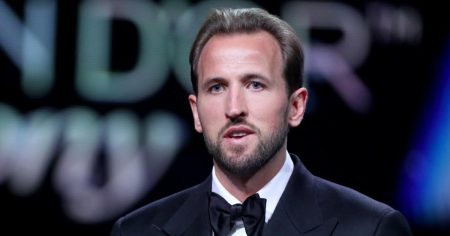


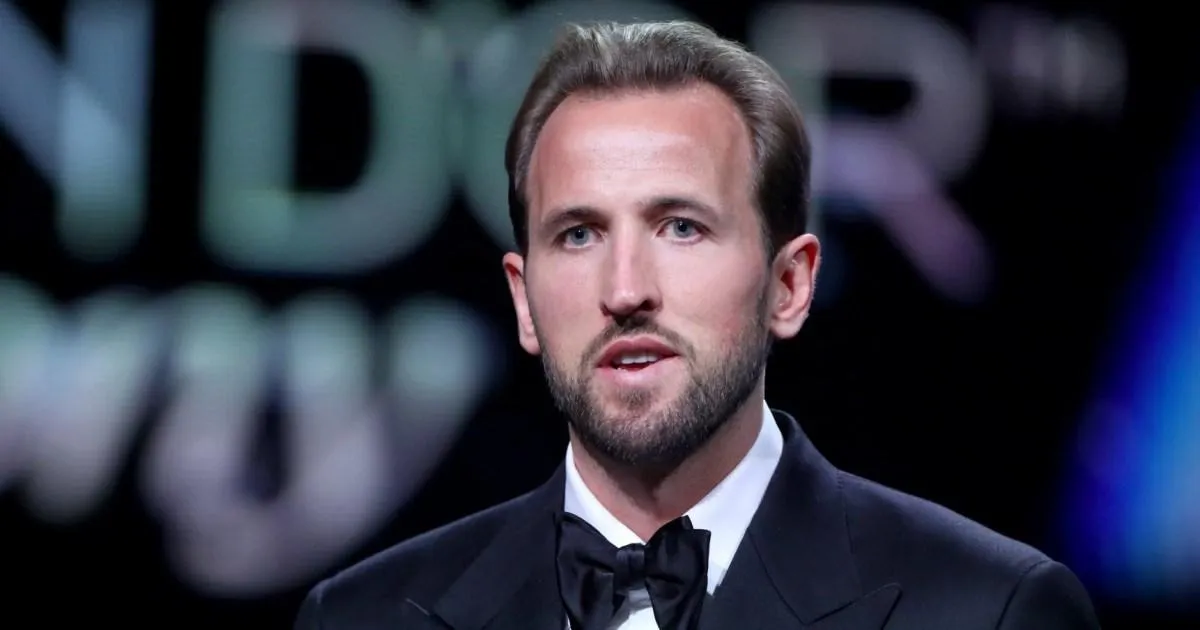
There are rare evenings in sport when the script refuses to be rushed, and Monday night at the London Palladium was exactly one of those moments. Harry Kane, the England captain and Bayern Munich striker, stood in the spotlight as the Brazilian football legend Ronaldo walked onto the stage with the most famous individual prize in the game. When the name “Harry Kane” rang out through the venue, a crowd that had spent the night in nervous anticipation erupted. Kane himself later admitted that his heart was pounding so hard he could barely breathe, and that he had been silently praying to hear his own name spoken by one of his childhood idols. “What a legend,” he said, his voice still thick with emotion. “Ronaldo was one of my idols growing up, so for him to be the one to present me the award, it’s a dream come true.” That dream, as he was quick to remind everyone, had become something far beyond anything he had ever allowed himself to imagine as a young boy kicking a ball around the streets of London. The significance of the moment was not lost on anyone watching. By winning the Ballon d’Or, Kane became the first Englishman in 25 years to claim the award, a gap that had weighed heavily on a nation that has always expected its greatest footballers to be recognised on the grandest stage. The cheers were not just for his goals, of which there have been so many, but for the years of devotion, the near misses, the injuries, the quiet professionalism, and the simple fact that he has never stopped believing that this moment would one day be his. As he stood there with the golden trophy in his hands, surrounded by his friends and family, it felt less like an arrival and more like a long-overdue acknowledgment of everything he has given to English football.
As the applause faded and Kane began to make his way through the night’s celebrations, the political world was quick to join in the chorus of congratulations. The Prime Minister personally phoned Kane to mark the achievement, and Downing Street described his victory as “extraordinary,” praising him for setting “a brilliant example to young players across the country.” It was the kind of official recognition that normally precedes talk of royal honours, and sure enough, the question of a potential knighthood was soon in the air. A No 10 spokesperson, asked directly whether the 33-year-old might one day be Sir Harry Kane, smiled and stopped short of confirming anything, saying only that “everyone would agree, Harry Kane has given enormous amount to English football, and this is a very special moment for him in the country.” She then added the familiar official caveat: “But as ever, I’m not going to pre-empt the honours process.” It was the kind of answer that leaves just enough room for hope, and for a player who has spent his entire career letting his performances do the talking, the suggestion of a knighthood felt like the natural next chapter in a story that has already had so many glorious pages. What made the Downing Street response even more appealing, though, was the hint that the honours system might not be the only thing on the horizon. With a gentle note of optimism, the spokesperson added: “Hopefully, there’s another trophy to celebrate with England before too long.” That single sentence managed to capture the feelings of an entire nation, because while Kane’s individual brilliance is beyond doubt, what he has always wanted more than anything is to lift a major trophy for his country. The Ballon d’Or is a personal triumph, but the hunger for collective glory remains, and knowing that the country is behind him as he chases it makes this moment feel like part of a much bigger journey.
Behind the glitz and the headlines, though, lies the extraordinary reality of Kane’s 2025-26 season, a campaign so prolific that even the most generous adjectives feel inadequate. He scored 73 goals for club and country, a number that would have seemed ridiculous just a decade ago, and yet he made it look almost routine. He won two trophies with Bayern Munich, where he has become not just a goal-scorer but the heartbeat of the team, and he led England to a third-place finish at the World Cup, carrying the hopes of a country on his shoulders with the same quiet determination he has always shown. England manager Thomas Tuchel, a man not known for excessive emotional outpourings, admitted that he had “run out of superlatives” to describe Kane’s performances. “To become the first Englishman to win this huge honour in 25 years makes it extra special,” Tuchel said, “and we are lucky to have you as our leader.” That word, leader, is crucial. Kane has never been the loudest man in the dressing room, nor the most flamboyant on the pitch, but he has become the reference point for everyone around him. His movement is intelligent, his finishing is ruthless, and his work-rate never drops, but it is his ability to make those around him better that truly separates him from the rest. At Bayern, he has formed partnerships that have terrified defences across Europe, while for England he has been the focal point of a young and exciting squad that clearly looks to him for guidance. There is a sense that this Ballon d’Or is not just a reward for a single season, but for everything he has been building towards since he first broke into professional football. Every long-range strike, every header, every penalty taken under pressure, every quiet moment of disappointment after a defeat has led to this. And yet, despite all the accolades, he still speaks with the humility of someone who knows that football can change in an instant, and that the only way to keep the highs coming is to keep working.
Not everyone, of course, was carried along by the romance of the occasion. In the days surrounding the ceremony, there were voices of dissent, and the most cutting criticism came from the uncle of Lamine Yamal, the teenage Barcelona sensation who finished third in the voting. Yamal’s uncle argued that football fans pay to see his nephew and not Kane, a comment that seemed to suggest the award had been won on statistics rather than spectacle. Then there was Samir Nasri, the former Arsenal and Manchester City midfielder, who took a more nuanced but still pointed approach. Speaking on Canal+, Nasri said: “Harry Kane, Ballon d’Or…okay, the statistics made the difference. He’s a fantastic player with so many qualities. But he’s never been the player who carried his team somewhere or made his team win in the very big matches. There’s often a slight weakness. But he’s an extraordinary player.” It is the kind of criticism that has followed Kane throughout his career, the nagging suggestion that he fills his boots against lesser opposition but disappears when the trophy is on the line. His supporters, though, would argue that this is a lazy narrative, and that no player scores 73 goals in a season without deciding countless big games. They would point to his performances in the biggest matches in Germany, his crucial goals in the Champions League, and his importance to England’s run at the World Cup. They would also point out that football has always been a game of opinions, and that every great player is destined to be debated for as long as the sport exists. What cannot be debated is the sheer volume of his production, the consistency with which he has found the net season after season, and the respect he commands from teammates and opponents alike. The criticism may sting, but it does nothing to diminish the scale of what he has achieved. If anything, the fact that people feel the need to question him is a sign of how high the bar has been set, and how much he has come to be expected to deliver.
For Kane, however, the night was about far more than the pundits and the critics. It was about the people who have walked beside him through every step of a journey that has not always been smooth. His wife, Katie Goodland, has been described as his “biggest support,” and she was there in the audience, watching with the quiet pride of someone who has known him since before he was a global superstar. Their children, too, were part of the celebration, and there was something deeply human about seeing a man who has struck fear into defences all over Europe transform into a father and husband, embracing his family as the weight of the moment finally began to sink in. Kane has always been careful to keep his private life exactly that, private, but in that brief moment on stage, the barriers came down. He spoke about how amazing it felt to share the evening with the people he loves, and how the trophies and records mean nothing if you cannot celebrate them with those who have seen you at your lowest. His friends from the early days, the people who used to watch him play in youth teams and never once doubted that he would make it, were also part of the scene, and their presence seemed to ground him in a way that no amount of professional praise ever could. There was something fitting about the fact that the ceremony took place in London, the city where he grew up, where he first learned the game on muddy pitches and dreamed of days exactly like this one. It felt like a homecoming, a chance for the football world to acknowledge not just the player he has become, but the journey he has taken to get there. And in that sense, the Ballon d’Or was never just an individual award. It was a celebration of a life devoted to the sport, and of the people who helped make that life possible.
So what happens now for Harry Kane? If the murmurs from Downing Street are anything to go by, a knighthood may eventually join the list of honours that already shine brightly on his name. But for a man who has never been motivated by titles or gongs, the real prize remains clearly in his sights: lifting a major trophy with England. The third-place finish at the World Cup was a step forward, and the promise of more silverware with Bayern Munich keeps him hungry at club level, but there is a sense that his legacy will ultimately be defined by what he does for his country from here. Tuchel’s words about being “lucky to have you as our leader” suggest that Kane’s influence on the national team is as strong as ever, and that the ballon d’or victory will only increase his authority in the dressing room. The critics will continue to talk, the comparisons with other great players will never quite go away, and there will always be someone who feels that another footballer should have won the award. But on a night at the London Palladium, surrounded by the ghosts of legends and the cheers of a grateful sport, Harry Kane proved that he belongs at the very highest level. He has spent years being described as one of the best strikers in the world, and now he has the trophy to prove it. The knighthood, if it comes, will be a nice addition, but the real satisfaction will come from continuing to do what he has always done: score goals, inspire his teammates, and chase the dreams that once seemed impossible. For English football, his victory is a source of immense pride. For Kane himself, it is a dream come true, but as he admitted, it is beyond his wildest dreams. And for everyone who has ever watched him play, it is a reminder that hard work, discipline, and unwavering belief can still carry you all the way to the top of the world.