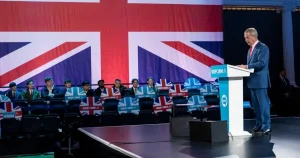


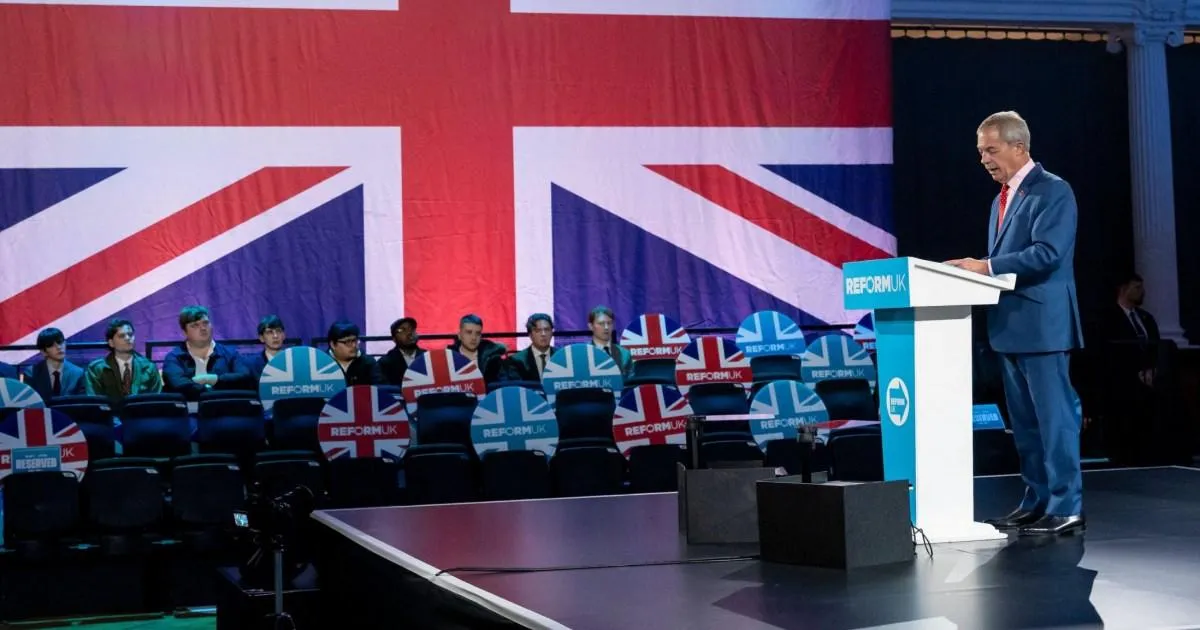
It is difficult to know what is more revealing about a political event: the words spoken from the stage or the spaces where people should be sitting. On this occasion, the spaces were everywhere. Nigel Farage arrived at Reform UK’s latest London event full of his usual restless energy, ready to launch the party’s “Economic Rescue Plan” and sell the idea that Britain was on the verge of a great populist breakthrough. But if the plan was about rescue, the room looked as if it might need one. Rows of seats stretched behind and to the sides of the podium, nearly all of them empty. A camera could still capture the few faithful supporters in the front row, but every wide shot told the real story. Farage, master of making a virtue out of failure, chose to address the issue directly. “As for this hall? Well, staff incompetence,” he said, as if the absence was merely a technical glitch, not a possible verdict on his party’s momentum. He offered a second excuse too. Monday, he explained, is a difficult day for business people. “It’s all well and good advertising the businesses, but on Mondays, people who run businesses tend to be rather busy.” The line was delivered with a laugh, a shrug and a self-conscious glance at the audience. Some people clapped. Robert Jenrick, standing beside him, managed a polite chuckle. Farage then added that those who had made the effort had probably paid “a very great deal of money” for the privilege. It was meant as gratitude, but it also underlined just how few had chosen to pay it. The whole performance had the strange intimacy of a comedian playing to a slightly too small room, trying to pretend that the empty seats are because the date was inconvenient, the ticketing was broken, or the weather was bad, rather than because people simply did not come. Farage laughed to himself, and for a moment the room laughed with him. But the image was hard to shake: a party that wants to be Britain’s next government, struggling to fill a hall for one of its most important announcements.
The London event was not the first time Reform’s audience had told a different story. A few days earlier in Plymouth, Jenrick had tried to fire up the crowd with what seemed like an easy question. He asked party members to stand up if they worked. The response was limited. He then asked those who run a business to stand. Even fewer people moved. Finally, trying to find some way to get the room on its feet, he asked those drawing down from their pensions to stand. This time, the majority appeared. It was an unfortunate image for a party that has repeatedly called itself the “real party of workers” and one that Farage did not handle with any more grace than the London seating problem. He suggested the rest were simply busy working; it was a Tuesday after all. But the excuse felt less convincing the third time it came around. In two appearances, Reform had accidentally revealed something important: its rallies looked less like the future of the British workforce and more like a retirement dinner with a few younger people at the back. The party could blame staff incompetence, Monday scheduling or the culture of business owners, but behind the jokes lay a demographic reality that no amount of stagecraft could hide. The people who stood for the pension question were not necessarily a problem in themselves; older voters turn out and they are politically engaged. But for a party that likes to wave the flag for working people, for small business owners, for the squeezed middle and the left behind, the visual was deeply awkward. It suggested that Reform’s base was less a movement of the economically active and more a community of those who had already finished their working lives. The juxtaposition of Plymouth and London, the two rallies separated by only a few days, created a cruder narrative than any political opponent could design. Farage’s jokes could not fully smooth over the fact that his party kept inviting people to stand and discovering that the room, like the nation’s changing electorate, was not quite what they expected.
The policy moment itself had been intended to turn the page and to give Reform credibility as a serious governing force. The Westminster event was meant for the launch of the party’s “Economic Rescue Plan,” and Farage used the occasion to insist that Britain was doing far better than the doom-mongers claimed. He praised the “success” of Brexit and told BBC Radio 4’s Today programme that Britain now stands “taller in the world.” It was a bold assertion, not least because he had said in 2023 that leaving the EU had “failed.” The gap between those two positions might have frustrated a more conventionally disciplined politician, but Farage does not do internal contradiction. He simply kept going, insisting that UK growth rates were higher than those of European competitors. For the people in the room, many of whom had given up a day’s work and paid a good deal of money to be there, the words seemed to land. It was a useful reminder that political success is often less about factual consistency and more about the confidence of the speaker. Farage’s ability to say something with total certainty, even when it conflicts with his earlier self, was never more on display. The empty seats, however, made the message feel slightly smaller. A politician launching an economic rescue plan wants a full hall, a roaring crowd, a sense of inevitability. Instead, he got a room with visible gaps and a leader who felt the need to explain them. If the economic plan was as strong as he claimed, why were so few people there to hear it? He would say it was an issue of timing and staff incompetence. His critics would say it was something closer to a brand losing its sparkle. The truth, as ever, was somewhere in between. But the moment captured something crucial about Reform’s position: the energy was still there, the rhetoric was still fluent, and yet the room itself was telling a quieter and more uncomfortable story.
But the rally and the rosy economic message were quickly overshadowed by a more uncomfortable media performance. Farage was questioned on BBC Breakfast about a tweet by Raheem Kassam, his former aide, branding Kemi Badenoch a “Nigerian scammer.” Sally Nugent, the presenter, asked whether Farage thought the term was racist. Farage’s first instinct was to distance himself, pointing out that Kassam was in America and no longer worked for him. He then noted that Kassam is of Indian heritage, seemingly to suggest the comment could not be considered racist. Nugent did not let it go. If Kassam is Indian, she asked, does that mean he can’t be racist? “I don’t know, you tell me the answer to that,” Farage retorted. The exchange became increasingly heated. At one point he laughed and said “So what?” before arguing that people say all sorts of things on X. Eventually he conceded that the comment was “over the top,” but he was careful to add that saying someone grew up in Nigeria is not racist. It was a classic Farage performance: deny, deflect, half-apologise, then shrug. The uncomfortable truth was that he spent more time trying to explain away the language than defending the target of the insult. He said Kassam was of Indian heritage, as though that were somehow a shield against the charge of racism. He said Kassam was in America, as though geography settled the matter. He said “people say all sorts of things” on X, as though the casual cruelty of social media excused it. But the question kept coming back, and Farage kept turning it. The viewer was left with the impression of a political leader who had been caught in a familiar trap, forced to answer for a remark he did not make, from a man he no longer controlled, about a rival he clearly did not respect. His refusal to honestly engage with the racism question was telling. He seemed less concerned about what the insult meant and more concerned about how to make it go away.
The wider context made the empty seats and the awkward interviews feel less like isolated mistakes and more like symptoms of a party struggling with its own internal culture. By the time of the London event, Reform had already been hit by a string of allegations. Farage was still under investigation over an undeclared £5 million gift from a crypto billionaire, and questions were being asked about the party’s vetting procedures. One aspiring MP, filmed undercover by ITV, had called for Britain to build concentration camps. A Bromley councillor, Dean Miller, had described Black children as “animals” before resigning. Reform mayor Luke Campbell was under investigation for allegedly showing a colleague naked pictures of himself. Sarah Pochin, a Reform MP, had been secretly filmed saying the party has a “male issue.” None of these stories had created a single catastrophic moment, but together they formed a drip-feed of scandal that had begun to take its toll. The party that enjoyed the smell of rebellion and fighting against the establishment was now spending most of its time defending its own candidates, its own finances and its own leader’s judgment. Farage had built his reputation on being the man who asked the questions others were afraid to ask, but now the questions were being asked about him. The half-empty hall, the pensioner-heavy crowd, the radioactive tweet, the unflattering scandals: none of these on their own would destroy Reform. But they created a mood, a sense of a party that had lost its footing. The old magic was still there, but it was flickering. The audience in London may have been small, but the attention on Social media and television was enormous, and what people saw was a political movement trying to explain itself rather than triumph.
The polling reflected the new mood. Recent Ipsos figures had Reform in third, behind Labour and the Conservatives, with Andy Burnham’s takeover of Labour proving a more successful move than many had predicted. Labour, after a wobbly 2025, was around twelve points clear of Reform, and with the Prime Minister’s first Autumn Budget just days away, the political wind had shifted. The jokes at the rally were still delivered with the old energy, and Farage still knew how to make people laugh. But the laughter was thinner than it used to be, and the empty chairs were harder to ignore. Reform had spent years promising to shake up British politics, but its latest launch had been forced to compete with awkward questions about racism, incompetence and an ageing fanbase. The party was still a serious force, and no one with any sense would write Farage off completely. Political obituaries have been written about him many times before, and he has always found a way back. Yet on that strange Monday, in a half-empty hall in London, with a former aide’s tweet hanging in the air and a string of scandals trailing behind him, the showman looked momentarily like a man performing to a crowd that was slowly finding other things to do. The applause may have been warm, but the room had already started to feel like the end of a long night. Farage can still command a stage, but stages mean more when they match the size of the ambition. That is the real danger for Reform now: not that it will disappear, but that it will become ordinary, just another party with bland excuses and empty seats, asking people to stand up and discovering that the crowd has already decided to stay seated.