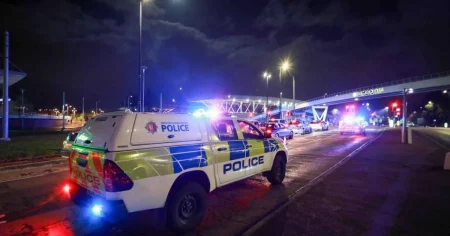


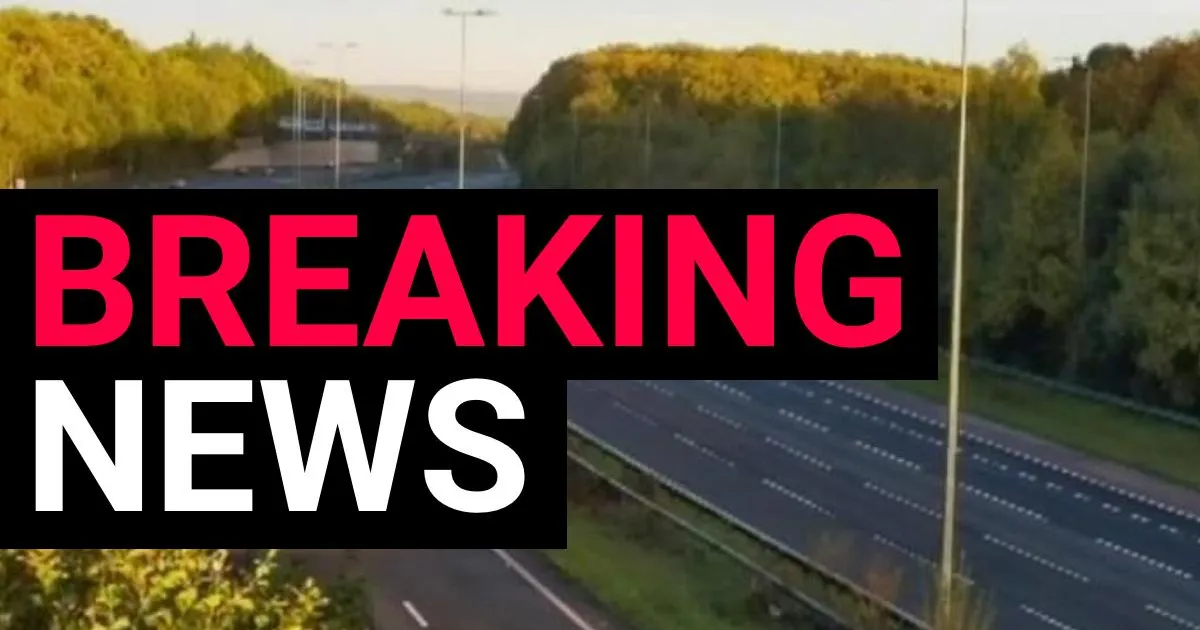
Late on Tuesday evening, the familiar hum of traffic along the M2 in Kent was broken in the most abrupt and unsettling way. A serious collision on the coastbound carriageway near Medway services turned what had been an ordinary night into a major emergency, and the aftermath has stretched well into the following morning, leaving a long stretch of one of the region’s busiest motorways sealed off in both directions. The accident happened at around 9.10pm, at an hour when many drivers were still making their way home, heading toward the coast, or moving goods through the country’s transport network. Within minutes, the quiet night air would have been filled with the approach of emergency vehicles, their blue lights reflecting off the roadside barriers and the darkness of the carriageway. Kent Police, paramedics, fire crews, and National Highways traffic officers all made their way to the scene, and the decision was soon made to close the motorway completely. That is never an easy call, and it is one that carries huge consequences for every driver who relies on the M2 for their daily commute or long-distance journey. The coastbound carriageway is now closed between junctions 3 and 5, while the London-bound side is shut from junction 5 back to junction 4, meaning that for miles in both directions the road is empty except for emergency vehicles, recovery teams, and the painstaking work of those investigating exactly what happened. There has been no official word yet on the number of people involved or the severity of their injuries, but the word “serious” used by police is enough to underline how grave this incident is. At its heart, this is not simply a traffic story, however frustrating the delays may be. It is a story about people whose lives were suddenly changed in a split second, and about the dedicated responders who now work through the night to piece together the events that led to their world being turned upside down.
Shortly before the morning rush hour, Kent Police issued a direct and urgent appeal to motorists, making clear that the M2 would not be reopening anytime soon. The force confirmed that the motorway remained closed in both directions following the serious collision near Medway Services, and asked drivers to continue finding alternative routes if they possibly could. The phrasing of that appeal is important: “if possible” is a gentle but honest admission that for many people, especially those living in the immediate area, there is no perfect way around a closure of this scale. The M2 is more than just a road; it is a vital artery connecting London to the Kent coast, linking communities, businesses, ports, and families. When a stretch of it is suddenly offline, the ripple effects are felt far beyond the emergency tapes. National Highways added its own warning, explaining that due to the nature of the incident, the road was expected to remain closed for several hours and into daylight. That statement is a quiet signal of how serious the collision really was. Road closures of this length are not about clearing a broken-down vehicle or waiting for a bumper to be swept aside. They are about preserving evidence, reconstructing the sequence of events, and ensuring that investigators can do their job in an environment that is safe and undisturbed. Every mark left on the tarmac, every piece of debris, every position of the vehicles involved may hold the key to understanding what happened, and that understanding often matters deeply to the families and loved ones of those caught up in the crash. The public may see only a closed road and a diversion sign, but behind the barriers lies a meticulous process carried out by people who are determined to find answers.
By the time dawn broke, the impact of the closure was already spreading through the local road network like ripples from a stone thrown into still water. Traffic was building on the M2 London-bound near Bredgar at junction 5, with queuing vehicles stretching back as drivers slowed to gawk at the scene or searched for an escape route. On the A249 at Sittingbourne Road, congestion was mounting, and the M20 past Maidstone, which had been suggested as a diversion, was itself beginning to feel the pressure of all the redirected traffic. The A229, a route already known for its sensitivity to congestion during peak hours, was snarling back for miles in its Maidstone-bound lanes, leaving drivers in a seemingly endless crawl. For anyone who had hoped to slip past the chaos using local knowledge, the morning quickly became a test of patience. Commuters trying to get to work, parents taking children to school, truck drivers with schedules to meet, and holidaymakers hoping to reach the coast all found themselves caught in a sprawling web of delays. The closure also carried a deeper human cost for local residents, who woke to find their quiet roads turned into unofficial highways, with unfamiliar traffic moving through villages and towns not designed for such volumes. Sitting in the queue, it can be easy to feel frustrated and to wonder why the road cannot simply be reopened. But every one of those minutes of delay represents time given to emergency teams so they can work carefully and safely. The seriousness of the collision, the complexity of the investigation, and the need to protect everyone involved demand that the job is done properly, even if that means the rest of us must wait.
At the center of this incident are the emergency services, whose work is often unseen and underappreciated until moments like this bring it into sharp focus. Kent Police were the first to confirm the closure, but behind that brief statement were officers coordinating a major response under difficult circumstances, working through the dark hours with limited visibility and the constant pressure of knowing that lives may hang in the balance. National Highways Traffic Officers were also on the scene, assisting with traffic management, setting up signs, controlling access to the closed section, and making sure that no one accidentally wandered into a hazardous area. Paramedics and fire crews would have been among the first to reach those involved in the collision, their priority being to provide urgent medical care and to safely extricate anyone trapped in damaged vehicles. Once the immediate rescue phase is complete, the focus shifts to investigation. The road has to be treated as a crime scene, or at the very least as an evidence-rich environment where every detail matters. Investigators measure distances, photograph skid marks, examine the vehicles, and take statements from witnesses. Specialist teams may be brought in to reconstruct the precise mechanics of the crash, using every scrap of data available. This is slow, methodical work, and it cannot be rushed. The decision to close both carriageways suggests the incident was severe enough to require full access to the area, and perhaps to protect people from debris or spilled material. Drivers passing on the London-bound side might have expected traffic to continue moving, but the closure in both directions shows just how much care is being taken to secure the scene and to allow the investigation to proceed without interference.
Amid the talk of junctions, diversions, and delays, it is important not to lose sight of the human reality at the heart of this story. A serious collision is not a statistic, and the overturned vehicle or crumpled metal seen from a distance represents someone’s loved one, someone’s family member, someone’s friend. The people involved may have been driving home after a long day at work, perhaps looking forward to seeing their children or simply hoping for a quiet evening. In a moment, everything changed. Their families may have received devastating phone calls in the middle of the night, or waited anxiously for news as the hours stretched on. Emergency workers, too, carry the weight of scenes like this long after the shift is over. They are the ones who must remain calm and professional while confronted with pain, fear, and uncertainty. And in the wider community, the crash will leave a lasting impression on those who witnessed it, or who arrived moments after the impact and tried to help before help arrived. For the rest of us, sitting in traffic or reading about the closure from the comfort of home, it can be tempting to think mainly about the inconvenience. But the closed barriers should also serve as a reminder of how fragile normal life is, and how quickly an ordinary Tuesday evening can become something none of us ever want to experience. Every time we get behind the wheel, we are trusting our own judgement, the judgement of other drivers, and the design of the roads we travel on. That trust is usually well placed, but when it fails, the consequences can be enormous, and they are never felt by just one person alone.
For now, the practical message from authorities is simple and clear: avoid the area if you can, and if you cannot, prepare for significant disruption. The M2 is likely to remain closed for several more hours, and National Highways has warned that the emergency services are still at the scene carrying out essential work. Drivers are being advised to use alternative routes where possible, including the M20 via Maidstone, but should be aware that these roads are already heavily congested and may become even more so as the morning progresses. Anyone planning to travel should check live traffic updates before setting out, follow the instructions of the emergency services, and build plenty of extra time into their journey. For those already stuck in traffic, it would be wise to have water, phone chargers, and patience close at hand, and to treat other drivers with the same courtesy they would hope to receive. The closed stretch of motorway, empty and silent apart from the flashing lights of response vehicles, is a place where a community is grappling with the aftermath of an event no one was prepared for. As daylight continues to spread across Kent, more information may emerge about what happened and how those involved are doing. Until then, the most humane response is not anger at the delay, but gratitude for the people who are working to help, and a quiet hope that all those touched by this crash receive the care and support they need in the difficult hours and days ahead.