

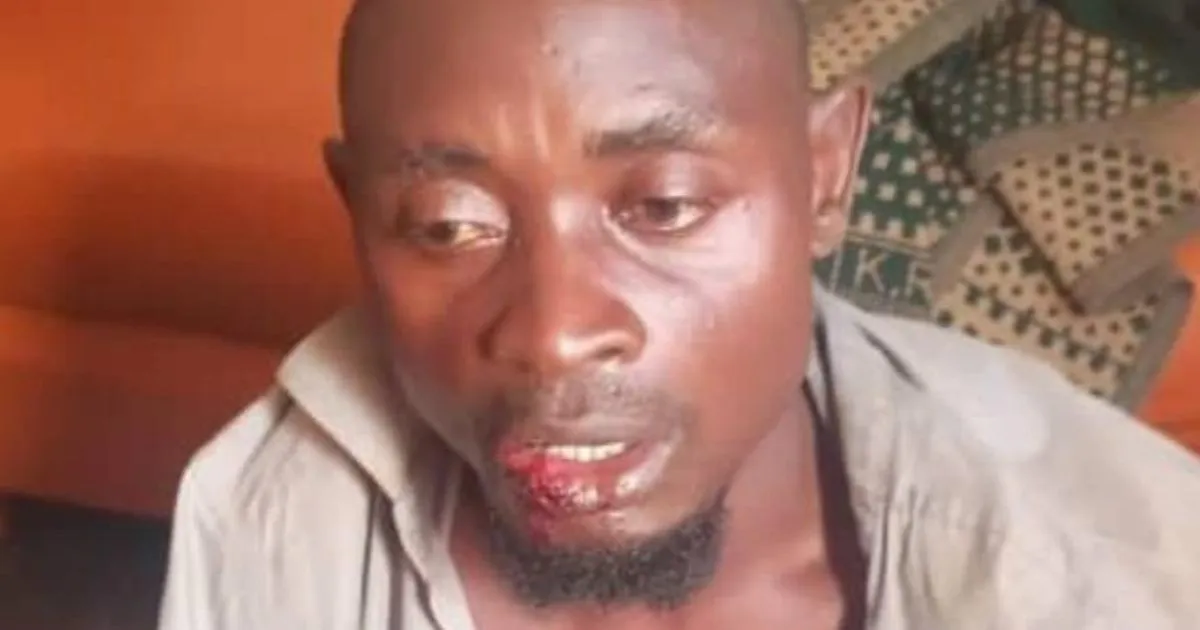
A man with a bloodied lip and a directionless stare has become the symbol of a fifteen-year nightmare. Mujurizi Moses was paraded before Uganda after being arrested by security forces, accused of murdering and cannibalizing 38 people between 2010 and 2025 in the districts of Masaka, Ibanda, and Kazo. The announcement came from Uganda’s highest police officer, Muhoozi Kainerugaba, who did not hide his contempt. In a social media statement, he described Moses as “the evil Mujurizi Moses” and “the worst serial killer and cannibal in Uganda’s history,” adding that the suspect would be tried in public and “definitely” executed. The photograph released alongside the statement showed the suspect shortly after his arrest, with a cut on his lip, looking less like the monster of folklore and more like a tired, ordinary man. That apparent ordinariness is perhaps the most disturbing detail of all. It reminds the public that the greatest horrors often arrive not as demons, but as neighbors, drifters, and strangers who seem harmless until the moment they strike. For the people of Greater Masaka, this arrest has been a long time coming. For more than a decade, they have lived with a fear that seeped into every corner of daily life. They checked their walls, they whispered about the machete killer, and they wondered why law enforcement could not stop a man who seemed to kill at will. The arrest has brought a rush of emotions: relief, anger, disbelief, and hope. But it has also brought a heavy burden. The suspicion now shifts from the fear of the unknown to the challenge of knowing. Who is Mujurizi Moses? Why did he allegedly kill and consume so many people? How did he evade capture for so many years? These questions will likely be answered in the trial, but the process of answering them will force families to relive their painful losses all over again.
According to the slow accumulation of police records and witness reports, the murders attributed to this suspect followed a method that was as brutal as it was chilling. The attackers—because it seems likely that more than one person was involved—would use drills to bore holes through the walls of houses, often in the dead of night, creating an entrance that the inhabitants never anticipated. Then they would slip inside with machetes and set upon the occupants. The wall, the very thing that should have kept a family safe from the outside world, became the doorway for death. This method was repeated again and again across Greater Masaka, leaving behind a trail of broken families and inexplicable horror. The worst recorded incident took place at the home of Pastor Steven Mugambe, a Pentecostal minister whose household was purportedly targeted with the same technique. His alleged killers drilled into his residence before hacking all of the occupants to death. The pastor’s murder became more than an atrocity; it became a message that no faith, no position, and no family could shield anyone from the evil that moved through the night. The police chief’s statement says 38 people were killed and “eaten” by the suspect, and the word cannibal has attached itself to the case like a second name. It is a term that dehumanizes, but it also speaks to something deeper in human psychology: the fear of being consumed, of vanishing completely into another person’s appetites. For the relatives of the victims, the accusation of cannibalism adds an extra layer of grief. Not only were their loved ones murdered, they were also desecrated. The pain of that thought is unimaginable, and it will likely be examined in clinical detail during the trial. What investigators are working to determine is whether the killings were the work of one disturbed individual or a coordinated network. The drilling through walls, the use of machetes, and the apparent ability to operate without detection for fifteen years suggest a degree of planning and local knowledge that may point to accomplices.
Long before the police chief announced the arrest of Mujurizi Moses, the region had its own dark story about a man named Fred Mujulizi, also known as Kulaish Kamugisha. He was described in earlier police records as a contract killer, a ghost-like figure who haunted Greater Masaka and was linked to multiple murders. Wanted posters with his name were distributed across the country, but the man remained out of reach. The relationship between Fred Mujulizi and Mujurizi Moses is still unclear. It is possible that the spelling difference is simply a clerical error, or possible that the suspect used several aliases to confuse authorities and survivors. What is certain is that the public faced a terrifying puzzle: a killer with a shifting identity, who could be captured and then, according to reports, escape or be released under disputed circumstances. Those captures and releases have now become a source of enormous anger. People are asking how a man connected to so many murders could repeatedly slip through the fingers of the police. Some believe that the suspect had protection, either through corruption or through sheer luck. Others think that the earlier captures involved a different person or a case of mistaken identity. The new investigation will have to resolve these questions. At the same time, the suspect has been tied to other crimes that go beyond mass murder. In later reporting, murder and human trafficking charges were referenced against him, stemming from the killing of a woman in Greater Masaka in late September. Investigators alleged that the woman was lured into a relationship before being killed in what they described as a “ritual murder.” The case is yet another example of the suspect’s alleged pattern of using trust as a weapon. The human trafficking charge suggests that his crimes may have included the sale or transportation of people in addition to killing them. All of this paints a picture of a predator who did not simply lash out in rage but targeted the vulnerable, manipulated their hopes, and turned human connection into a trap. For the police, this means investigating not only the 38 alleged murders but also a broader web of exploitation and terror. For the public, it means facing the unsettling truth that monsters do not always announce themselves with fangs and horns; sometimes they come with a smile and a promise, and they wait until the door closes.
The toll of the alleged killings cannot be counted in numbers alone. Every victim left behind a mother, a father, a sibling, a child, or a friend. In the villages and towns of Greater Masaka, the murders created a climate of chronic fear that changed daily life. People began sleeping in shifts, with one family member staying awake to listen for the sound of drilling or footsteps. Families reinforced their walls with bricks and bars, and some hired night guards they could not afford. Neighbors no longer opened their doors at night, even for people they knew, because the killers seemed to use every bit of trust as a weapon. The murder of Pastor Steven Mugambe and his household was perhaps the darkest moment in this period of terror. The attack on a pastor, in his own home, with his congregation or family around him, sent a signal that no religious sanctuary could provide safety. The grief was not confined to a single household; it spread through the community like a sickness. Survivors described sleeping with machetes beside their beds. Some people moved away from the region entirely, unable to endure the constant anxiety. When the arrest was announced, the floodgates of grief opened. Members of the public came forward to say that the suspect had killed their relatives. Some of these cases may be impossible to verify because bodies were buried years ago or the evidence was never collected. But the claims show a deep need for recognition. People want the legal system to look at them, to hear them, and to acknowledge that their loved ones mattered. The police have said that they will review these claims, but the review will be an enormous task. With so many cases and so much time having passed, investigators face a mountain of paperwork, old reports, rumors, and faded memories. The greatest danger is that the most forgotten victims may never receive justice. For the community, the arrest has brought some relief, but it has also brought a long-awaited opportunity to speak. In the coming months, as the investigation unfolds, more stories will emerge. Some will be heartbreaking; others will be infuriating. But they will all be part of the truth of what happened in Greater Masaka—a truth that must not be buried with the dead.
The police chief’s promise that the suspect will be “tried in public and definitely executed” has ignited a fierce debate about justice in Uganda. Capital punishment remains a serious issue in the country. The death penalty has been used in the past, but there are ongoing efforts by human rights organizations and legal scholars to abolish it. Public anger over the alleged crimes is so intense that many ordinary people are demanding the harshest possible punishment. They see the execution of the accused as the only way to guarantee that he will never kill again and the only adequate response to the enormity of his alleged crimes. For the families of victims, the desire for execution often comes from a place of deep pain. They have spent years wondering if the police would ever catch the person who destroyed their lives. They have lost faith in institutions. The promise of a public trial and execution offers a form of closure that feels immediate and final. Yet the legal system demands patience and rigor. Everyone is considered innocent until proven guilty, and the accusation of cannibalism, mass murder, and trafficking must be proven in court. The defence will have the right to challenge the evidence. The trial must determine not only the guilt of the accused but also the extent of his role. Were there accomplices? Did he act alone? Did the previous cases involve the same person? Are the witnesses reliable? These questions cannot be answered by rage. They can only be answered by careful, unhurried investigation. If the suspect is convicted and sentenced to death, the execution would be the end of a long legal process. But legal experts warn that public executions or predetermined outcomes could undermine the credibility of the court. Justice is not simply about punishment. It is about establishing the truth in a way that everyone, including the victims’ families, can accept. If the public sees a flawed trial, the pain will only deepen. If it sees a fair trial that exposes the evidence, the legal system may regain some of its lost trust. Either way, the case will be remembered as a defining moment in Uganda’s response to extreme violence. The decision must be made with the victims at the center, but also with a commitment to the principles of law. Otherwise, the promise of justice will ring hollow.
Perhaps the deepest truth of this case is that no punishment can bring back the dead. No execution can reconstruct a family shattered by a machete attack. No public trial can fill the empty chairs at the tables of the bereaved. What justice can do is acknowledge the humanity of the victims. It can say, with legal authority, that the lives taken were valuable and that the person responsible will be held to account. It can give survivors a place to stand and be heard. It can provide a record of what happened, so that future generations will know the history and refuse to let it repeat. The story of Mujurizi Moses—whatever name history chooses to remember—is a story of human capability for cruelty, but it is also a story of human endurance. The people of Greater Masaka survived fifteen years of terror with resilience and courage. They kept waking up, kept going to work, kept raising their children, kept hoping that one day the nightmare would end. The arrest of the suspect is a testament to that endurance. It is also a reminder that the work is not over. Communities must heal, grief must be processed, and the conditions that allowed such violence to continue must be examined. There are lessons about policing, about the need to respond to warnings, about the danger of ignoring the vulnerable. The names of the victims must be spoken. Their stories must be told. In the long run, the most important monument to them will not be an execution or a courtroom verdict; it will be a society that learns to protect its people, to listen to their fears, and to act before the shadows grow. As Uganda enters this difficult period, the families of the victims deserve more than anger. They deserve truth. They deserve support. They deserve a future in which the sound of a drill in the night does not mean death. The man in custody is now waiting for the machinery of justice to turn. Whatever happens next, the memory of those lost will remain—not as statistics, but as human beings who loved and were loved, and whose deaths will not be in vain if they lead to a safer, more compassionate nation.