

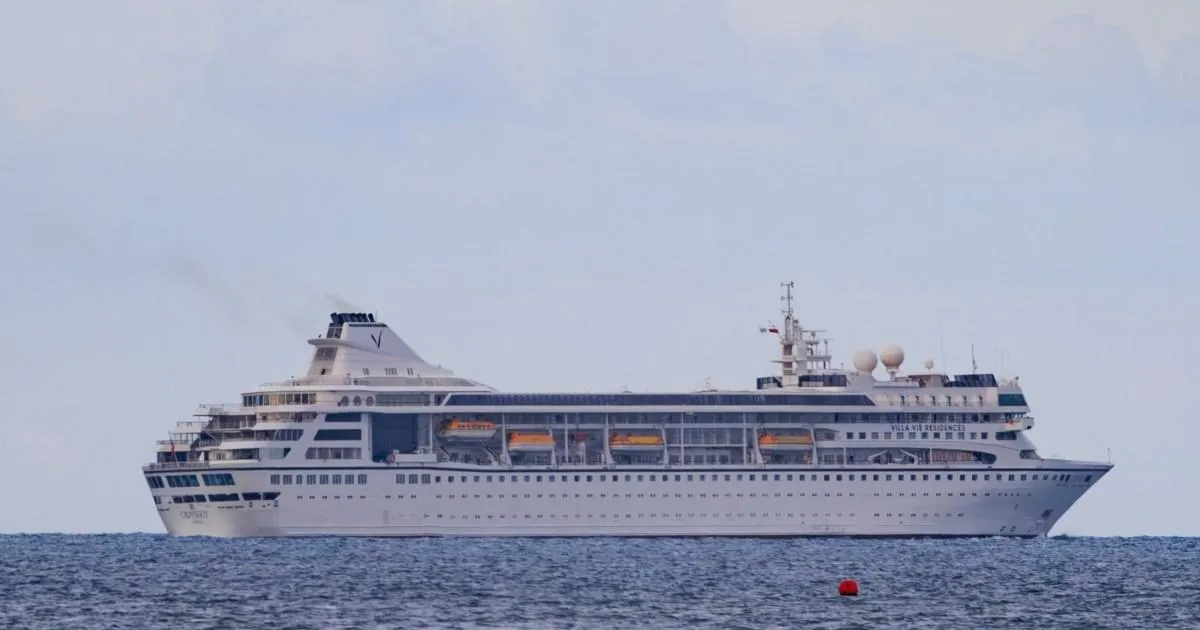
For a certain kind of dreamer, the idea was irresistible: sell the house, pack one suitcase, and wake up every morning to a different horizon. The Villa Vie Odyssey promised exactly that—a floating home, a resident-driven community, an endless cruise that would carry a few hundred travelers around the world for years rather than weeks. It was marketed as a “never-ending voyage,” and for the mostly North American passengers who came aboard, it was not simply a vacation but a complete rewrite of ordinary life. Some rented cabins for 35 days or 120 days; many bought their suites outright for sums ranging from about £90,000 to £260,000, gaining a berth on a three-year residential circuit that would take them from European capitals to the Pacific islands to the ancient ports of Asia. One couple, Melody and John Hennessee from Palm Beach, Florida, had made the decision to live out the rest of their lives on the ship, trading the burdens of ownership—lawns, leaks, property taxes—for ocean views, room service, and a community of fellow adventurers. They had imagined birthdays at sea, new countries on every calendar date, and the profound comfort of knowing exactly where they would be when they woke up: on board, at home, among friends. For weeks, as tensions overseas escalated and energy markets wobbled, there had been rumors that the voyage might be in trouble, but no one wanted to believe them. Then, this week, the dream came to a sudden and heartbreaking halt. Docked in Cambodia, the ship sent a message that was brief, bureaucratic, and devastating: it could not go on. Fuel was too expensive, too difficult to secure, and too uncertain. The vessel would enter a temporary layup, the crew would remain behind to maintain it, and every resident had to be off the ship by two o’clock that afternoon. For people who had chosen the sea as their permanent home, it was not just an itinerary cancellation. It was an eviction.
The Odyssey’s story had never been smooth. In 2024, long before these residents found themselves scattered in Southeast Asia, the ship spent months stranded in Belfast, Northern Ireland, undergoing repairs. Passengers waited, some for more than a hundred days, in a city that was not on any dream itinerary. They watched the calendar, the weather, and the slow work of engineers. They formed strange, temporary families in hotels and pubs, helped each other with luggage and medication, and stubbornly refused to give up on the promise of a floating future. Eventually, the repairs were finished and they set sail, hopeful that the worst was behind them. The ship’s business model was as unusual as its itinerary was ambitious. Villa Vie Residences did not sell ordinary cruise tickets. It sold a lifestyle, a membership in a mobile society. Cabins could be rented in segments of 35 to 120 days, or purchased outright for roughly £90,000 to £260,000. The price included a “never-ending” cruise, essentially a three-year global journey. For that sum, residents received more than a berth; they received a community. The crew knew their coffee orders, their allergies, their preferred seats at dinner. The passengers celebrated each other’s birthdays, mourned each other’s losses, and created the kind of intimacy that emerges among people who know they will be spending a very long time together. For many, the ship was their permanent address; mail was forwarded to the dock, medical records were kept aboard, and family visits were planned around ports. The Hennessees, who had chosen the ship as their final home, had surely imagined growing old at sea, with doctors and nurses onboard, with friends who shared their love of travel, and with no need to worry about housekeeping or property maintenance. Instead, they and their fellow residents found themselves packing again, not because they had decided to move on, but because the company could no longer afford to keep the lights on. The ship was a small city, after all—with a medical center, laundry, restaurants, a bar, internet connections, and the constantly moving machinery of daily life. All of that required energy. And energy had become a luxury. The dream had survived bad weather, mechanical problems, and months of delay. It could not survive the price of fuel.
The message came without warning and with very little comfort. The company’s statement did not offer a grand apology or a detailed explanation. It simply said: “Unfortunately, we were unable to secure the fuel necessary to continue operations. As a result, the Odyssey will enter a temporary layup this afternoon, with crew remaining onboard to maintain the vessel and its essential systems. All residents must disembark by 2pm today. For those who are unable to collect all their belongings before disembarking, please coordinate with Guest Services to arrange an orderly return using the shuttles.” The words were logistical, almost clinical, but the emotional weight was enormous. Residents had to gather their lives—clothes, photographs, medications, keepsakes, the little things that made a cabin feel like a home—and carry them down the gangway. The crew, meanwhile, would stay behind to look after the empty vessel. There was no mention of where passengers would go, whether they would be reimbursed, or whether the company had any plan to reunite them with the belongings they could not take at the last minute. A shuttle would take them to shore. After that, they were on their own. For people who had made the ship their permanent address, it was like an eviction notice delivered at sea. Think about what it means to be given two hours to leave your home. There is the panic of deciding what to pack, the guilt of leaving things behind, the uncertainty of where to sleep that night. Now imagine that the home is a cruise ship in a foreign country, and the reason is not a fire or a flood but a global fuel shortage. The shock was compounded by the fact that this was not the first time the voyage had gone wrong. They had already endured Belfast, already waited out the delays, already invested more money and more patience than any typical traveler would ever consider. They had believed in the project, defended it to skeptical friends, and imagined themselves as pioneers of a new way of living. Now they stood on a dock in Cambodia, watching the floating home that had consumed their savings and their trust, wondering if they would ever see it again.
The immediate cause of the collapse was not a mechanical failure. It was not a pandemic or a storm. It was the price of fuel. The vessel had not become unseaworthy; it had become unaffordable. Passengers paid roughly £70 per day for rent, utilities, and food, a figure that assumed energy costs would stay relatively stable. But they did not. Fuel prices have soared since the outbreak of the war in Iran, which, according to the original report, began in late February. In parts of Asia, the price of the specific fuel needed to move the Odyssey has reportedly tripled. A large cruise ship is not like a car that can be parked in a driveway when petrol rises. It requires fuel to move, but it also requires power to keep refrigeration running, to heat water, to run air conditioning, and to maintain the medical and safety equipment that keeps hundreds of residents alive. A spokesperson for Villa Vie explained that the company had tried to ride out the storm. “Since the conflict began in late February, we have taken significant steps to reduce fuel consumption, including slowing the itinerary and spending more time in port,” they said. That meant sailing at slower speeds, altering routes, and lingering in harbors longer than planned. But a stationary ship is not a cheap ship. Port fees, maintenance, and the human cost of the crew all continue. The spokesperson continued: “We have been unable to continue carrying the resulting operating losses. Passing the full increase on to residents is not a realistic solution.” In other words, the arithmetic simply did not work. The residents could not absorb the full fuel spike, and the company could not absorb it either. So the ship stopped. This is a small story with a very large backdrop. The same conflict that stranded the Odyssey has pushed up energy prices across the world. In the UK, petrol is reportedly 41 pence per litre higher than it was seven months ago. Emergency fuel shortage plans have been drawn up, including diesel rationing, speed limits reduced to 50 miles per hour, and priority filling for emergency services and public transport. Officials at the Department for Energy Security and Net Zero told Metro that supplies are not the issue, but the anxiety is palpable. The same global pressure that squeezed the Odyssey is being felt by commuters, truck drivers, and families trying to heat their homes.
For the residents of the Odyssey, the pain is not abstract. Many of them are retirees, people in their sixties and seventies who had sold houses, given away furniture, and deliberately made themselves homeless in the most optimistic way. They had chosen the sea as their final chapter. The Hennessees, for instance, were not taking a long vacation; they were living out a promise they had made to themselves. Their story is one of human longing: waking up to rolling waves, celebrating anniversaries in different countries, making friends during trivia nights and shore excursions, and never again worrying about mowing a lawn or fixing a roof. That life is now in limbo. It remains unclear whether Villa Vie is helping passengers with accommodation or refunds. At the time of the announcement, no plan had been offered for the suddenly displaced residents. Some may find hotels in Cambodia; others may try to fly back to North America. But what happens to the suites they bought for the full three-year voyage? What happens to the tens of thousands of pounds, in some cases more than a quarter of a million pounds, that passengers paid in the expectation that the ship would be their home? Is there an insurance policy, an escrow account, or any legal protection for someone who bought a floating residence rather than a cruise ticket? The silence on these questions is maybe the most troubling part of the whole affair. A “temporary layup” sounds reassuring, but for the people standing on the dock it has no set date and no guarantee. They do not know if the ship will sail again next week, next month, or ever. They do not know if the crew, still onboard, will be paid. They do not know if the company will survive, and if it does not, their investment may disappear into paperwork and bankruptcy proceedings. They had imagined growing old with a horizon outside their window. Instead, they are looking at airport departure boards. They wanted a place to live, not just a journey. The dream was sold as never-ending, but the reality is that it ended with a two-hour notice and a shuttle ride. That is not how anyone would choose to leave home.
At its heart, the Odyssey story is about the fragility of dreams in an age of volatility. It is about the collision between personal ambition and geopolitical crisis. It is about retirees and adventurers who trusted a vision, and about the harsh arithmetic of a war that raises prices not just at the pump but in every corner of a floating city. It is also a warning. Any lifestyle built on cheap energy and stable borders can be undone by a conflict half a world away. The passengers who disembarked in Cambodia are not the first people to be displaced by rising costs, but they are among the most symbolic. They had tried to opt out of the ordinary rhythm of mortgages, commutes, and property taxes, only to discover that the sea is not an escape from economics. It is simply another place where economics live. The same fuel that powers delivery trucks and ambulances and school buses also powers the dream of infinite travel. When that fuel becomes too expensive, everyone feels it—the truck driver, the nurse, the retiree on a cruise ship. Yet even as they scattered to different hotels and flights and uncertain futures, one truth remained: they had not lost their love of the sea, only their ability to afford it. And somewhere in a harbor, the Odyssey sits quietly, its crew still aboard, its engines silent, waiting for a world in which the fuel is cheap enough to chase the horizon again. Perhaps that world will come. Perhaps the ship will refuel, the residents will be invited back, and the never-ending voyage will resume with a new sense of caution. But for Melody and John, and for all the others who believed in that floating home, the horizon is no longer a promise. It is just a memory. The ocean will still be there tomorrow, beautiful and indifferent. But the home they built on it has been left behind, and the only thing they can do now is keep traveling, or find another place to rest, and hope that someday, somewhere, the dream comes back to life.