


# Devastating Himalayan Flood: What We Know About the Glacier Collapse
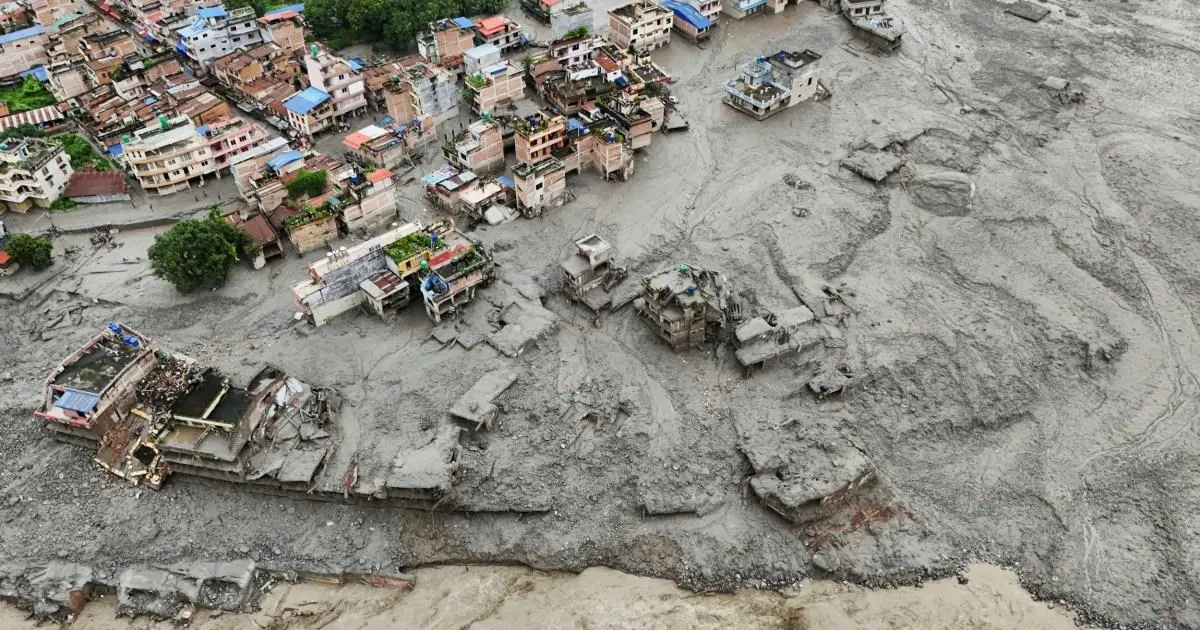
A catastrophic flood swept through the Himalayas this week, leaving at least 359 people dead and many more missing after a massive glacier collapse triggered a wall of water that crashed through the Gyirong border crossing between Nepal and Tibet. The sudden disaster caught residents completely off guard, with video footage showing people scrambling to escape as the torrent of water, rocks, and ice engulfed buildings within seconds. Entire villages in the region have been buried under mud and debris, with a 40-mile path of destruction left in the flood’s wake. More than 1,000 individuals remain unaccounted for, including British tourists who were visiting the popular mountain region at the time of the catastrophe.
Satellite imagery and preliminary analysis from experts suggest the disaster began when a massive chunk of ice broke free from a glacier approximately 17,000 feet up in the mountains. Dr. Simon Cook, an environmental scientist from the University of Dundee in Scotland, has been studying the imagery and believes the collapse may have been triggered by meltwater seeping beneath the glacier. This water likely lubricated the ice and destabilized it, causing the entire section to break away and plummet over a kilometer into the valley below. The immense energy released when the ice slammed into the valley floor generated intense heat from friction, melting much of the ice instantly and creating the devastating flash flood that tore through populated areas. The force of the impact was so powerful that it registered as a 5.2 magnitude seismic event on monitoring equipment.
The scientific community is increasingly concerned about the frequency and intensity of such events, and Dr. Liam Taylor, a geography lecturer at the University of Leeds, emphasizes that this tragedy is likely not an isolated incident. The Himalayas have been experiencing accelerated warming for years, making the region particularly vulnerable to glacial instability. The Hindu Kush mountain range, which includes the Himalayas and stretches across Afghanistan, Pakistan, India, Nepal, and Myanmar, has lost approximately 89 feet of ice thickness since 1975 according to recent expert assessments. Taylor describes the situation as “unhealthy glaciers under new climate extremes,” noting that as these massive ice formations become more unstable, the risk of similar catastrophic failures increases dramatically.
The mechanism behind this disaster involves a phenomenon known as glacial detachment, where entire sections of a glacier break away suddenly rather than melting gradually. Experts describe these events as “sudden detachment-style events” that remain relatively rare but pose a growing threat to mountain communities living in close proximity to glaciers. Taylor stresses that while still uncommon, these occurrences could become more frequent as global temperatures continue to rise. The challenge for scientists and local authorities is that predicting exactly which glaciers are most at risk remains difficult, and the widespread nature of the problem means that many vulnerable communities across the world’s mountain ranges could face similar threats.
This disaster is part of a troubling pattern of glacial events across the globe over the past century. In 1941, a glacial lake outburst flood devastated the Peruvian city of Huaraz, killing approximately 5,000 people. Peru experienced another tragedy in 1962 when a massive ice slab broke off Mount Huascarán, unleashing 10 million cubic meters of rock, ice, and snow that buried villages below and killed 4,000 people. A similar event in 1970 at the same mountain claimed over 25,000 lives. More recently, a glacial collapse in Tibet in 1981 killed 20 people, and the Chamoli disaster in India’s Uttarakhand region in 2021 resulted in 100 deaths. Just last year, a serac—a large column of glacier ice—collapsed in the Italian Alps, killing 11 hikers. Each of these events demonstrates the devastating potential of glacial instability in mountain environments worldwide.
As rescue efforts continue in the aftermath of this latest disaster, experts emphasize that regardless of the precise role climate change played in triggering this specific event, the broader trend is clear. Assistant professor Maximillian Van Wyk de Vries, who specializes in natural hazards at Cambridge University, points out that while there has been significant focus on glacial lake outburst floods, these ice-rock avalanches represent an equally serious and sometimes overlooked threat. The scientific community acknowledges that attribution of any single event to climate change requires careful analysis, but the accumulating evidence points toward a warming world creating increasingly unstable mountain environments. For the communities living in the shadow of these majestic but dangerous glaciers, the question is no longer whether such disasters will happen again, but when—and how to prepare for them.