



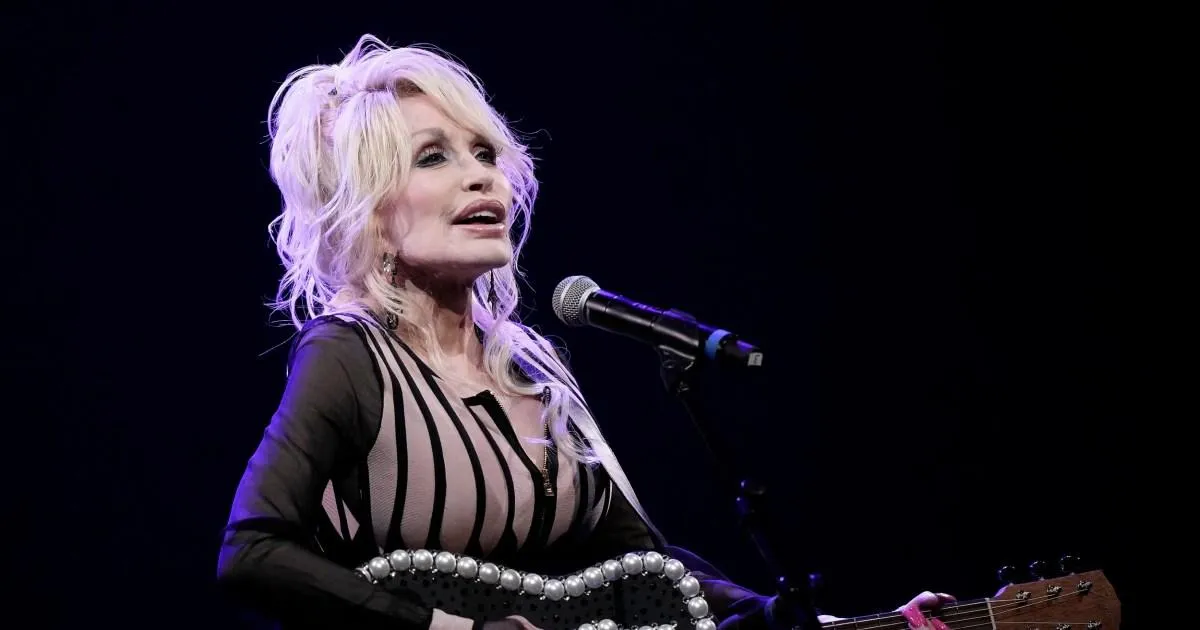
In the quiet aftermath of a great loss, the universe often seems to move in strange, poetic, and sometimes uncanny ways. Within days of the death of the beloved country music legend Dolly Parton, who passed away on Tuesday surrounded by family in Nashville at the age of 80 after a brief battle with cancer, the vast, windswept reaches of the Atlantic Ocean began to stir. Meteorologists at the US National Hurricane Center, their eyes fixed on swirling satellite imagery, spotted two distinct areas of low pressure, two “investigative” zones of churning thunderstorms that had the potential to grow into something much more powerful. The coincidence was almost too much to bear: the next potential storm to brew in these waters, were it to reach the status of a named tropical tempest, was scheduled to be called Dolly. It seemed both heartbreaking and lasciviously, profoundly fitting that the heavens themselves would conjure a memorial in the sky for the woman who spent her life being a force of nature.
The news of this meteorological coincidence spread quickly, capturing the collective online imagination as a rather strange piece of serendipity. It was widely reported that two areas of concentrated weather, one a swirling blob of low pressure hundreds of miles south-southeast of the Cabo Verde Islands and another to the north of Bermuda, were being watched with great intent. The National Hurricane Center designated the first as “Invest 96L,” a technical term that lacks the magic and fairy dust that Dolly Parton brought to the world. The second system, drifting somewhere in the general watery haze northeast of Bermuda, was designated “Invest 95L,” and forecasters predictably predicted it would not strengthen significantly. However, the potential for the first one, the one trailing after the infamous Cabo Verde archipelago, was real. It is that system which the meteorologists believe could be the one that eventually spins its winds high enough to earn the official designation of “Dolly,” with the name “Edouard” standing by as a consecutive identifier, to be given to the next storm that forms shortly after.
For South Africans, and indeed for all of us members of a worldwide family, this news triggered a deep and unavoidable pang of sorrow. We were all prepared for the fact that Dolly Parton was a force of reincarnated magic, a rhinestone-studded icon whose resemblance was something we were lucky to witness in our spheres. But the news of a “Tropical Storm Dolly” appearing less than a day after her passing felt like an intrusive, jarring note in the natural dirge of grief. We found ourselves scrolling through our feeds, looking at the weather maps with a weird, emotional disconnect, wondering: “Is the world really doing this? Are we really witnessing a storm being named after her the moment she leaves us?” The irony was further heightened by the fact that Parton was born in 1946, the same year the first storm named “Dolly” made landfall in China. It was a weird, celestial boomerang effect, almost as if the earth was saying a grand, atmospheric farewell to one of its most beloved daughters, a final, dramatic, unforgettable entrance onto the world stage, albeit this time as a tropical cyclone.
Despite the romanticism of the timing, and the immediate desire to see their favorite star’s name emblazoned on the world’s radar in a moment of poetic justice, the human—as it often is—was far less charming and far more procedural. The Met Office and the National Hurricane Center had to gently break the news to the world that this was simply an alphabetical coincidence woven into an outdated system. The names of storms, they explained, are set years in advance by a committee from the World Meteorological Organization, one of six lists which are rotated each year, and “Dolly” stands as the fourth name on a list that is being used for this season. It was a blind chance play of the alphabet, and they had no intention of bending any rules to appease the public’s demand for narrative poetry. Officially, there was no intention to name a storm for a legendary singer; she was just a lucky human being who shared a name with number four on a weather list. The storm did not know who Dolly Parton was, and the world of climatology was in no hurry to make it a performative gesture.
As the news sunk in, the story inevitably leaned into the exhausting, yet medically ginger, truth of weather forecasting and hurricane naming conventions, but it also allowed us to step back and truly mourn what was happening. The extra details in the story walked a dangerous line between cool scientific fact and rolling grief. They explained that if the storm’s winds passed 73 miles per hour, the “Tropical Storm Dolly” would be enhanced to “Hurricane Dolly,” and they proceeded to detail its long, illusory and often devastating lineage. There had been a “Hurricane Dolly” in 2008, a Category 2 storm, that tore through Texas and Mexico with threatening 85-mph winds, killing 22 people. There was another that skimmed Cape Cod in 2020, another in 2014 that came ashore in Mexico, and the very first “Dolly” from 1946, the year Parton was conceived in a one-room cabin, which devastated eastern China. To read the history of these names, these global empathy generators, layered upon a mere singer whom we immortalize for so many other reasons, was to ache for winters long past.
Yet, in the end, the story turned its face from the storm itself, to focus on what really mattered to her: the human energy, the reminder not of the stars shining in the sky, but of the hearts she touched. The test wasn’t about the storm, but about the style in which she lived. The most touching thing was the sudden reminder that weather will always do what storms do; it will run its course; it will dissipate. But the gentle, ragged grace of her legacy was in the details that emerged. We read about an an outsider’s bond with a small English town, an affection for a place that could felt so far from the Tennessee hills. We read about Richard Madeley’s choked-up interview on a morning show, remembering her brief time in front of the camera, and her wisdom to use public platform to gently critique the true nature of wealth. Her legacy was no less than a form of living music; it had all of our story in it. This week, a natural storm may drift across the Atlantic and take her name, but after it dissipates, an atmosphere will remain stable.
In this final thought, in these six paragraphs, we can allow that this isn’t a story about meteorology; it’s about the weather of our hearts. A storm passing by will be temporary, a swirling occurrence in a calm summer ocean. But Dolly Parton was a legacy and a real, permanent phenomenon. She embodied the spirit of resilience, creativity, and grace, and her departure from this world has left a void that not even a thousand Atlantic cyclones could fill. The potential “Tropical Storm Dolly” is a coincidence, but in the days following her death, it gave us a form of spiritual permission, to speak her name, to remember her voice, to acknowledge the storm of emotion she caused in all those who heard her songs. As the sky turns, silent, we can almost hear her smiling, that smoky, rhinestone-clad voice whispering behind a new cape, “Just look at me now.” She is gone, but like the weather, her name will still appear—in stories, in memories, and maybe, once in a while, in the winds. And it will always make us take a moment, pause and remember the beauty that goes by, and in how the world we spin our stories onto the vast, unknowable sky.