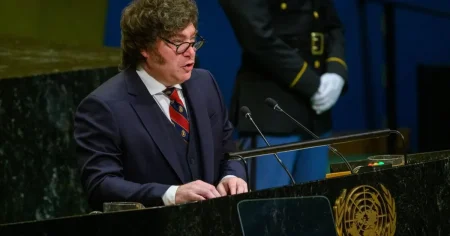


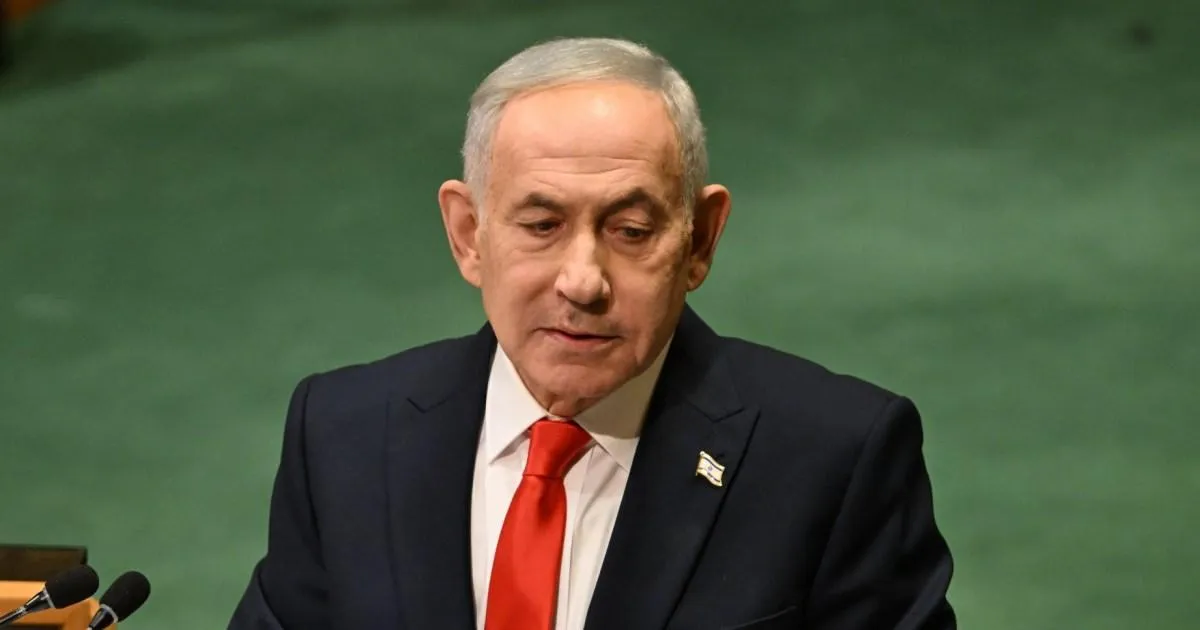
When Benjamin Netanyahu stepped up to the podium at the United Nations General Assembly in New York, the room had already made up its mind. Dozens of delegates rose from their seats and walked out, some booing, some turning their backs. It was a visual protest, a public rebuke, before the Israeli prime minister had even said a word. Netanyahu, however, seemed prepared for exactly this. He looked out over the thinning hall and delivered a challenge wrapped in sarcasm: “If there are any other moral cowards who haven’t yet left this hall, please do so now.” The line was aimed at the remaining delegates, and it drew attention away from the empty seats and back to the man at the microphone. This was not a quiet diplomatic statement. It was a defiant performance, part sermon, part war address, delivered in the middle of one of the most contentious conflicts of the modern era. Just before Netanyahu spoke, Palestinian Authority President Mahmoud Abbas had used the same stage to accuse Israel of a “malicious colonial plan” to push Palestinians out of Gaza and the West Bank. The contrast could not have been sharper. One leader came to plead for international sympathy; the other came to dismiss international opinion as cowardice. The United Nations, built on the idea of dialogue, had become an echo chamber of accusation and counter-accusation. The empty seats were not just a diplomatic gesture; they were a symbol of how far the world has moved from the old rules of engagement. For years, leaders stood in this same hall and spoke about peace, about reconciliation, about the shared future of humanity. Today, the language was different. It was the language of war, of ultimatums, of grievance. And the people who walked out were not just protesters; they were representatives of countries that have increasingly come to see Israel’s prime minister as a destabilizing force. But Netanyahu did not seem hurt by the snub. He seemed energized by it. He turned the walkout into a badge of honor, a proof that he was saying things the world needed to hear but did not want to accept. For his supporters, it was a moment of strength; for his critics, a display of arrogance. Either way, it set the tone for everything that followed.
The core of Netanyahu’s address was a full-throated defense of Israel’s military campaign in Gaza and a rejection of the word that has haunted it: genocide. Without mentioning the International Court of Justice directly, he answered the legal and moral charges head-on. “Israel didn’t commit genocide; Israel prevented genocide,” he insisted. Then he went further, calling the accusation “the biggest lie of the century.” These words were carefully chosen. Genocide is not just a legal term; it carries the weight of the Holocaust, and for many Israelis, hearing their country compared to past perpetrators is not merely offensive but dangerous. For Palestinians, however, the same word describes what they have lived through in recent months: tens of thousands of dead, entire neighborhoods flattened, families fleeing from one refugee camp to another, hunger and disease spreading through Gaza. Netanyahu’s response did not address those images directly. Instead, he framed Israel’s actions as a necessary fight for survival, a war forced upon the Jewish state by enemies who want to destroy it. In his telling, the world’s focus on Palestinian suffering is a distortion, a moral inversion in which the victims of terrorism are accused of being the aggressors. “Israel prevented genocide” was a sweeping claim, one that seemed to suggest that without Israel’s campaign, something even worse would have happened. But to the delegates who had just walked out, and to the millions watching from the Arab world and beyond, the phrase sounded less like a defense and more like a rejection of their reality. The accusation of genocide has been circulating since the early days of the Gaza war, brought before international courts, debated in universities, chanted in street protests. Netanyahu’s answer was not a legal argument but a moral one. He did not list evidence or address the civilian casualties. He simply declared the charge false and moved on. That may be enough for his supporters, who see the international legal system as biased against Israel. But for the rest of the world, the word “genocide” will not disappear just because a prime minister calls it a lie. It will keep echoing through the halls of the UN, through the ruins of Gaza, through the memories of families who have lost everything.
Netanyahu also spoke of the broader regional war, particularly the fight with Iran, and his tone turned almost celebratory. He described the decision to attack Iran as “one of the easiest decisions I’ve ever had to make.” It was a striking admission from a leader often portrayed as cautious, and it revealed how he now sees the conflict: not as a messy, painful series of military operations, but as a clear-cut battle between good and evil. “Israel had no choice but to win,” he declared, repeating a theme that has defined his entire career. In this framing, every strike, every casualty, every diplomatic cost is justified by the simple fact that Israel’s enemies would not stop if Israel did. The word “easiest” is particularly humanizing—it shows how the prime minister has internalized the threat from Iran. To him, the danger is so overwhelming that action becomes simple. There is no room for hesitation or moral doubt. That clarity may be genuine, but it is also a political choice. By painting the war with Iran in such absolute terms, Netanyahu can make any negotiation or restraint look like weakness. He is not asking the world to understand him; he is asking the world to choose sides. And for anyone who does not, he has nothing but contempt. This is the same man who mocked the walkouts, the same leader who calls genocide accusations a lie, the same prime minister who sees himself as the shield of his people. Whether or not you agree with him, there is no denying the force of his conviction. But there is also no denying the cost of such certainty. Wars are rarely “easy” for the people who fight them. The mothers in Tel Aviv who send their children to the army, the fathers in Beirut who wonder if the next airstrike will hit their home, the families in Tehran who have no say in their government’s actions—none of them are likely to describe any of this as easy. Netanyahu was speaking from a position of power, a leader who makes decisions and lets others carry them out. His certainty is the luxury of someone who does not have to look into the eyes of the dead. That does not make him insincere, but it makes his words harder to accept for those who bear the consequences.
Perhaps the most revealing part of the speech was Netanyahu’s tribute to former U.S. President Donald Trump. He called Trump Israel’s “greatest partner” and thanked him for working together to “launch the war against Iran” in order to “save civilization.” This was not just a diplomatic nicety; it was a statement of ideology. For Netanyahu, alliances are not simply agreements between governments but bonds between leaders who share a worldview. Trump, who moved the U.S. embassy to Jerusalem and brokered the Abraham Accords, has long been a hero to the Israeli right. Netanyahu’s words on the UN stage cemented that bond, and they also served a domestic purpose. By invoking Trump, he reminded Israeli voters that he has powerful friends, that Israel is not alone, and that the international community’s anger does not matter as long as America stands with him. “Save civilization” is a phrase that could have come from a blockbuster movie, but Netanyahu used it with complete seriousness. In his narrative, Israel and its allies are not defending a border or a piece of land; they are defending the very future of the Western world. That kind of language may sound grand, but it also shuts down nuance. If your enemy is trying to destroy civilization, every strike is justified, every criticism is treasonous, and every compromise is a step toward the abyss. It is a worldview that makes peace nearly impossible, because the other side is not a negotiation partner but an existential threat. And in that world, Trump is not just a former president; he is a co-savior, a partner in a crusade. The mention of Trump was also a signal to American politics. Netanyahu knows that his support in Washington is increasingly partisan, and by tying Israel’s cause so closely to Trump, he is choosing a side in the domestic debate. That choice may help him in the short term, but it also deepens the divisions around Israel in the United States. There was a time when support for Israel was a bipartisan consensus. Netanyahu’s speech made clear that he no longer cares about that consensus. He wants allies who share his vision, not friends who qualify their support with concerns about human rights. In the UN hall, surrounded by delegates who had just condemned him, that message was meant to be heard both in Jerusalem and in Washington.
Against all this, the words of Mahmoud Abbas carried a very different weight. The Palestinian leader had taken the same podium earlier and accused Israel of pursuing a “malicious colonial plan” aimed at driving Palestinians from Gaza and the West Bank. For years, Abbas has been seen as a moderate, a negotiator, a man who still believes in a two-state solution. But on this day, his message was darker. He spoke of displacement, of ethnic cleansing, of a slow-motion land grab that has accelerated during the war. From the Palestinian perspective, the evidence is everywhere: settlements expanding in the West Bank, Israeli operations in Gaza, families being pushed toward the sea, and no political horizon. Abbas’s words were an appeal to the same international community that Netanyahu had just insulted. He was asking the world to see what Israel’s leader refused to acknowledge: that the military campaign is not just about security but about territory and control. “Malicious colonial plan” is a strong phrase, but it reflects how many Palestinians interpret the events of the past year. They see a government in Israel that does not want to coexist with them, that wants to make life so unbearable that they will eventually leave. Netanyahu did not directly respond to Abbas, but the subtext was clear. In his view, there is no colonial plan, only self-defense. The two leaders were speaking past each other, not to each other. The UN hall, with its empty chairs and shouted slogans, had become a mirror of the conflict itself: two peoples, two narratives, no common ground. For Abbas, however, the speech was also a sign of his own weakness. He leads an authority that is fragmented, that has no control over Gaza, that is seen by many younger Palestinians as irrelevant. His words may resonate, but his power is limited. Netanyahu, for all his isolation, commands an army, a government, and a powerful international ally. Abbas commands only a podium. That asymmetry is at the heart of the conflict. The Palestinians are not just fighting for recognition; they are fighting against a power structure that is far stronger than their own. And when Abbas speaks of a “malicious colonial plan,” he is trying to give that asymmetry a name, to turn lived experience into a political charge that the world cannot ignore.
In the end, Netanyahu’s speech was less a diplomatic address than a rallying cry. He came to the United Nations not to persuade but to resist, not to explain but to condemn. The boos and walkouts only reinforced his message to his base: the world is against us, and that is proof we are right. “The biggest lie of the century” may be his response to the genocide charge, but for many observers, the bigger issue is not whether one phrase is true or false. It is the way language is being weaponized on both sides. When Netanyahu says Israel “prevented genocide,” he is using the weight of the Holocaust to protect his government from scrutiny. When Abbas says Israel has a “malicious colonial plan,” he is using the language of anti-colonial struggle to describe a conflict that also involves terrorism, hostages, and regional aggression. Neither phrase captures the full picture. The people of Gaza, the hostages in tunnels, the families in Israeli kibbutzim, the settlers in the West Bank, the mothers and fathers on both sides—they are all caught in the middle of a story that is being told with words far too simple to contain it. The walkouts at the UN General Assembly will be remembered as a symbol of how deeply polarized the world has become. But they will not change the reality on the ground. Netanyahu returned to Israel with his defiance intact, Abbas returned to the West Bank with his warnings unheard, and the war continues. For a brief hour, the world’s greatest stage hosted a confrontation that was as much about memory and fear as about facts. And when the speeches were over, the hall emptied out, and the cameras turned away, the people most affected by these words were left waiting to see which story would actually win. There will be more summits, more speeches, more walkouts, more accusations. But as long as the two sides cannot even agree on the basic language of the conflict, there is little reason to expect a breakthrough. The boos were loud, the applause was scattered, and the truth, if it exists, was buried somewhere in between. The war will continue to produce its own facts, its own victims, its own language. And the UN, once a place of last resort, will continue to be a stage for performances that change nothing for those who need change most.