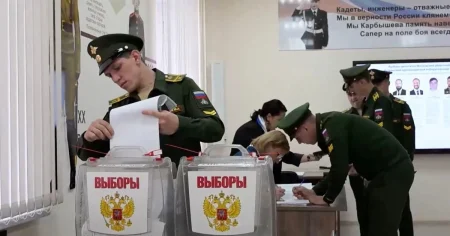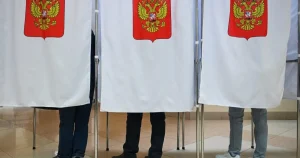


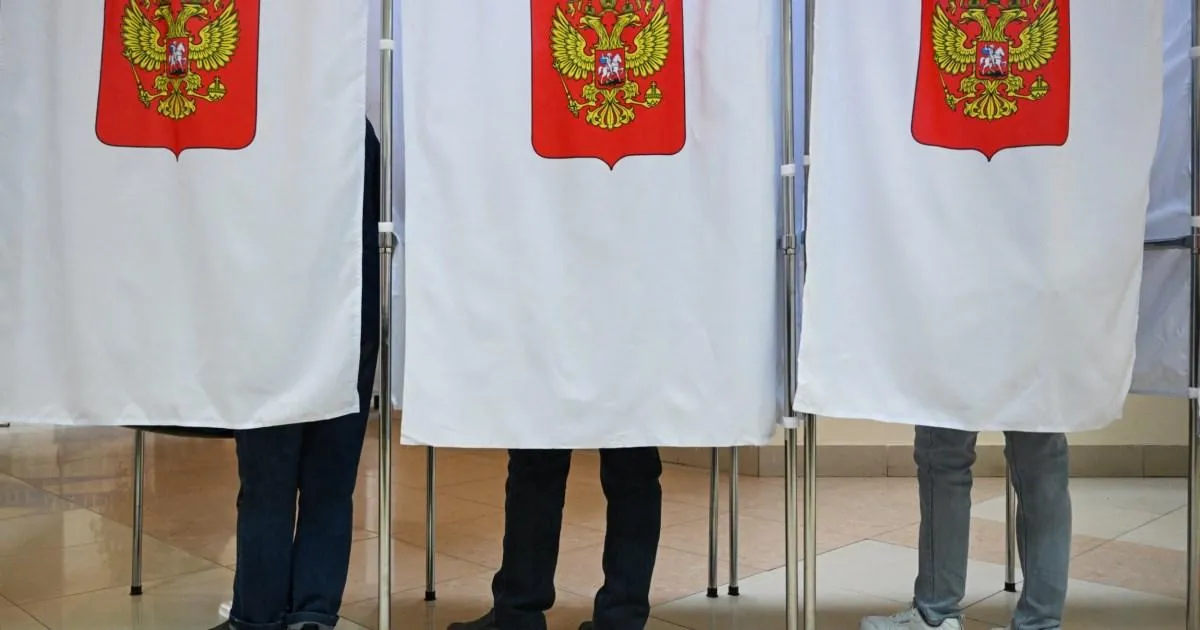
In a country where so much of public life has been flattened by fear, the image of a man standing in a voting booth, pen in hand, scrawling an insult across his ballot might seem like a tiny, almost pathetic gesture. But in Russia, even a few angry words can be enough to bring the full weight of the state down on a person’s head. That is exactly what happened to Stanislav Morozov, a blogger from the city of Penza, who was sentenced to two weeks of administrative arrest after he shared a video of himself writing “Putin is a d***head” on his ballot during last week’s parliamentary elections. The charge was “petty hooliganism,” a legal category as vague as it is useful to those in power. Morozov was not accused of threatening anyone, of violence, or of inciting a crowd. He simply expressed, in crude and undiplomatic language, what many Russians feel but dare not say aloud. The video was a momentary act of frustration, perhaps even of despair, but it was also a deliberate one—a refusal to pretend, for even a few seconds, that the ritual of voting in an election with a predetermined outcome was a meaningful act of citizenship.
The swiftness of Morozov’s arrest tells us everything about the climate in which he lives. According to the Russian outlet New Alternative Route, Morozov had barely posted the video when a police officer and a civilian-clothed officer approached him and took him away. There was no prolonged investigation, no shadowy midnight raid, no dramatic chase. The state simply reached out and grabbed him, as if to reassure its citizens that even the smallest spark of impudence will be stamped out. In a normal democracy, a person who writes an insult on a ballot might be scolded by a polling station official, or perhaps ignored altogether. The ballot itself would be discarded or invalidated, and the angry voter would go home, having spent his protest in a few seconds of meaningless rebellion. But in Putin’s Russia, the act of insulting the leader, even in the privacy of a voting booth, is not meaningless. It is a crime. And the punishment is designed to be just severe enough to hurt, but not severe enough to draw too much international attention. Two weeks in jail is a short sentence in the grand scheme of Russian repression, yet for Morozov, it is a fortnight of his life stolen by a system that cannot tolerate being mocked.
Morozov, however, is not just a foul-mouthed prankster who made a crude joke at the wrong moment. Behind the video lies a more complex and troubling history of activism in a region where speaking out against the government carries real risks. The arrest came only months after Morozov had shared information about local residents being arrested and allegedly forced to sign contracts with the Russian Defence Ministry. This kind of reporting, often done by citizen journalists and bloggers, fills a void left by increasingly suppressed independent media. It is dangerous work, and Morozov appears to have known that. Over the summer, he was hit with two separate accusations from local authorities. One was for insulting Putin and calling him “evil.” The other was related to a video he made about a local military registration office, which Morozov had called a “torture camp.” That phrase, with all its visceral horror, was not chosen lightly. Reports of mistreatment, unpaid wages, and coercive recruitment practices have emerged from various corners of Russia since the invasion of Ukraine, and Morozov was doing what many people would consider basic journalism: documenting abuses and urging his neighbors to “unite” after it became known that recruitment office employees were repeatedly beaten. None of this makes Morozov a saint, but it makes him a human being trying to hold on to some sense of decency and solidarity in a system that punishes both.
The case against Morozov fits into a much larger pattern of retaliation, one that extends far beyond obscure bloggers in provincial cities. The Russian government has a long history of arresting opponents and anyone else it perceives as a threat to Putin’s personal power. Dissidents, journalists, activists, and ordinary citizens have all found themselves on the wrong side of laws that seem to exist solely to silence them. But Moscow’s vindictiveness is not confined to its own borders. In a striking counter-move, Russia issued an arrest warrant for Karim Khan, the British prosecutor of the International Criminal Court, who had led the effort to hold Putin accountable for atrocities committed during the war in Ukraine. The Kremlin’s response to international legal action was not to defend its record, but to try to criminalize the prosecutor himself. Russian media, citing the Interior Ministry’s database, announced that Khan had been added to the wanted list. It was a brazen symbolic act, a message to the world that no one is beyond the reach of Moscow’s wrath. In March of last year, just days after the ICC issued an arrest warrant for Putin, Russia opened criminal cases against Khan and three other ICC judges. The charges were as absurd as they were predictable: knowingly prosecuting an innocent person, pressing unlawful felony charges, and organizing an attack on a head of state aimed at destabilizing international relations. The fact that the ICC’s investigation was based on documented evidence of child abductions, not abstract political animosity, was apparently irrelevant to the Kremlin’s propagandists.
The ICC warrant itself was a landmark moment in international justice. It ordered the arrest of Putin and Russia’s commissioner for children’s rights, Maria Lvova-Belova, on war crimes charges related to the abduction of Ukrainian children. For decades, the world had seen Putin as a pragmatic, ruthless but ultimately untouchable leader. The warrant shattered that illusion, at least in the eyes of those who still believed in the power of international law. It accused the Russian president and his allies of a systematic campaign to remove Ukrainian children from their homes, deport them to Russia, and erase their identities. It was a charge so serious, so dehumanizing, that it demanded a response. And Russia’s response was to attack the messenger. Khan was now the criminal, not Putin. The victims of Russia’s invasion, the grieving mothers, the kidnapped children, the destroyed villages, were all dismissed as pawns in a Western conspiracy. The Kremlin’s narrative is as simple as it is relentless: Russia is not committing war crimes, Russia is a victim of Western aggression and lies. Anyone who says otherwise is either a fool or a saboteur. This narrative is repeated on state television, in schools, in workplaces, and in the army, until it becomes almost impossible for ordinary Russians to separate truth from fiction. And for those who refuse to accept it, there is always the threat of a knock on the door, a short trial, a two-week sentence for “petty hooliganism.”
In the end, what happened to Stanislav Morozov is both tragic and absurd. He will spend two weeks in an administrative detention center, likely with little or no access to the outside world, for a few seconds of crude self-expression. The ballot he defiled will be discarded, no official will be held accountable, and the election that he mocked will produce the same parliamentary outcome it was always going to produce. But the meaning of his gesture will not be lost. It will be shared, whispered about, perhaps even passed around on encrypted messaging apps, as proof that not everyone has surrendered. It will remind Russians that inside their society, under the heavy blanket of fear, there are still people who refuse to be silent. It will also remind us, outside Russia, of what is at stake in this war, not just for soldiers on the front lines, but for ordinary human beings who simply want to live with dignity. Morozov may not be a hero in the traditional sense. He is not a politician, not a celebrated dissident, not a famous artist. He is just a person who, in a moment of raw frustration, decided to write the truth as he saw it, using the ugliest words at his disposal. For that, he will lose two weeks of his freedom. And yet, in a strange way, his words will outlast his punishment. They will sit there, in the public memory, a small crack in the monument of lies, a reminder that even in the most oppressive systems, the human spirit will eventually find a way to speak. Maybe not tomorrow, maybe not next year, but eventually. And when that day comes, people like Morozov will turn out to have been not criminals, but prophets of a future that the Kremlin could never have imagined.