


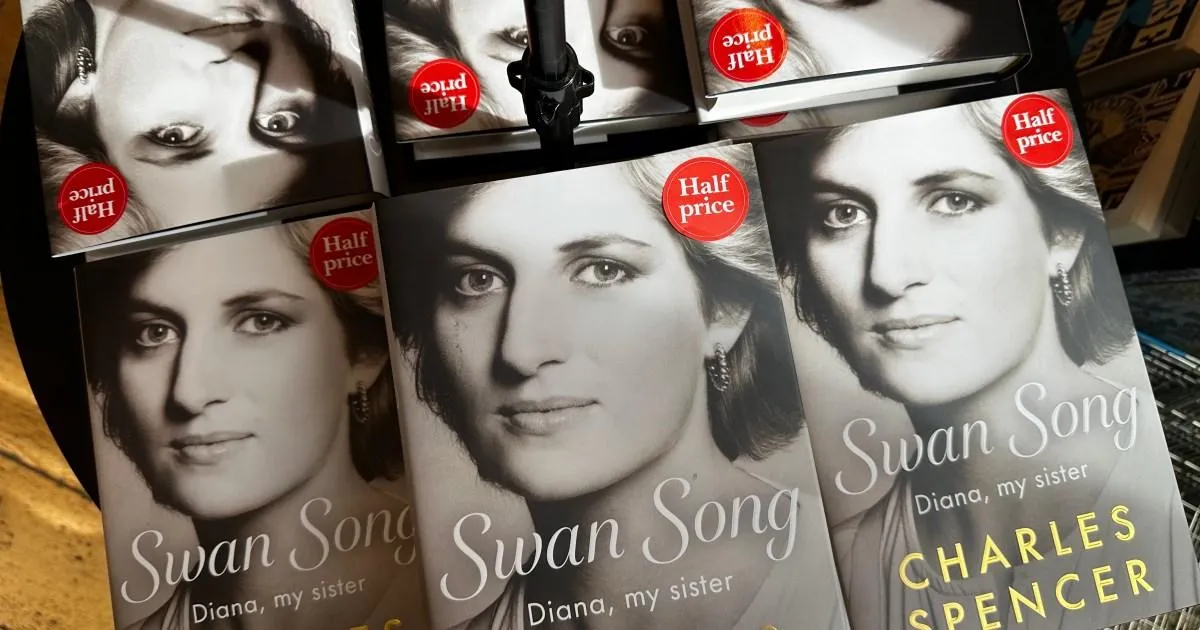
It was a curiously muted beginning for a book that should have caused a sensation. On the day Earl Spencer’s memoir about his late sister, Diana, Princess of Wales, finally reached the shelves, bookshops across London were unusually quiet. There was no frantic queue at the till, no electric buzz of anticipation, no sense that crowds had turned out to claim a piece of history. Instead, something stranger happened: copies of Swan Song: Diana, My Sister were already being marked down to half price just hours after the book was released. At Waterstones in Kensington, the £28 hardbacks had been slapped with bright red “half price” stickers, as if the shop was trying to clear stock from a previous season rather than celebrate a major new publication. The same discount appeared online, and across the city, from the windows of local bookstores to the enormous frontage of Waterstones Piccadilly—Europe’s largest bookshop—the book sat on display, polished and prominent, but still somehow lonely. It felt less like a tribute and more like a strange, uncomfortable bargain. For a memoir written by a brother about a sister the world still mourns, the immediate markdown seemed to speak to something deeper about how we consume grief, memory, and the lives of the famous. It also set the tone for a complicated emotional landscape: a man approaching three decades of silence, finally ready to talk, and a public that may be exhausted, overwhelmed, or simply unsure how to feel about the royal family’s most painful chapter.
This is the first time Earl Spencer, now 62, has spoken at length about Diana since he walked behind her coffin through the streets of London in 1997. For almost thirty years, he has kept the details of their relationship largely private, appearing publicly only to defend her memory or to deliver the devastated eulogy at her funeral that moved the watching world to tears. That eulogy was raw, angry, and loving—a brother’s public declaration that his sister had not been treated kindly by fate or by the institution she married into. Now, with Swan Song, he has returned to that place of deep personal excavation, offering a much fuller account of what it meant to grow up with Diana, to watch her struggle, to witness her transformation into the most photographed woman on earth, and, finally, to lose her in the blur of a Paris tunnel. The book is not just a biography or a memoir; it is an attempt to reclaim his sister’s story from the noise of tabloid headlines and royal spin, to tell the world what he knows from the inside. And he does not hold back. Last week, in a passage that instantly made headlines, he revealed that just days after Diana died in 1997, King Charles allegedly told him: “Rest assured, we’ll forget her soon enough.” The words, whether exact or echoed, carry a coldness that has haunted Spencer for decades. They also suggest that his decision to write this book was never going to be a gentle stroll down memory lane. This is a man confronting old wounds, and the book is both a love letter to his sister and a direct challenge to the family that he believes failed her.
The palace responded with a carefully worded statement that tried to balance compassion with dismissal. “While we do not comment on books as a matter of principle,” it read, “His Majesty is mindful that the pain of fraternal grief can cloud reason, affect judgment and colour memory in ways others do not recognise, even many years after such a loss.” The language is diplomatic, almost gentle, but beneath it lies a quiet accusation: that Earl Spencer, in his sorrow, cannot be trusted to remember things as they actually happened. It is the kind of response that happens in families everywhere, not just palaces—the sibling who insists a parent was cruel, and the parent who insists the sibling is exaggerating, blinded by old pain. But this is not a private family dispute; it is playing out on the world stage, with the weight of monarchy, history, and tabloid obsession pressing down on every word. The palace’s statement also hints at something human and tragic: grief is not linear, and memory is not a perfect record. Two people can experience the same event and carry away completely different truths. For Charles, perhaps, the alleged comment was a clumsy attempt to suggest that the world would move on. For Spencer, it was a wound that never healed, proof that his sister’s life and death were being dismissed by the man closest to her. There is no way to medically scan a memory and decide who is right. There is only the anguished collision of two families trying to survive a loss that was never allowed to be private.
Royal expert Duncan Larcombe, speaking to Metro, described Spencer’s allegations as a “cataclysmic” start to what will be a major anniversary year. Next year marks the thirtieth anniversary of Princess Diana’s death, and the royal family knows that the world will be watching, remembering, and replaying every moment of her life and that terrible final week. Larcombe called this moment “the calm before the storm,” and it is hard not to feel it. For decades, the monarchy has tried to control the narrative around Diana—to soften her into a fairy tale, a cautionary tale, or a distant memory. But Spencer has never wholly allowed that. He sees himself, perhaps, as the guardian of her flame, the brother who refused to let her be erased. Larcombe’s description of Diana as “the biggest threat the British establishment had for decades” is striking. She was not a politician or a revolutionary; she was a shy young woman with a kind heart who became the most beloved and scrutinized person in the world. Her power came not from official authority but from her humanity—the way she touched people, hugged children, challenged the royal coldness, and made millions feel seen. That is exactly why the establishment feared her. And her brother, carrying her memory, represents a lingering threat to the version of history the palace would prefer. Larcombe suggests the royal family is “very worried” that Spencer may speak out publicly and criticise the institution again. He describes Spencer not as a man letting bygones be bygones, but as “a ticking time bomb waiting to go off.” That image is brutal but perhaps accurate. For years, Spencer has been quiet, polite, dignified, and restrained. But grief does not tick quietly forever. At some point, the pressure builds, and the need to say what was left unsaid becomes unbearable.
The immediate discounting of the book adds another layer to this strange, emotional moment. At first glance, seeing a memoir about Diana slashed to half price hours after release feels disrespectful, almost grotesque, as if her memory itself is being put on clearance. But perhaps it speaks to something more nuanced about the public’s relationship with royalty. There is a deep fatigue mixed with fascination. People are tired of the old battles, the constant reopening of wounds, the endless speculation about what Charles said or did twenty or thirty years ago. At the same time, they cannot look away. The book will likely sell well because Diana’s name still resonates, especially as the thirtieth anniversary approaches. But the quiet bookshops and red stickers may reflect a more melancholic reality: that we have already heard so much of this story, in so many forms, that even a brother’s long-awaited testimony feels like another chapter in a saga we have lived with our entire lives. And yet, for Earl Spencer, this book is not just about sales or headlines. It is about saying goodbye. The title Swan Song suggests something final—a beautiful, mournful last note from a voice that has kept silent for too long. It may well be his attempt to lay his sister to rest in his own heart, to tell the world everything so that he can finally let go. The half-price sticker cannot diminish the weight of that act. If anything, it makes it more human: even the most profound personal testimony eventually becomes product, marked down, placed in windows, judged by readers and critics, and then shelved.
Ultimately, this story is about grief, family, and the impossibility of finding a single truth when loss is tangled with history. Earl Spencer loved his sister, and he has carried that love and that loss for three decades. In writing Swan Song, he has opened himself up to accusations of betrayal, exaggeration, and opportunism. But he has also done something brave: he has insisted that the memory of Diana should not be forgotten, and that even a king cannot simply decide that the world will move on. The palace’s response, with its careful mention of “fraternal grief,” is as close as we get to acknowledging that families can never fully agree on what happened, especially when power, celebrity, and tragedy are involved. For the rest of us, watching from afar, the most human response is empathy. We have all mourned people we could not save. We have all replayed conversations, hunted for meaning, and wondered if we could have done more. Earl Spencer’s memoir is not merely an attack on the royal family; it is a brother saying, “I loved her, and I still miss her, and I need you to understand why she mattered.” Whether you believe the book is justified or unkind, necessary or cruel, it comes from a place that every human recognizes: the need to tell the truth as you experienced it, before time steals even that. The half-price stickers and quiet shop floors cannot erase the power of that need. In six paragraphs, we have tried to capture what makes this moment so significant: not just the revelations about Charles, not just the feud with the palace, but the small, human heartbreak of a man who has waited thirty years to say his sister’s name out loud, and to demand that the world remember her—not as an icon, not as a myth, but as his little sister, Diana.