


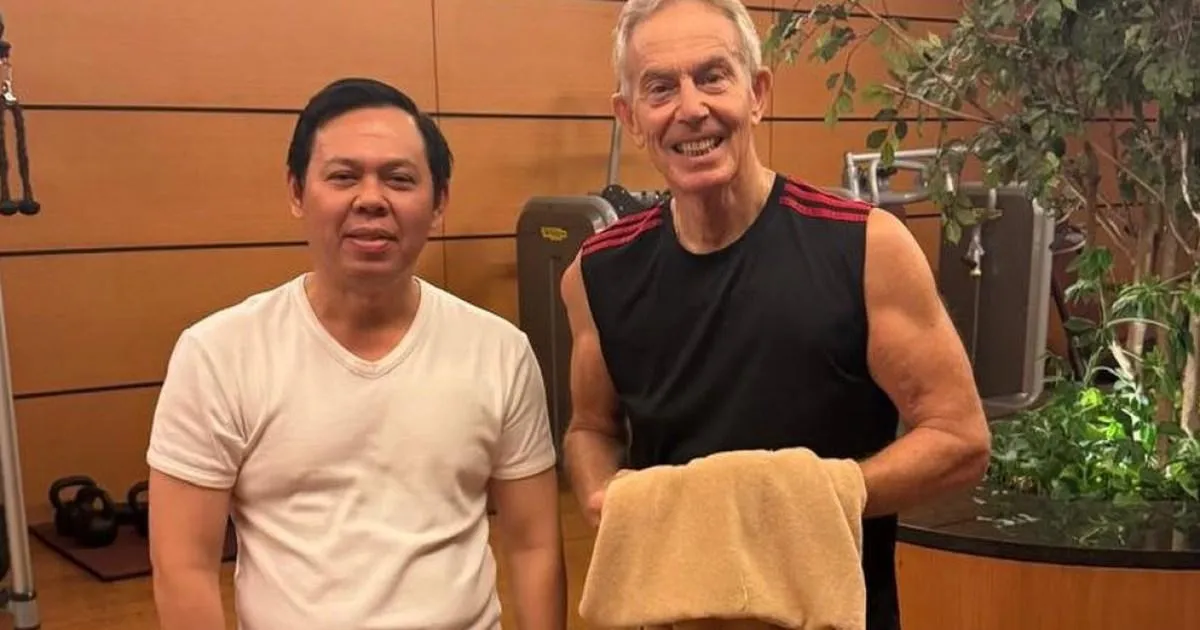
Tony Blair has always understood the value of a well-managed image. On a recent afternoon in Jakarta, the 72-year-old former British Prime Minister offered a masterclass in the art of staying visible. A photograph posted on Instagram showed Blair after a gym session with Sultan Bachtiar Najamudin, speaker of Indonesia’s Regional Representative Council. His face was flushed with exertion, his grin broad and unguarded. He was wearing a tank top, and the photograph made no effort to hide how toned and fit he looked for a man of his age. For anyone who remembers the lanky politician who swept into Downing Street in 1997, the sheer physicality of the image might have come as a surprise. Blair has always been lean, but in his younger years he was more often associated with thoughtfulness and lawyerly precision than with gym selfies. Now, in his eighth decade, he has the appearance of someone who takes his own advice about staying active. The photo quickly took on a life of its own, not because it was politically substantial but because it spoke to something universal: the idea that age need not mean decline. Blair was not standing on a podium with world leaders. He was simply standing in a gym, sweat-damp and smiling, proving that he is still capable of the kind of physical and mental stamina that defined his years in office. It was, in many ways, a very Blair image: controlled, deliberate, and impossible to ignore. For a man whose political career has been built on a refusal to settle into the background, the photograph was not just a personal update. It was a statement of continued presence, a small but effective reminder that Tony Blair is still very much part of the conversation.
The photograph was not merely a piece of vanity or social media content. The man next to Blair is one of the most significant political figures in Indonesia, and their workout was described by Najamudin as a special afternoon. In an Instagram post, Najamudin wrote: “This afternoon’s exercise felt special to be able to exercise with Mr. Tony Blair, former Prime Minister of England.” He added: “From something as simple as exercising together, it turns out there are many interesting things to share. The most important thing is to stay active, stay healthy and keep spirit.” Those words might seem like the kind of polite caption that accompanies any celebrity meeting, but in Blair’s case they carried real weight. The former Prime Minister is not a retired tourist in Southeast Asia; he is a prominent adviser to the Indonesian government through his Tony Blair Institute for Global Change. He has served on the steering committee for the construction of Indonesia’s new capital city, Nusantara, a colossal project aimed at moving the country’s administrative centre away from the congested, sinking megacity of Jakarta. There have even been rumours that Blair could join the supervisory board of Danantara, Indonesia’s state sovereign wealth fund. These are not honorary titles handed out as souvenirs. They are serious roles at the heart of one of Asia’s most ambitious and dynamic economies. Najamudin himself frequently engages with high-profile foreign delegates visiting Jakarta, but the gym session with Blair had a different texture. It combined diplomacy with companionship, trade with trust. For a man who once stood at the centre of global power, Blair has managed to carve out a second life in which he remains useful, consulted and genuinely influential. The gym photo was not a sign that he has nothing to do; it was a sign that he can do business anywhere, even on a treadmill.
Blair’s post-premiership career has been a remarkable exercise in reinvention. Since leaving Downing Street in 2007, he has been a peace envoy for the Middle East, a global advocate for faith and dialogue, a pandemic adviser, and most significantly, the founder of the Tony Blair Institute for Global Change, which advises governments around the world on policy, technology and governance. His critics often describe him as a kind of international Zelig, appearing wherever power is being exercised. But the sheer scale of his activity suggests something more than opportunism. Blair genuinely seems to believe that his brand of centrist, pro-business, interventionist politics can be exported to any country, regardless of history or culture. Indonesia is a perfect case in point. The country is young, fast-growing and politically complex, and Blair has positioned himself as a bridge between Jakarta and the West. The new capital project alone would be enough to keep a team of consultants busy; Blair’s involvement gives it a sheen of global legitimacy. And unlike many former Western leaders who fade into obscurity, Blair has maintained a punishing travel schedule. The gym session with Najamudin was not a one-off. It was part of a rhythm that has kept the former Prime Minister in shape, both physically and professionally. At 72, he has the stamina of a man who still believes he has something to offer. There is something almost stubborn about his refusal to slow down. He could have chosen the quieter path of a retired statesman, collecting honours and enjoying the privileges of a life fully lived. Instead, he continues to take on advisory roles, deliver speeches, and write interventions in British political debates. The toned physique in the Instagram photo is not incidental; it is a metaphor for his entire approach to life. Blair does not want to be seen as a relic. He wants to be seen as a man who is still fit for purpose, in every sense of the phrase.
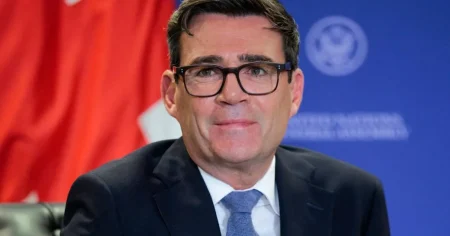
Back in Britain, however, Blair’s continued visibility is not always welcome. Earlier this year, he faced criticism from two prominent figures in his own party, Andy Burnham and Wes Streeting, who pointed to what they described as a “striking weakness” in his failure to engage with inequality. Burnham, the Mayor of Greater Manchester and one of the most popular voices in Labour politics, was particularly blunt. “He doesn’t mention inequality once,” Burnham said in May, suggesting that Blair’s political legacy had been built on blind spots as much as achievements. This is a familiar accusation, and one that has followed Blair since his time in office. His governments championed public service reform, introduced a national minimum wage and poured money into health and education. But they also presided over rising economic inequality, the erosion of social housing, and a deregulated financial sector whose excesses eventually contributed to the 2008 crash. For critics like Burnham, Blair’s focus on economic dynamism and electoral pragmatism came at the expense of a more fundamental challenge to structural injustice. The fact that Blair had just been photographed grinning in a gym with an Indonesian politician seemed, to some, further evidence of his detachment from the gritty realities of life in Britain. While Burnham was meeting voters in train stations and dealing with the everyday problems of housing and transport, Blair was globetrotting, advising governments, and flexing in front of cameras. The contrast was not lost on those who have long argued that Blair’s worldview is too managerial, too focused on growth and too willing to accommodate the wealthy. The criticism from Streeting and Burnham was not just about a single speech or policy; it was about a fundamental disagreement over what Labour should stand for. Blair represents a tradition that believes you cannot help the poor if you are not in power, and you cannot keep power without appealing to the middle. His critics believe that this approach hollows out the soul of the party and leaves inequality to fester. The gym photo, in this context, was almost too perfect a symbol: a former leader, in excellent shape, looking extremely pleased with himself, while the people he once represented continue to struggle with the consequences of his era.
Blair, predictably, has not taken his critics lying down. In a lengthy and characteristically interventionist critique of Labour’s time in office under Keir Starmer, he argued that the government needed to be far more assertive in cracking down on welfare spending, abandoning restrictions on oil and gas production, and smoothing relations with Donald Trump. For Blair, these are simple matters of electoral arithmetic and modern governance. He believes that Labour, like his own New Labour project, must position itself as the party of enterprise, security and national interest. To do otherwise, in his view, is to hand the political centre-ground to the Conservatives. He has always been attracted to power, not just for its own sake but because he believes it is the only way to get anything done. The critique was vintage Blair: confident, combative, and at times maddeningly condescending to his successors. It treated Labour’s current difficulties as a failure to absorb the lessons of the 1990s and 2000s, rather than as a natural reaction to a very different political landscape. On welfare, Blair argued that the party needed to demonstrate fiscal discipline and tackle what he saw as an unsustainable culture of dependency. On oil and gas, he insisted that Britain could not simply turn its back on domestic production in the name of climate ambition without considering the economic consequences. On Trump, he warned that Labour would be making a historic mistake if it allowed personal animosity to damage relations with the leader of the free world. These are not the positions of a man seeking to be loved by activists. They are the positions of a former leader who believes he knows what it takes to win, and who is not afraid to say so, even if it means provoking outrage. The response from Burnham was swift and pointed, but Blair seemed untroubled. He has been on the receiving end of far sharper criticism over Iraq, over the financial crash, over everything in between. A few more attacks from the Westminster village are unlikely to keep him awake at night. But the episode revealed something important about Blair’s relationship with modern Britain: he is still a polarising figure, still fighting old battles, and still convinced that he, perhaps more than anyone else, has the answers.
Which brings us back to the image of Tony Blair in that Jakarta gym, smiling through the sweat. There is something almost perfectly self-contained about the scene. He was with a politician who respects him, in a country that values his advice, doing something that keeps him feeling alive. The caption written by his host — “stay active, stay healthy and keep spirit” — could easily be Blair’s personal motto. It is a simple philosophy, but it explains a great deal about how he has managed to remain relevant for so long. He does not allow himself to become static. He does not retreat. He does not sit out the argument. Instead, he keeps turning up, in gyms and think tanks and newspaper columns, flexing his intellectual and physical muscles in equal measure. His critics may argue that his failure to engage with inequality is a fundamental weakness, and they may be right. His interventions in Labour politics may generate more resentment than gratitude. But few can deny that Blair remains one of the most recognisable and active political figures Britain has ever produced. The gym photo is not just a postcard from a privileged corner of the world. It is a reminder that public life is not only about policies and votes; it is also about endurance. Blair has endured. He has survived the fall from power, the controversies of Iraq, the criticisms of his legacy, and the indifference of a new generation of voters. And here he is, at 72, looking healthier and more confident than many people half his age. Whether that is admirable, irritating, or both is a matter of opinion. What is not negotiable is the fact that Tony Blair is still very much on the stage. The photograph from Jakarta, with its tank tops and broad smiles, captures the essence of the man: persistent, performative, and impossible to write off. As he might put it himself, the best is yet to come.