

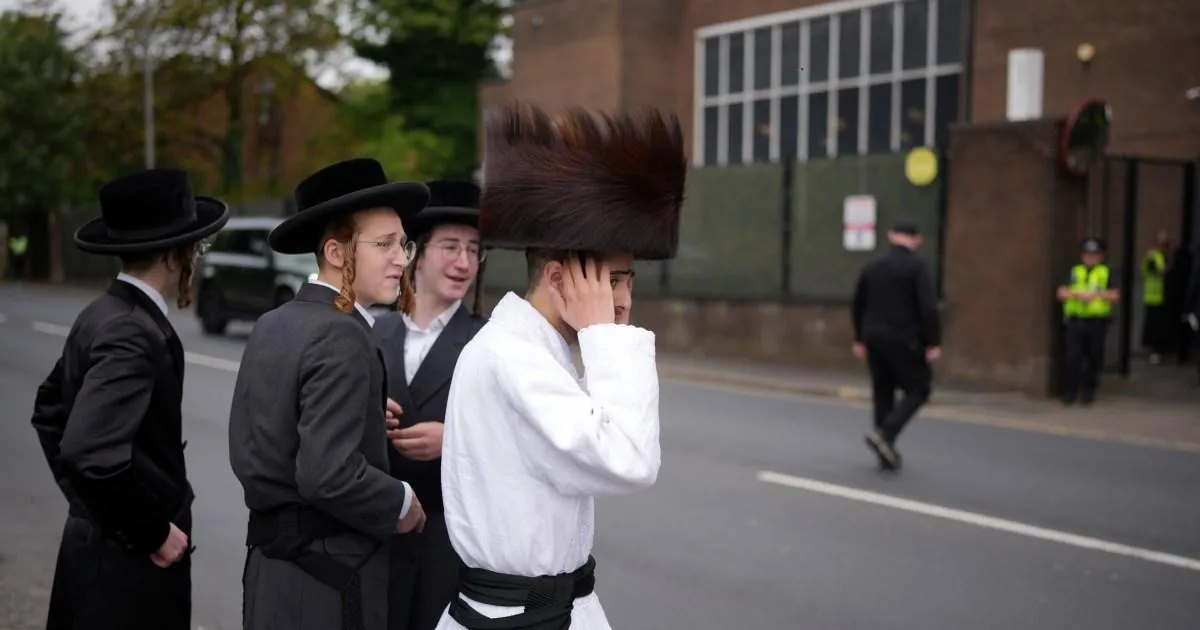
On a late Sunday afternoon in Manchester city centre, on a street that might otherwise have been unremarkable, two men in their thirties were arrested by counter-terrorism police. The arrests took place on Newton Street, and the force used was Section 41 of the Terrorism Act 2000, a legal power designed to detain individuals reasonably suspected of involvement in terrorism. At first, the scene gave little away. There was no dramatic public announcement, no immediate flood of detail. But then the news broke: the arrests were linked to an alleged plot to target Jewish people in Manchester during Yom Kippur, the holiest day in the Jewish calendar. Yom Kippur, the Day of Atonement, began at sundown that same Sunday and continued until nightfall on Monday. For Jewish communities across the city, this was not just another security alert. It was a violation of something sacred. The High Holy Days are meant to be a time for fasting, prayer, reflection, and renewal—a period when families gather in synagogues, often dressed in white, to seek forgiveness and to hope for a good year ahead. Instead, those entering services that evening carried the weight of knowing that police believed an attack had been planned against them. Deputy Assistant Commissioner Vicki Evans, speaking on behalf of the Metropolitan Police, said the arrests would cause “further concern” to the Jewish community, “especially given the significant High Holy day period.” For many, the word “concern” felt too clinical. This was fear—deep, personal, and painfully familiar. It was the fear of worshippers scanning the room for exits instead of focusing on the prayers. It was the fear of parents holding their children a little closer. And it was the fear that, even in a country like Britain, being Jewish can still make you a target.
The significance of Yom Kippur cannot be overstated. It is the most solemn day in the Jewish faith, a day when the community collectively pauses, fasts, and stands before God in a spirit of repentance. The prayers are long, the emotion is raw, and the connection between the individual and their faith is at its most intense. It is also, unfortunately, a day when Jewish people gather in large numbers, which makes the idea of a planned attack during that period especially horrifying. The arrests on Newton Street were not made in a vacuum. They were the result of quiet, meticulous intelligence work by officers whose job is to imagine the worst so that the rest of us never have to live through it. The two men were taken into custody just hours before the holiday began, a timeline that suggests police were racing against the clock. Section 41 of the Terrorism Act 2000 is a significant step; it is not used lightly. The fact that police acted on it indicates they had reason to believe these men were involved in terrorism and that there was an imminent threat to life. For the Jewish community in Manchester, the timing of the arrests only added to the trauma. Instead of entering Yom Kippur with a quiet heart and a clear mind, many worshippers entered services with a knot in their stomachs, aware that the protection they received came at the cost of constant vigilance. The sacred space of the synagogue, which should feel like a refuge, was once again a place where security guards, police checkpoints, and anxious glances were part of the experience. That is not something any community should have to accept as normal, yet it is the reality for British Jews in a time when antisemitism and terrorism remain serious threats.
The Community Security Trust, which monitors antisemitism in the UK and works alongside police to protect Jewish sites, responded to the news with a mixture of horror and gratitude. In a public statement, the CST described the alleged plot as “utterly chilling,” and the choice of words was apt. The organisation noted that the arrests came “so close to the anniversary of the terrorist attack at Heaton Park Synagogue last year,” which made the threat feel even more raw. They spoke of being in close communication with police across Manchester and the country throughout Yom Kippur, as part of their security operation over the High Holy Days. This is the quiet, relentless work that often goes unseen: the monitoring of threats, the sharing of intelligence, the placement of guards, the checking of doors, the rehearsing of emergency plans. The CST also used the moment to thank police and other agencies for their work protecting the Jewish community and British society as a whole from terrorism. But perhaps the most important part of their message was addressed directly to Jewish people. The CST urged the community to remain calm and alert, and to report any suspicious activity to police on 999 and then to the CST. It was a stark reminder that, even with all the security infrastructure in place, ordinary people remain part of the defence. The instruction to stay calm is not easily followed when you have just learned that someone may have been planning to attack your community during your holiest day. Yet it is also, in its own way, a form of defiance. To continue attending synagogue, to continue practising your faith, to continue raising your children with Jewish traditions—that is precisely the resilience that terrorism seeks to destroy.
The memory of Heaton Park Synagogue makes this latest scare impossible to ignore. Nearly a year ago, on October 2, the Manchester community suffered a brutal attack that still echoes in the minds of Jewish people across the country. Jihad al-Shamie, a 35-year-old Syrian-born British citizen, drove into the gates of Heaton Park Hebrew Synagogue in Crumpsall and carried out a knife attack while wearing a fake suicide belt. The attack claimed the lives of Melvin Cravitz, 66, and Adrian Daulby, 53. They were two men, part of a congregation, part of a community, killed in a place where they should have been safe. The attack took place on Yom Kippur, the same sacred holiday that had just begun when the latest arrests were made. For the families of the victims, the news of an alleged plot on the eve of the anniversary must have reopened wounds that had barely begun to heal. For the wider community, it was a heart-stopping reminder that the previous attack was not a one-off, not an isolated tragedy, but part of a pattern of hatred that persists and evolves. The CST’s reference to the Heaton Park attack was deliberate. It was a way of saying: we have been here before, we know what this feels like, and we must not pretend that the danger has passed. The names of the two men killed, Melvin Cravitz and Adrian Daulby, deserve to be remembered not only as victims but as human beings with families, friends, and stories. Their deaths remain a pain in the heart of the Jewish community, and every new threat brings that pain closer to the surface.
The broader picture is one that no community should have to face alone. Across Britain, police have become increasingly focused on the threat of terrorism in all its forms, from Islamist extremism to far-right violence and other ideologies. The nature of the alleged plot in Manchester has not been fully detailed in public, and the investigation is likely to continue for some time. But the response from law enforcement reflects a wider commitment to protecting Jewish communities during periods of heightened risk. The High Holy Days are a time when security is increased, and the fact that this alleged plot was discovered and disrupted before it could be carried out is a testament to the importance of that work. It also raises difficult questions about how much more needs to be done. Why are Jewish synagogues still being targeted? Why does a community have to rely on armed officers and security guards to pray in peace? Why, in the twenty-first century, does antisemitism continue to lurk beneath the surface of a supposedly tolerant society? These questions do not have simple answers. But they demand honesty. The threat to Jewish people is not a problem for the Jewish community alone. It is a threat to the values of the country as a whole. When any community is forced to fear for its safety during its most sacred moments, the entire social fabric is weakened. The CST was right to thank the police, but the wider public also has a responsibility to stand with Jewish neighbours, to condemn antisemitism wherever it appears, and to understand that security for one community is security for everyone.
In the end, this is a story about fear met with bravery, hatred met with vigilance, and darkness met with the stubborn light of faith. On a Sunday afternoon in Manchester, two men were arrested because the police believed they were planning something terrible. But that is only part of the story. The other part is about the Jewish families who, despite everything, still came to synagogue that evening. They came not because they were oblivious to the danger, but because they refused to let fear govern their lives. They fasted. They prayed. They stood together as a community, as their ancestors have done for thousands of years. They knew that the world can be dangerous, but they also knew that the answer to hatred is not to shrink from the world, but to embrace the very identity that hatred targets. The police deserve immense gratitude for their work, as do the security teams, the volunteers, and the intelligence officers who make such bravery possible. But so too do the worshippers who walked through the doors with heavy hearts, the rabbis who led prayers while carrying the weight of the news, and the community leaders who helped people process their fear while urging them not to panic. What happened in Manchester was a close call. It could have been so much worse. And in the days and weeks ahead, as the investigation unfolds, the Jewish community will continue to do what it has always done: to remember the past, to protect the present, and to hope for a future in which the words “Yom Kippur” do not appear in the same sentence as “terror plot.” Until that day comes, we all have a part to play—in watching, in speaking out, and in standing beside our Jewish friends and neighbours with love, strength, and an unwavering commitment to peace.