
Here is a summarized and humanized version of the content in six paragraphs, exploring the incident, the man behind it, and the deeper human and social currents it reveals.
—
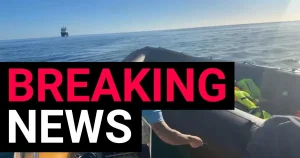
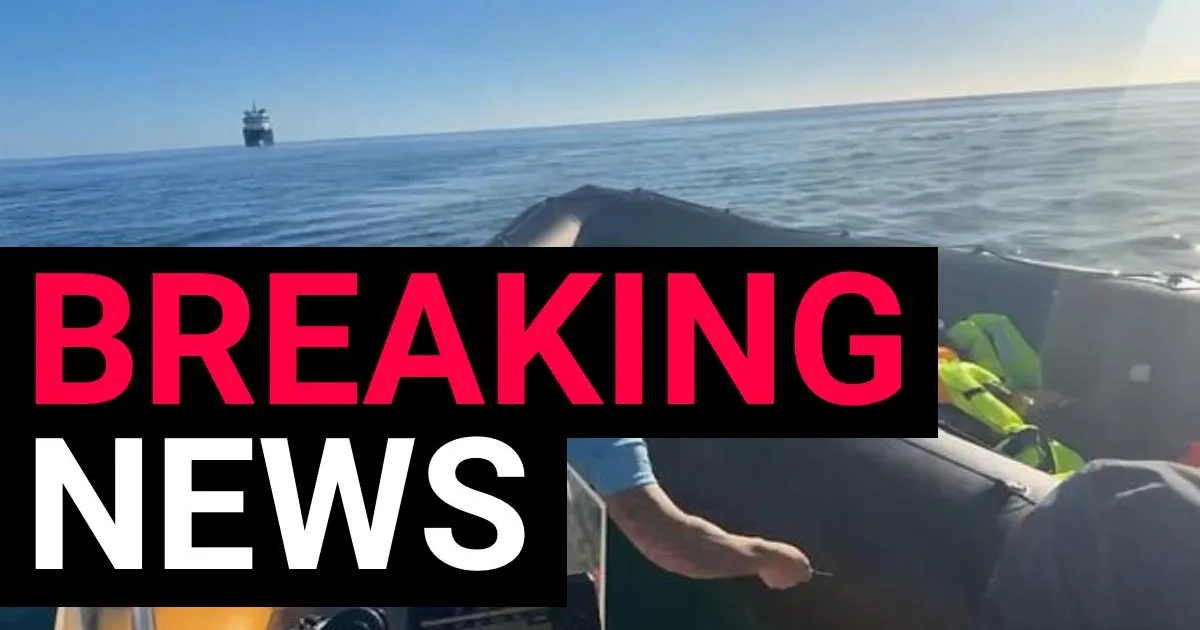
It began as another online spectacle, but it quickly became something far darker. Daniel Thomas, a nationalist activist known to his followers as Danny Tommo, was live-streaming from the English Channel when he pulled his speedboat alongside a deflated-looking inflatable dinghy. A French rescue worker had just jumped aboard the small craft to inspect it after a group of migrants had apparently made the dangerous crossing from France in calm waters. What happened next was captured in chilling detail: Thomas took out a blade and slashed the side of the dinghy, cutting into the very vessel that had carried desperate people toward an uncertain future. The rescue worker, still on board, was suddenly in danger. Debris and discarded life jackets littered the interior of the dinghy, silent evidence of the human cargo that had been there only moments before. Thomas, shouting at the rescue workers who were simply doing their job, said, “You are not using these boats. No more migrants in our country. No way!” He then screamed, “This is England you are not in France anymore. Get off the boat. You have time to get off the boat. This is not France. No more of this. We pay you money. Let’s go. Try and take that back to France – you traitors!” Then he sped off, leaving the rescue worker bobbing in the water, surrounded by the wreckage of an already perilous journey. What makes this especially disturbing is not just the violence of the act, but the casual, performative nature of it. It was not a spontaneous outburst; it was content. It was theater for a digital audience, filmed, shared, and celebrated by those who see migration as an invasion rather than a humanitarian tragedy.
Thomas has positioned himself as a patriot patrolling the English Channel, a self-appointed guardian of Britain’s borders. He crowdfunded his own speedboat to intercept migrant dinghies arriving in the UK, presenting himself as a man of action doing the work that the authorities refuse to do. But this latest stunt was not an isolated moment of bravado. It was part of a longer, stranger pattern of online behavior. He had previously bought a boat using funds from his supporters, but that vessel sank while still tied to the dock—a metaphor for the entire enterprise, perhaps. He was also filmed eating a chocolate bar and shouting at a large naval carrier, a moment that felt less like defiance and more like a parody of strength. As he sped toward the dinghy to slash it, he told his stream, “We can’t even let our kids go to the park. What kind of life is that?” The phrase is a fascinating window into his mindset: he sees himself not as an aggressor, but as a protector, a man driven by fear and frustration. He is not interested in the complexity of migration policy, the legal asylum process, or the human stories of refugees. In his world, there are simply us and them, enemies and traitors. The dinghy is not a vessel of suffering; it is a symbol of invasion. And the rescue worker is not a humanitarian; he is a collaborator. This reduction of human beings into categories of friend and enemy is what makes his actions so dangerous. He is not engaging in political debate; he is wielding a knife in international waters, endangering lives for the sake of clicks and donations.
To understand Daniel Thomas is to look at a life already shaped by violence, punishment, and a complicated search for redemption. He is understood to have served as a tank driver for the King’s Royal Hussars, an armored regiment of the British Army, but was discharged on medical grounds without performing any active service. That military background, even if brief, gave him a language of discipline and duty that he now applies to his vigilante work. In 2016, he was sentenced to two years in prison for breaking into a man’s house brandishing knives, accusing the owner of having stolen £10,000 of drugs from him. It was a violent, reckless act that landed him behind bars. After his release, he claims to have turned to God and Christianity, with his X bio referring to “trusting in Jesus Christ” and posts quoting Bible verses. There is something profoundly human in that arc: a man who has experienced the depths of his own brokenness, who has inflicted harm and been punished, who then reaches for faith as a way to rebuild himself. But the story does not have a clean redemptive arc. He is often referred to as the English Defence League co-founder’s right-hand man, and this summer he launched Patriot Platform, a far-right group that has been linked to the riots that shook England. His Christianity, which could have taught him compassion for the stranger, instead seems to be folding into a nationalist fervor that sees migrants as a threat to the nation. The contradiction is heartbreaking and frightening: a man who says he follows Jesus, who was himself imprisoned and judged, now sits in a boat and slashes a dinghy carrying a rescue worker. He has not escaped the violence of his past; he has merely found a new excuse for it.
The language Thomas uses in the video is telling. “This is England. You are not in France anymore.” He is not merely shouting at a rescue worker; he is attempting to establish a moral boundary, to draw a line in the water and claim that those who cross it are trespassers. “Get off the boat” is not just a command; it is a rejection of the very idea that the people on that boat belong on the sea. But the deeper anger is directed at the rescue workers, whom he calls “traitors.” It is a powerful word, one that implies betrayal not just of nationality, but of something sacred. In his mind, the rescue workers are not saving lives; they are complicit in an invasion. They are paid with British tax money, and yet they work against British interests. By calling them traitors, Thomas frames the entire migration crisis as a kind of war, in which anyone who helps the incoming side is an enemy. This is dangerous rhetoric, because it dehumanizes both the migrants and the rescuers. The migrants are never seen in the video; only their debris remains, the life jackets and swirling rubbish. They have become faceless, nameless, stripped of their stories and their suffering. The rescue worker becomes a target rather than a human being. In this framework, the only person who matters is Thomas himself, the vigilante hero, the patriot with a knife. The narcissism is staggering, but it is also deeply human. People who feel powerless often seek out enemies to blame, and they construct fantasies in which their own violent acts are righteous. The problem is that these fantasies have real consequences. Slashing a dinghy in the middle of the Channel is not a symbolic act of protest; it is a violent assault that could have ended in drowning, injury, death.
The legal and moral consequences of Thomas’s actions have yet to fully play out, but they are likely to be significant. Slashing an inflatable boat while a rescue worker is on board could constitute criminal damage, assault, or even endangering life, depending on how prosecutors choose to interpret the footage. There are also complex questions of jurisdiction: the incident took place in the English Channel, which involves British, French, and international waters, and the rescue worker was French. Any prosecution would require careful coordination between authorities, and it is unclear whether the live-stream audience will be enough to hold him accountable. Even if charges are brought, the video has already served its purpose for Thomas: it has generated outrage, donations, and notoriety. It fits into a wider pattern of far-right activism that uses social media to spread fear and project strength. Thomas’s previous boat sinking while still docked is an image that cannot be forgotten: a vessel built for grand gestures, unable even to leave port. But the failure did not discourage him; it only made him more determined to prove himself. And so he took to the sea again, with a blade and a camera, ready to carry out his own version of justice. In a rational society, we would reject this as lawlessness. But we live in a time when online platforms reward controversy, when outrage is currency, and when a man with a knife and a following can become a symbol for thousands of people who feel left behind, who are angry at the world, and who are desperate for someone to blame. The real tragedy is that the underlying issues that drive migration are not addressed by slashing dinghies. People continue to flee war, poverty, persecution, and climate collapse. They will keep crossing the Channel because the alternative is worse. And the rescue workers will keep going out to save them, because that is what decent human beings do. No amount of crowdfunded vigilantism will change that. It only adds more danger to an already deadly journey.
But perhaps the deepest lesson of this story is not about politics at all; it is about the human condition. Daniel Thomas is not a monster in the abstract sense. He is a man who served in the military, who went to prison, who found God, who now believes he is doing the right thing. His anger is real, and it echoes the anger of many people who live in communities that have been hollowed out by economic decline, distanced from political power, and told that their identity is under threat. They look across the Channel and see boats coming, and they feel that their world is changing, and they are afraid. That fear is human. But fear can be channeled in different ways. It can lead to compassion, to a desire to protect the vulnerable, or it can curdle into hatred. Thomas has chosen the latter, and his choices have consequences not just for himself, but for everyone around him. The migrants whose boat he slashed are also human. They left homes and loved ones, traveled across continents, and risked their lives in the hope of a better future. They are not abstractions. The rescue worker, who was simply doing a job, suddenly found himself in mortal danger, not because of the sea, but because of a man with a knife. In the end, this is a story about how we respond to the suffering of others. It is easy to watch a video like this and feel disgusted, to shake our heads and move on. It is braver to sit with the discomfort, to ask why a man like Thomas feels so threatened, and to ask why so many people are desperate enough to climb into a flimsy boat in the middle of the night. The answer to that question is not a knife. It is not a crowdfunded speedboat. It is a society that remembers its own humanity, that sees the stranger not as an enemy but as a neighbor, and that refuses to turn tragedy into content. That is the real challenge. And in the flickering light of a live stream, with the waves of the Channel and the sound of a man shouting into his phone, we are all being asked to decide which side of our own humanity we want to stand on.