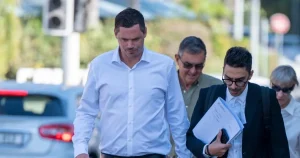

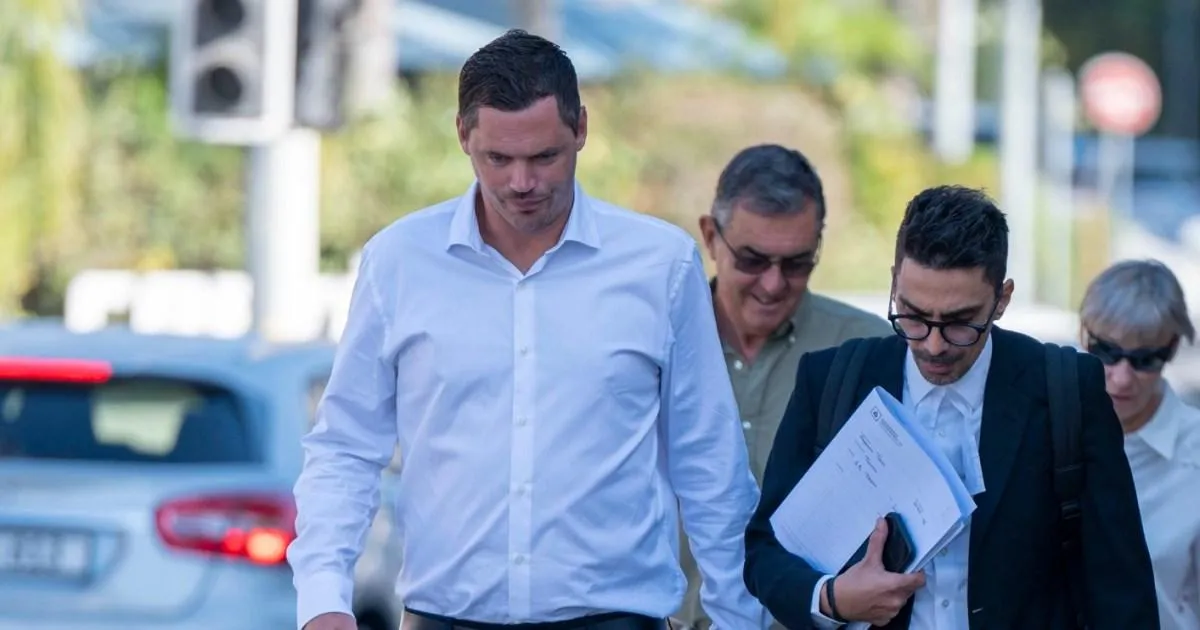
The story of Joshua Foster is one of those heart-wrenching reminders that life can fracture in a single, unthinkable moment. On the surface, the 37-year-old British father appeared to have everything in order: a successful career as an AI director at the global accountancy firm KPMG, a family that loved him, and a holiday in the sun. Yet on July 12, while staying at the King Evelthon Beach Hotel and Resort in Chlorakas, Cyprus, that ordinary summer trip turned into a parent’s worst nightmare. His two-year-old son fell from a fourth-floor window, and the little boy’s life ended before he ever had a chance to grow up. In the days that followed, Foster was arrested, detained, and eventually brought before the Paphos District Court, where he has now admitted responsibility for the death through a reckless, rash, or dangerous act. It is a charge that carries a maximum sentence of four years in prison, but no prison term, no fine, and no legal outcome can ever address the true weight of what has been lost. This is not a story about a monster; it is a story about a father, a family, and a tragic accident that has shattered everyone it touched.
The circumstances surrounding the little boy’s fall are deeply painful, and the details that have emerged in court only add to the tragedy. At an earlier hearing in July, the court was told that Foster had been holding his son around the waist and swinging him from side to side when the child slipped through an open window and fell to his death. That account, if true, would suggest a moment of terrifying carelessness, a father playing too roughly with his toddler in a hotel room high above the ground. But Foster has since disputed that version of events. According to reports, he says he had sat his son on a window ledge while waiting for a lift, and that he simply did not realise the window was open. Whether the child moved, whether he leaned forward, or whether some sudden shift caused him to fall, the outcome remains the same: a tiny life ending in the space between one heartbeat and the next. For any parent, the thought is almost unbearable. The difference between a window that is closed and a window that is open can be a matter of inches, and yet those inches can rewrite your entire existence. Foster’s account suggests a momentary lapse in awareness rather than a deliberate act of harm, and that distinction matters, even if it does not undo the devastation.
In legal terms, Foster’s decision to plead guilty has brought some clarity to a case that could otherwise have dragged on for months or years. At the Paphos District Court on Tuesday, he stood before the judge and admitted the charge, a step that his lawyer described as a deliberate choice to protect his family from the agony of a long trial. A further hearing has been scheduled for October 5, when the prosecutor will lay out the facts of the case and the defence will present its mitigation. Until then, Foster remains subject to travel restrictions, although his legal team has indicated that they will ask the court to lift those restrictions so he can return to the United Kingdom to be with his wife and daughter. The potential sentence ranges from a mere fine to four years in prison, a wide spectrum that reflects the unusual nature of the case. This is not a premeditated crime, nor is it a case of malice. It is a father whose actions, whatever the precise details, led to the death of his own child, and the courts are now left to decide what kind of justice that demands. Foster’s lawyer has already said he will appeal if the maximum sentence is imposed, suggesting that the defence sees this as a tragedy in which punishment must be balanced against humanity.
The human cost of this case is staggering, and it goes far beyond the courtroom. After his arrest, Foster spent eight days in jail, a period that must have been a surreal and horrifying blur of grief, guilt, and disbelief. He had lost his son, and yet he was being treated as a criminal, locked in a cell in a foreign country while the reality of what had happened slowly sank in. Perhaps the most devastating moment came when he had to break the news to his daughter, the dead toddler’s sister, over a video call. Imagine having to look at your own child’s face and tell them that their little brother is gone, knowing that you were the one who was holding him, or watching him, or failing to notice the danger that was right in front of you. There are no words for that kind of conversation. Foster was eventually allowed to return to the UK for the toddler’s funeral, a brief and heartbreaking reprieve from his legal ordeal, but only on the condition that he would fly back to Cyprus for the plea hearing. That means he attended his own son’s funeral as a man awaiting trial, surrounded by family who were grieving the same little boy, while knowing that he might soon be sent back to prison. The weight of that cannot be measured.
Foster’s lawyer, Alexandros Alexandrou, has been careful to frame his client not as a perpetrator but as another victim of the same tragedy. After Tuesday’s hearing, he told the Associated Press that a long trial would mean Foster is “again a victim of this tragedy,” and that “the most important thing for him is to return to his family.” That language is significant because it acknowledges the layers of loss that have accumulated: the child who died, the family that has been broken apart, and the father who must now live with the knowledge that his actions played a role in it all. Alexandrou has said he will ask the court to lift travel restrictions so Foster can go home to his wife and daughter in the UK until the next hearing. It is a request that seems almost impossibly small and yet profoundly important. To be allowed to grieve beside the people who share your pain, rather than alone in a foreign detention facility, is a basic human need. But the court must also consider the seriousness of the offence, the public interest, and the need to ensure that justice is seen to be done. There is no simple answer, only the painful, grinding machinery of law trying to process something that is fundamentally beyond the reach of legal remedy.
Behind the legal arguments, the police reports, and the court appearances, there is a little boy whose life mattered. Speaking to the Daily Mail, a relative remembered him as “a truly special, easy-going little boy who brought so much joy to everyone around him.” They said he was “deeply adored” and that his “infectious smile, warm cuddles and kind heart are already so deeply missed and always will be.” Those words are a reminder that this story is not just about a court case or a legal charge. It is about a child who will never grow up, a brother who will never be known to the world, a son whose absence will be felt in every holiday, every birthday, every ordinary morning for the rest of his family’s lives. The tragedy in Cyprus has left a trail of destruction that no judge can repair. Foster may face a fine, he may face prison, or he may be allowed to walk free, but he will never be free of the memory of that day. And his wife, his daughter, and his extended family will carry the loss with them forever. If there is any hope in this dark story, it is that Foster has chosen to accept responsibility and spare his family the harrowing process of a trial. It is not a happy ending, and there can never be one. But perhaps, in time, the family can begin to heal, holding onto the memory of a small boy who was loved, not for the way he died, but for the joy he brought while he was here.